
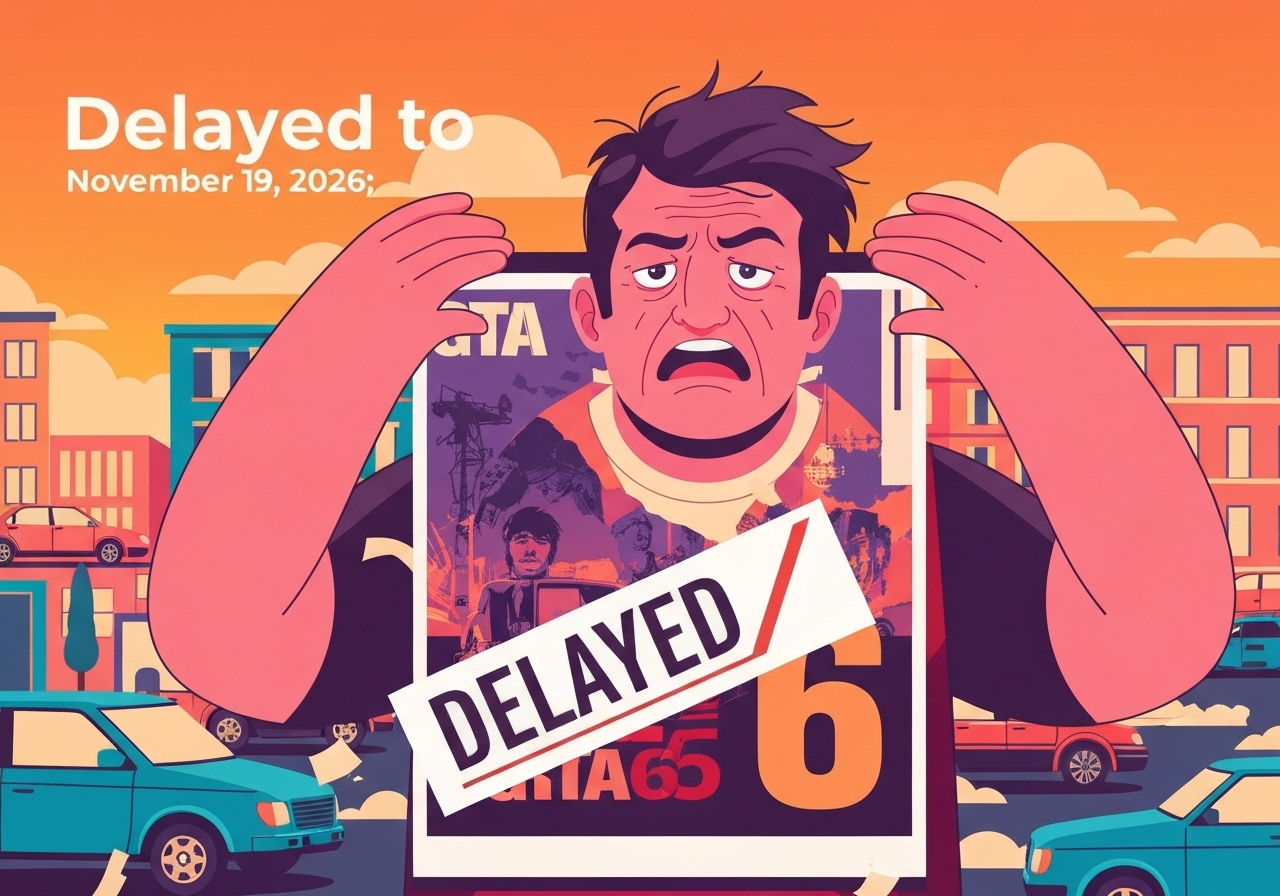
Lead: Rockstar Games and parent company Take-Two announced on November 6, 2025, that Grand Theft Auto VI will now launch on November 19, 2026, a six-month push from the previously stated May 2026 window. The announcement arrived alongside Take-Two’s July–September quarterly results and represents roughly a 12-month shift from the original Fall 2025 timeframe. Take-Two’s CEO Strauss Zelnick offered reassurance about the game’s quality but did not provide a detailed explanation for the additional delay. The news prompted a wave of disappointment and sarcasm across online fan communities.
Key Takeaways
- Release date: Grand Theft Auto VI is scheduled for November 19, 2026, as confirmed in Take-Two’s Q1 fiscal report on November 6, 2025.
- Delay length: This announcement adds six months to the May 2026 date set earlier in 2025, totaling about a year’s shift from the initial Fall 2025 target.
- Corporate comment: Take-Two CEO Strauss Zelnick said the company is “both excited and confident” Rockstar will deliver an exceptional product, but gave no technical reason for the delay.
- Developer message: Rockstar acknowledged the added wait and framed the extra time as necessary to reach expected levels of polish.
- Fan reaction: Online forums, including Reddit threads, saw significant frustration and humor—several posts noted the long span between GTA releases for individual fans.
- Financial context: The delay was disclosed in Take-Two’s quarterly earnings communication, linking product timing to investor reporting.
- Industry pattern: This is the second major postponement Rockstar has announced publicly for GTA 6 since it moved from a Fall 2025 window to May 2026 earlier.
Background
Grand Theft Auto is among the best-selling and most influential entertainment franchises, and Rockstar Games’ development timelines attract intense public and investor scrutiny. After the commercial and critical success of GTA V, expectations for GTA 6’s scope and technical ambition have been unusually high, amplifying the impact of any schedule changes. Take-Two Interactive, Rockstar’s parent company, reports release timing as a material factor for fiscal forecasts and investor guidance; disclosures about major titles often appear in quarterly earnings calls and filings. That linkage helps explain why this latest scheduling change was announced alongside Take-Two’s July–September results rather than solely on Rockstar channels.
Delays for large-scale, open-world titles are not uncommon: expanded scope, cross-platform optimization, and the need to polish emergent gameplay systems can extend development time. Rockstar cited the need for additional polish when it moved the launch from Fall 2025 to May 2026 earlier; the November 2026 date extends that rationale. Stakeholders include millions of franchise fans, retail partners, platform holders, and investors whose revenue expectations can hinge on launch quarter timing. Public sentiment matters both to brand perception and to community goodwill, especially after long promotional cycles.
Main Event
On November 6, 2025, Take-Two released its quarterly financial results and confirmed a new launch date for GTA 6: November 19, 2026. The shift was described in the investor communication; Strauss Zelnick reiterated confidence in Rockstar’s ability to meet high standards but did not enumerate technical or operational causes for the postponement. Rockstar also posted a brief statement to its channels apologizing for the extra wait and framing the additional months as necessary to achieve the franchise’s trademark polish.
Fans reacted immediately across social platforms. Reddit threads and message boards filled with frustration and jokes about the protracted timeline—some highlighted how long the gap felt in personal terms, comparing ages at the time of GTA V release to projected ages at GTA 6 launch. The mood ranged from resigned humor to impatience, with many users questioning the cadence of public updates and release certainty. A subset of the community remained optimistic that the extra development time would produce a more polished experience.
Financially, the announcement was folded into Take-Two’s quarterly narrative rather than separated as a standalone developer bulletin, which underscores that release timing is being handled as both a product and investor-relations matter. Market analysts will track whether the later release affects near-term revenue forecasts and promotional schedules tied to holiday retail windows. For Rockstar, the November 2026 slot positions the game for the holiday season but removes it from earlier fiscal periods where Take-Two may have expected revenue recognition.
Analysis & Implications
From a development perspective, additional polish time can address stability, performance, and content scope—areas that modern open-world titles increasingly struggle to finalize across multiple platforms. Rockstar’s previous projects have set a high bar for technical consistency and production values; slipping a launch to protect those benchmarks is defensible in quality terms, though it carries reputational and financial trade-offs. Investors typically prefer predictable schedules, so repeated postponements can increase scrutiny of internal project management and milestone transparency.
For the player community, repeated delays erode the predictability of release planning and can amplify skepticism toward future date announcements. That social cost has practical implications: pre-order behavior, community engagement, and PR momentum can all be dampened by perceived schedule unreliability. Conversely, a well-received, polished release can restore goodwill and drive stronger long-term monetization and franchise value.
Economically, moving a flagship release into a different quarter affects revenue recognition and marketing cadence. A November 19, 2026 launch aims to capture holiday demand but compresses any post-launch monetization cycle within the fiscal year depending on Take-Two’s accounting periods. Competing releases and the broader holiday slate will also shape initial sales velocity and media attention.
Comparison & Data
| Announcement | Date Announced | Planned Release |
|---|---|---|
| Initial window announced | Prior public statements (Fall 2025) | Fall 2025 (original) |
| First major delay | May 2025 | May 2026 (revised) |
| Second delay (current) | November 6, 2025 | November 19, 2026 |
Context: The timeline above compresses the public schedule changes: the title moved roughly 6–12 months in two distinct announcements. That pattern is consistent with other AAA franchises that expand development time as scope grows or technical hurdles appear. For stakeholders, the key metrics to watch are milestone transparency from the publisher, marketing investment timing, and whether additional platform certification requirements emerge before the November window.
Reactions & Quotes
Corporate and community responses illustrate both the official posture and fan sentiment. Take-Two framed the postponement within investor communications, while Rockstar emphasized quality and polish in its message. Online communities provided immediate, often sarcastic, reaction that reflected fatigue with repeated timeline shifts.
“We are both excited and confident Rockstar Games will deliver an unrivalled blockbuster entertainment experience.”
Strauss Zelnick / Take-Two (CEO, company statement)
Context: Zelnick’s phrasing was delivered during the company’s earnings-related communication and functions as reassurance to investors rather than a technical explanation.
“We are sorry for adding additional time… these extra months will allow us to finish the game with the level of polish you have come to expect.”
Rockstar Games (official post)
Context: Rockstar’s public message acknowledged the wait and framed the delay as a quality-driven decision; it did not provide granular development details.
“My therapist will hear about this Rockstar.”
Reddit user (fan reaction)
Context: Social responses mixed humor and frustration; community posts highlighted the emotional impact of a long promotional cycle and repeated postponements.
Unconfirmed
- No official technical breakdown has been released indicating whether platform-specific optimizations (e.g., for consoles versus PC) are a principal cause of the delay.
- There is no confirmed change to the game’s content scope or monetization strategy tied to the new release date.
- Internal staffing or restructuring as drivers of the postponement have not been publicly confirmed by Rockstar or Take-Two.
Bottom Line
Rockstar’s November 19, 2026 launch date for Grand Theft Auto VI represents another shift in a development timeline watched closely by fans, investors, and industry observers. The publisher frames the delay as quality-focused, and that rationale is credible given the technical complexity of modern open-world titles; however, the lack of detailed public milestones means stakeholders must balance cautious optimism with skepticism about future date certainty.
For consumers, the most practical takeaway is that the extra time may yield a more stable, polished release, but it also extends uncertainty for purchase and play plans. For investors and competitors, the new date realigns revenue timing into the holiday window and will shape marketing and competitive-release strategies for late 2026. Watch for further official updates from Rockstar and Take-Two that add milestone detail or confirm platform-specific timing.