
Lead
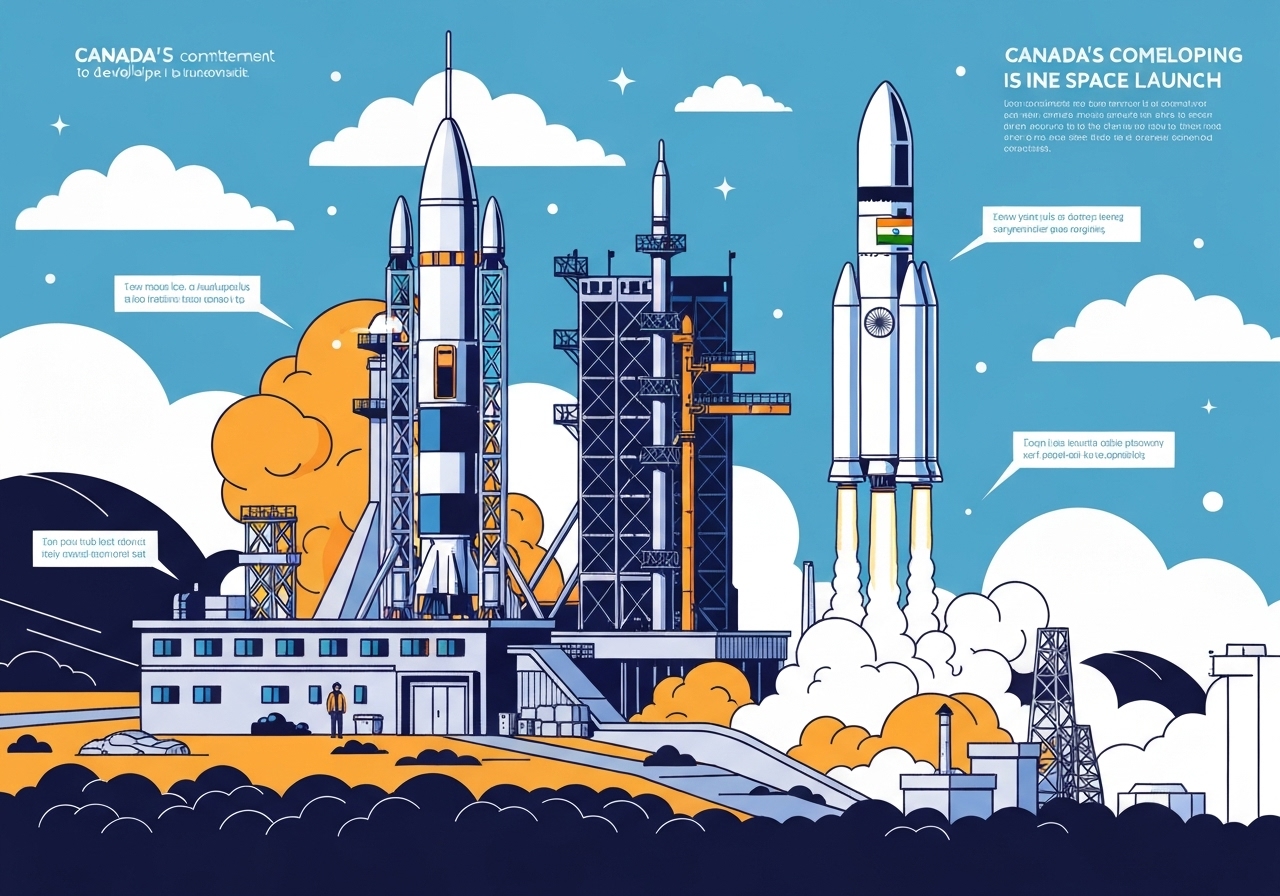
Canada announced C$182.6 million (US$129.4 million) in this week’s federal budget to establish a sovereign space‑launch capability, with funds available this fiscal year and to be spent over three years. The move joins a global trend of governments investing in homegrown launchers for security and economic reasons. Meanwhile, India achieved a milestone when an LVM3 lofted the Indian Navy’s 4.4‑ton GSAT‑7R (CMS‑03), the heaviest satellite ever carried by an Indian rocket. Other developments this week included Blue Origin preparing New Glenn’s second flight on Nov. 9 with NASA’s ESCAPADE payloads and Europe’s Ariane 6 delivering Sentinel‑1D to a 693 km Sun‑synchronous orbit.
Key takeaways
- Canada allocated C$182.6 million (US$129.4 million) to create a sovereign launch capability, with the Department of National Defence managing the funding.
- Blue Origin confirmed a Nov. 9, 2025 target for New Glenn’s second flight; NASA paid roughly US$20 million to launch the ESCAPADE Mars mission on New Glenn.
- New Glenn’s seven BE‑4 engines completed a full‑power 22‑second test that produced nearly 3.9 million pounds of thrust on the pad.
- ISRO launched GSAT‑7R (CMS‑03) on an LVM3 from Satish Dhawan; the satellite weighs about 4.4 metric tons (9,700 lb), India’s heaviest payload to date.
- Ariane 6 (Ariane 62) successfully placed Sentinel‑1D into a 693 km Sun‑synchronous orbit approximately 34 minutes after liftoff from Kourou.
- The U.S. Air Force tested an unarmed Minuteman III ICBM (Glory Trip 254) from Vandenberg over ~4,200 miles to a Pacific test range to assess system readiness.
- Russia’s Vostochny construction contractor reportedly accumulated US$627,000 in unpaid energy charges, prompting partial power cuts at sections of the spaceport under construction.
- Vast’s Haven Demo deployed on a Falcon 9 rideshare and extended its single solar array in orbit as a subscale testbed for a planned human‑rated habitat.
Background
Governments increasingly view assured access to space as a matter of sovereignty and national security. Nations with growing space needs prefer domestic launch options to avoid relying on a small set of foreign providers. Canada’s budget move reflects that trend: Ottawa has for years nurtured a small but growing launch sector that includes firms such as Maritime Launch Services, Reaction Dynamics, and NordSpace. Public procurement and defense budgets are now common levers to accelerate nascent industries in Germany, the U.K., South Korea, and Australia.
At the same time, the commercial launch market is maturing but remains risky. New entrants must master propulsion, avionics, and operations while attracting customers who want reliable, certificated services. Europe’s Isar Aerospace, for example, has raised about US$600 million but still needs repeated successful flights to prove operational reliability. Established players — SpaceX, ULA, ISRO, Arianespace — provide contrast in scale, cadence, and demonstrated performance.
Main event
In Ottawa, the federal budget set aside C$182.6 million for a sovereign launch capability and announced the creation of a Defense Investment Agency to streamline procurement. The Department of National Defence will oversee the initial spending, but the government has not released a detailed plan breaking down the allocation between infrastructure, subsidies, or direct investments in firms. The funding window runs across three years, and the government signaled co‑investment with domestic industry may follow.
Across the Atlantic and into orbit, Arianespace performed another successful Ariane 6 mission, lofting Sentinel‑1D on an Ariane 62 configuration from the Guiana Space Center. The radar imaging satellite separated about 34 minutes after liftoff into a 693 km Sun‑synchronous orbit, expanding Europe’s Copernicus environmental monitoring capability. Arianespace said this was Ariane 6’s fourth flight and third operational mission, and the company reiterated plans to raise cadence in 2026.
In India, the LVM3 placed the Indian Navy’s GSAT‑7R (CMS‑03) into orbit. The nearly 4.4‑metric‑ton spacecraft is the largest payload an Indian rocket has carried, and ISRO described the launch as a step to enhance naval communications and maritime domain awareness. India has flown four orbital launches so far in 2025, down from a peak of eight in 2023; a May PSLV failure contributed to the reduced cadence while investigators examined the anomaly.
Blue Origin’s New Glenn moved toward a scheduled Nov. 9 launch from Cape Canaveral after a successful pad test of its seven BE‑4 main engines. The company integrated NASA’s two ESCAPADE satellites inside the payload shroud and rolled the vehicle to Launch Complex‑36 for preflight operations. New Glenn will attempt its second flight on a rocket that has not yet received NASA or U.S. Space Force certification, and the ESCAPADE mission departs outside typical interplanetary windows using a specialized trajectory to reach Mars in 2027.
Analysis & implications
Canada’s budget commitment is modest in absolute terms but significant politically: C$182.6 million buys initial capability development, demonstration flights, or seed investments rather than a full national launch base. The Defence Investment Agency model centralizes buying power and could accelerate procurement decisions, but meaningful launch sovereignty requires years of iterative tests, infrastructure, and regulatory build‑out. Expect Ottawa to aim for public‑private partnerships and to funnel some funds into existing Canadian startups and established contractors like MDA Space.
For Blue Origin and New Glenn, the ESCAPADE contract illustrates a two‑edged bargain. NASA’s reported ~US$20 million price for a heavy‑lift rocket is economical compared with dedicated rides on proven vehicles, but the trade‑off is schedule and certification risk. New Glenn has flown only once; its second flight must demonstrate reliability and cadence before customers entrust time‑sensitive missions. If New Glenn meets the Nov. 9 target and recovers its first stage as planned, that would strengthen Blue Origin’s commercial pitch and planned reuse on an early 2026 Blue Moon booster mission.
Europe’s Ariane 6 flight success helps stabilize the continent’s independent access to space, but Europe’s launch startups still face an experience gap. Isar Aerospace’s large private funding round shows investor appetite, yet orbital success remains the threshold for routine commercial customers. A doubled Ariane 6 cadence in 2026 (six to eight missions) would relieve pressure on Europe’s launcher needs but hinges on industrial throughput, supply chains, and manifest certainty with customers like the European Commission.
India’s heavier LVM3 manifests a different trajectory: rather than a proliferation of small launchers, ISRO has focused on higher‑mass capability and reliability. Deploying a 4.4‑ton naval communications satellite underscores India’s maritime strategy and indigenous capacity. Still, restoring PSLV to operational status and returning to higher yearly launch counts will be critical for domestic and commercial ambitions.
Comparison & data
| Item | Key figures | Context |
|---|---|---|
| Canada sovereign launch fund | C$182.6M (US$129.4M) | Funds available this fiscal year; spent over three years; managed by Department of National Defence |
| Isar Aerospace fundraising | ~US$600M | Largest private raise among European launch startups; one orbital attempt failed March 2025 |
| India launches (2025) | 4 orbital launches | Down from 8 in 2023; LVM3 carried 4.4‑ton GSAT‑7R |
| Ariane 6 | 4 flights (3 operational) | Sentinel‑1D inserted at 693 km SSO; target: 6–8 flights in 2026 |
| New Glenn | Second flight target Nov. 9, 2025 | ESCAPADE to Mars; rocket not yet NASA/USSF certified |
The table highlights differing scales: Canada’s investment is an early‑stage industrial stimulus, Isar’s fundraising is venture‑scale capital, and vehicles like LVM3 and Ariane 6 are operational heavy lifters showing incremental cadence gains. Funding alone does not guarantee orbital competence—repeated, successful flights and supply‑chain maturity are the decisive factors.
Reactions & quotes
The Air Force framed the Minuteman III test as a routine readiness exercise; officials emphasized data collection and system reliability. The test used a missile from F.E. Warren AFB and sent an unarmed reentry vehicle to a Pacific test range to validate system performance.
“The data collected during the test is invaluable in ensuring the continued reliability and accuracy of the ICBM weapon system.”
Lt. Col. Karrie Wray, 576th Flight Test Squadron (U.S. Air Force)
Vast’s CEO cast the Haven Demo as a validation step toward a human‑rated commercial station, stressing that the subscale flight exercised systems identical to those intended for the crewed habitat.
“Haven Demo’s mission success has turned us into a proven spacecraft company.”
Max Haot, CEO (Vast)
Arianespace leadership publicly signaled a push for higher cadence in 2026, describing plans for both the two‑ and four‑booster Ariane 6 variants to meet European demand for environmental and navigation satellites.
Unconfirmed
- Precise breakdown of how Canada’s C$182.6 million will be allocated (infrastructure vs. company subsidies vs. R&D) has not been published publicly.
- The extent and precise damage to the Shenzhou‑20 return vehicle remain under investigation and Chinese authorities have not released full engineering assessments.
- Whether New Glenn’s second flight will achieve a successful first‑stage landing and on‑schedule reuse for the planned early‑2026 third flight is still to be seen.
- Europe’s ability to sustain an Ariane 6 cadence of six to eight flights in 2026 depends on supply‑chain continuity and manifest certainty, which remain subject to change.
Bottom line
This week’s developments illustrate two concurrent trends: governments are moving from enabling policy to direct investment to secure independent access to space, while legacy and commercial heavy‑lift providers continue to demonstrate and extend capability. Canada’s budget commitment is a meaningful start but will require sustained follow‑through to create operational sovereignty.
Operational tests and second‑flight validations will shape commercial confidence. New Glenn’s upcoming launch and Ariane 6’s steady deployments are barometers of whether newer heavy vehicles can transition from demonstration to dependable service. For nations like India, demonstrating heavier payload capacity signals strategic and commercial maturity even as investigators and industry work to restore and increase cadence after setbacks.
Sources
- Ars Technica (news analysis)
- SpaceQ (Canadian space news outlet)
- SpaceNews (industry reporting)
- Air & Space Forces Magazine (U.S. defense reporting)
- The Hindu (Indian national newspaper)
- European Spaceflight (European launch reporting)
- The Moscow Times (Russian regional reporting)