
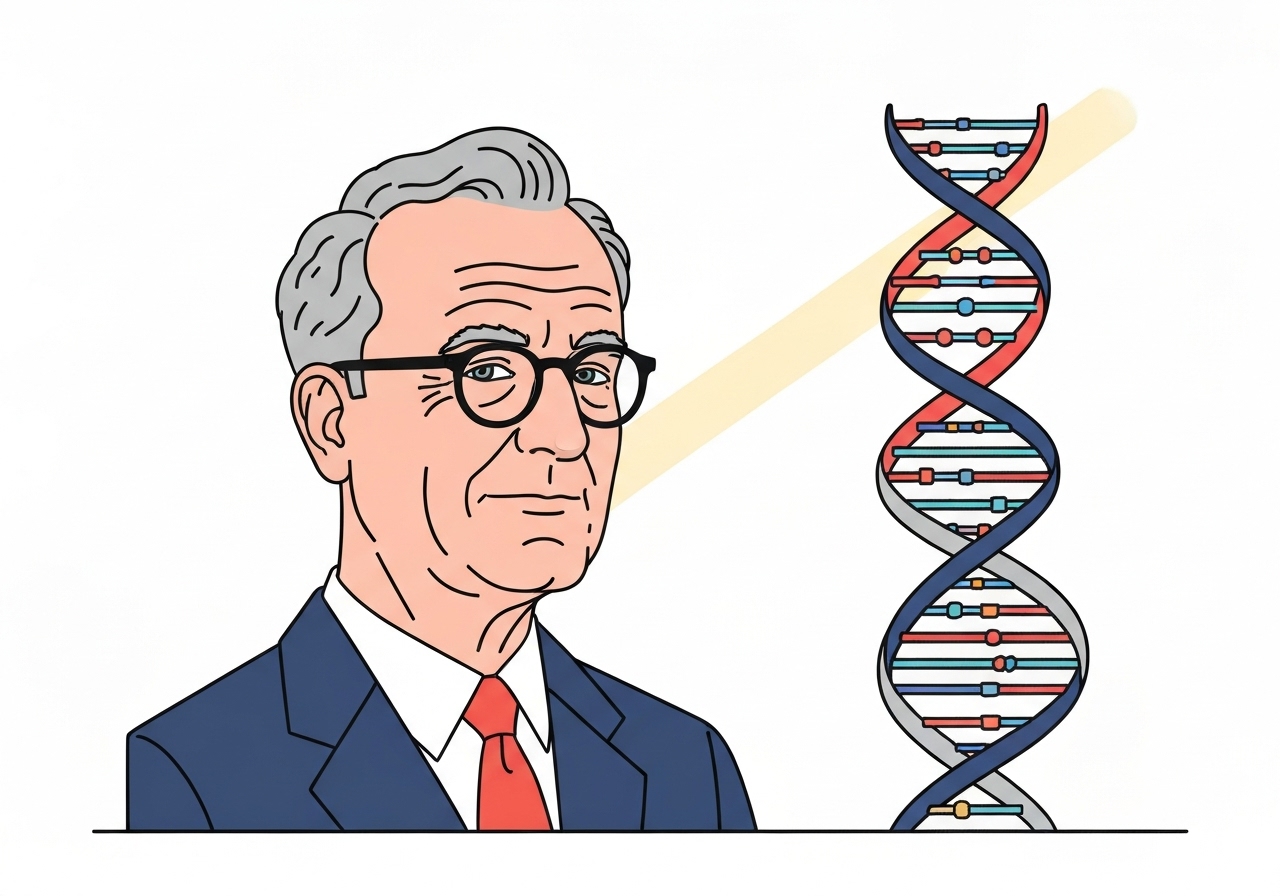
Lead: James D. Watson, the molecular biologist who helped reveal DNA’s double‑helix and later led early efforts to map the human genome, died on Nov. 7, 2025, in East Northport, New York. He was 97. His son, Duncan Watson, confirmed that he had been moved to hospice care this week after treatment for an infection. Watson’s scientific breakthroughs secured a central place in 20th‑century biology even as later controversies clouded his public reputation.
Key takeaways
- Watson co‑authored the 1953 model of DNA’s double‑helix with Francis H.C. Crick; the discovery reshaped genetics and molecular biology.
- He shared the 1962 Nobel Prize in Physiology or Medicine with Francis Crick and Maurice Wilkins for the DNA structure work.
- Watson directed Cold Spring Harbor Laboratory from 1968 to 1993 and served as the first director of the U.S. Human Genome Project effort before leaving in 1992.
- The Human Genome Project produced a working draft of roughly three billion base pairs in 2000, a milestone Watson helped initiate.
- Controversial public remarks about race in 2007 prompted resignations and, later, revocations of honorary titles in 2018 by Cold Spring Harbor Laboratory.
- He published the influential memoir The Double Helix (1968) and a textbook, Molecular Biology of the Gene, both widely read in the field.
- Watson sold his Nobel medal at Christie’s in 2014 for $4.1 million; the buyer returned the medal to him.
Background
By the early 1950s the identity of the molecule of heredity was accepted but its physical form remained unclear. Building on decades of biochemical and X‑ray studies—dating back to Friedrich Miescher’s 1869 isolation of “nuclein”—teams in Cambridge and London pursued DNA’s structure. At the Cavendish Laboratory in Cambridge, Watson and Crick combined chemical reasoning with structural insights to propose a twisted‑ladder model in 1953 that explained base pairing and suggested a copying mechanism for genetic information.
The 1953 model catalyzed a cascade of research: it explained mutation and inheritance, enabled the identification of disease‑causing variants, and laid conceptual groundwork for genetic engineering and sequencing technologies, including CRISPR‑based editing decades later. In institutional terms, Watson’s later career would pivot from bench work to leadership—most visibly at Cold Spring Harbor Laboratory and in the early organization of the Human Genome Project.
Main event
Watson’s death was announced after his son, Duncan, confirmed that he had been transferred from a hospital to hospice care in East Northport, Long Island, following treatment for an infection. Watson was 97. Public records and prior reporting place his birth on April 6, 1928, in Chicago; his scientific ascent accelerated after doctoral work at Indiana University and a move to Cambridge, England, in 1951.
In 1953 Watson and Crick published a brief paper in Nature describing a double‑helical DNA structure whose complementary base pairing explained how genetic information could be copied. That paper, together with contemporaneous contributions from Maurice Wilkins and Rosalind Franklin’s X‑ray data, led to the 1962 Nobel Prize shared by Watson, Crick and Wilkins. Franklin had died in 1958 and was therefore ineligible for the prize.
Watson left active laboratory research as he took on administrative and programmatic roles. He became director of Cold Spring Harbor Laboratory in 1968, transforming its conferences, education programs and research profile, and he played a key role in organizing the Human Genome Project, which produced a working draft of the roughly three billion‑letter human genome in 2000.
His later years were marked by public controversy. In 2007 a Sunday Times interview in which Watson made statements about race provoked widespread condemnation; he resigned certain positions and, after repeated public incidents, Cold Spring Harbor Laboratory rescinded honorary affiliations in 2018 when a PBS documentary re‑aired his remarks. Watson apologized at the time, saying there was “no scientific basis” for such claims.
Analysis & implications
Scientifically, Watson’s role in making DNA’s structure intelligible is foundational: the double‑helix supplied a physical mechanism for heredity and mutation that underpins modern molecular biology. That intellectual advance enabled diagnostics, gene discovery, personalized medicine, genetically modified crops and later techniques such as CRISPR. The Human Genome Project he helped shepherd created reference data that continue to drive biomedical research and commercial genomics.
Institutionally, Watson’s leadership at Cold Spring Harbor reshaped a midsized laboratory into a global center for molecular biology and genetics. His emphasis on training—especially through summer courses and high‑school programs—expanded the field’s workforce. Yet the laboratory’s historical links to early eugenics debates meant Watson’s later public remarks carried amplified institutional risk and reputational consequences for the center he led.
The juxtaposition of towering scientific achievement with repeated public statements that many judged racist complicates Watson’s legacy. For funders, policymakers and academic institutions, his life is a case study in separating individual scientific contributions from personal conduct and in setting boundaries for public leadership roles. For the public and for emerging scientists, it underscores the importance of ethical stewardship alongside scientific ambition.
Comparison & data
| Year | Event |
|---|---|
| 1953 | Watson & Crick publish DNA double‑helix model |
| 1962 | Nobel Prize in Physiology or Medicine awarded to Watson, Crick, Wilkins |
| 1968–1993 | Director, Cold Spring Harbor Laboratory |
| 2000 | Human Genome Project publishes working draft (~3 billion base pairs) |
| 2007 | Controversial remarks reported; resignations follow |
| 2014 | Nobel medal sold at Christie’s for $4.1M; later returned |
The timeline highlights how a brief, decisive insight (1953) launched decades of institutional and technological change that culminated in the 2000 genome draft. Watson’s administrative span (1968–1993) coincided with expanded federal investment in molecular research and the emergence of large collaborative projects that now define genomics.
Reactions & quotes
“It changed biology forever.”
Bruce Stillman, Cold Spring Harbor director (1994–), on the 1953 discovery
“He was transferred to hospice from a hospital this week after being treated for an infection.”
Duncan Watson (son), confirmation of death
“There is no scientific basis for such a belief,”
James D. Watson, 2007 apology
Institutional responses over the last two decades ranged from public denunciations to formal removal of titles; scientists and science historians have balanced admiration for Watson’s discoveries with condemnation of his repeated offensive remarks. Colleagues who worked with him emphasize both his skill at spotting talent and the alienating bluntness that characterized his public persona.
Unconfirmed
- The precise degree to which Rosalind Franklin would have been credited as a co‑author on the 1953 paper under today’s standards is debated among historians of science.
- Motivations behind the 2014 sale of Watson’s Nobel medal—whether purely financial or partly symbolic—have been described differently by associates and commentators.
- Accounts vary about the internal decision process at Cold Spring Harbor Laboratory leading to the 2018 revocation of honorary titles; some minutes and private discussions remain unpublished.
Bottom line
James D. Watson’s contributions to molecular biology—most notably the formulation of DNA’s double‑helix and his role in launching the Human Genome Project—are central to modern life sciences. Those achievements underpin contemporary genetics, medical research and biotech industries, and they will shape biology for decades to come.
At the same time, Watson’s repeated public remarks that many deemed racist and other offensive public comments materially affected how institutions, funders and colleagues treated him. His life illustrates how scientific stature does not insulate a figure from accountability, and it complicates simple narratives of scientific heroism.
For readers and institutions, the practical lessons are clear: preserve rigorous scholarship and historical record‑keeping while maintaining ethical standards for public conduct and leadership. Watson’s scientific legacy will remain foundational; the debates over his conduct will continue to inform how science manages authority, responsibility and public trust.
Sources
- The New York Times (news obituary)
- The Nobel Prize (official prize summary)
- Cold Spring Harbor Laboratory (institutional site)
- Nature / Scitable (educational background on DNA)