
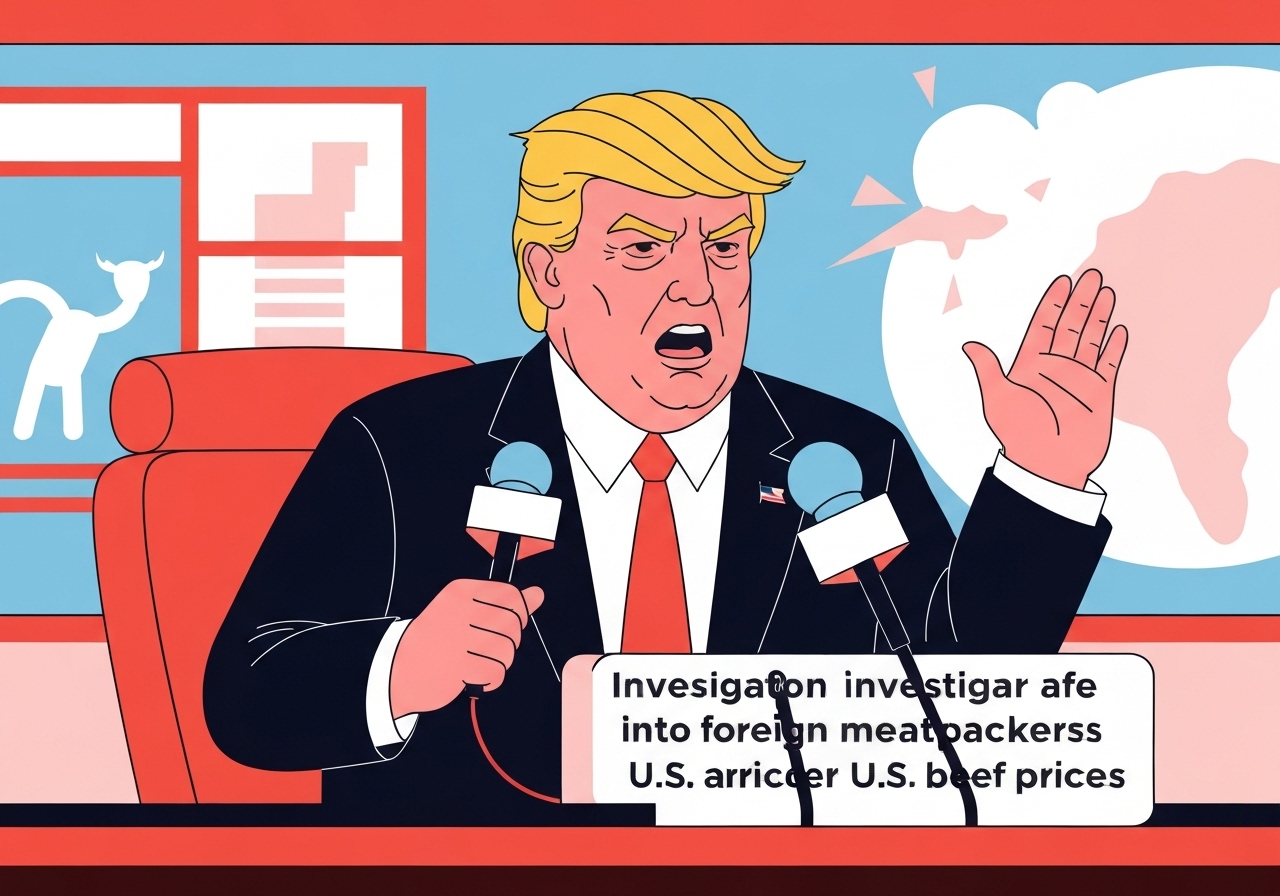
Lead: On November 7, 2025, President Donald Trump urged the U.S. Department of Justice to open an inquiry into foreign-owned meatpackers, alleging they have inflated U.S. beef prices. He made the request on social media days after Republicans lost key races where voters emphasized the cost of living. The president characterized boxed beef pricing as “fishy” and said foreign ownership and alleged collusion were to blame, but he provided no evidence to support those claims. The call renews political and regulatory attention on how supply, trade policy and industry structure affect retail beef costs.
Key Takeaways
- On November 7, 2025, President Trump publicly asked the Department of Justice to “immediately begin an investigation” into meatpacking companies he said were driving up beef prices.
- The president cited “Illicit Collusion, Price Fixing, and Price Manipulation” in a social media post and singled out “Majority Foreign Owned Meat Packers.”
- Mr. Trump made the announcement shortly after his party lost several races where voters highlighted rising living costs as a top concern.
- He suggested last month that the U.S. might buy Argentine beef to lower domestic prices, a proposal that drew criticism from U.S. cattle ranchers.
- Beef costs have risen amid drought conditions and several years of low prices, contributing to the smallest U.S. cattle herd in decades, and U.S. tariffs on Brazil have also reduced some imports.
- The president did not present supporting evidence for collusion or price-fixing claims; legal review and fact-finding by DOJ would be required to substantiate them.
- The move has intensified bipartisan attention on food prices, reviving past initiatives aimed at increasing competition in meat processing.
Background
Retail beef prices in the United States have been under upward pressure due to a combination of weather-driven supply shocks and structural industry factors. Extended droughts in key cattle-producing regions reduced herd sizes after years of low returns to ranchers; that smaller herd is widely cited as a principal driver of higher wholesale and retail beef prices. At the same time, trade policy, including recent tariffs on Brazilian beef imports, has constrained some sources of foreign supply.
The U.S. meatpacking sector has long been characterized by a high degree of concentration in processing capacity, prompting recurring scrutiny from regulators and lawmakers over its effects on prices and farmers’ margins. Debates over foreign ownership of major processors have intensified as global firms expanded their presence in U.S. processing facilities and acquisitions. Antitrust investigations and congressional hearings in prior years have targeted conduct such as price coordination and buyer power, though proving criminal collusion requires specific evidence and legal thresholds.
Main Event
On November 7, 2025, President Trump posted on social media that he had asked the Department of Justice to start an investigation into meatpacking firms he described as “driving up the price of Beef through Illicit Collusion, Price Fixing, and Price Manipulation.” He framed the action as protection for American ranchers and consumers and accused majority foreign-owned firms of artificially inflating prices and threatening the nation’s food security.
The president’s statement followed political setbacks for his party in which Democratic victors campaigned heavily on easing cost-of-living pressures. Trump countered those narratives by asserting that grocery prices are generally down with “some exceptions,” while pointing to boxed beef pricing as anomalous and worthy of scrutiny. He repeated the claim that foreign ownership was a key factor, though he did not provide documentary or statistical evidence in the post.
Earlier, in October 2025, Mr. Trump publicly floated the idea of importing Argentine beef to help lower domestic prices—an idea that angered some U.S. cattle producers who argued it would undercut domestic supply chains. Observers note that changes in import policy, tariffs on key exporters and domestic herd reductions have all influenced the market backdrop for beef prices.
Analysis & Implications
Politically, the DOJ probe request serves several purposes: it addresses a salient voter concern (food inflation), signals toughness on perceived foreign influence in U.S. supply chains, and positions the president as siding with ranchers and consumers. The timing—after electoral losses where cost of living was prominent—suggests political incentives to demonstrate action. However, rhetoric alone does not translate into enforceable findings without a factual investigation.
Legally, the Department of Justice would need to gather documentary and transactional evidence to pursue claims of collusion, price fixing or manipulation. Antitrust enforcement requires proof of coordination or concerted action that unreasonably restrains trade; ownership or nationality alone does not constitute illegal conduct. Any DOJ civil or criminal inquiry could take months or years and would likely involve subpoenas, industry data analysis and sworn testimony.
Economically, even a credible enforcement action could have mixed effects on consumers. If wrongdoing were proven, enforcement could restore more competitive pricing over time. But many analysts emphasize supply-side factors—drought, herd size and import constraints—as primary drivers of recent price gains. Trade measures such as tariffs on Brazil reduce available imports and can raise domestic prices absent offsetting supply increases.
Internationally, singling out “majority foreign-owned” firms risks diplomatic friction with exporting countries and foreign investors, especially if the language leads to policy measures that restrict investment or trade. Regulators and policymakers must balance enforcement of U.S. competition laws with commitments to open investment and trade relationships.
Comparison & Data
| Date | Action or Condition |
|---|---|
| Oct 2025 | President suggested buying Argentine beef to lower U.S. prices |
| Nov 7, 2025 | President asked DOJ to investigate foreign-owned meatpackers |
| Recent years | Droughts and low prices led to smallest U.S. cattle herd in decades |
| Ongoing | U.S. tariffs on Brazilian beef have reduced some imports |
The table above places the president’s request alongside recent policy and market conditions. While political statements are discrete events, price trends reflect cumulative supply and demand dynamics. Analysts will examine wholesale-to-retail spreads, import volumes and herd statistics to separate industry conduct from broader market drivers.
Reactions & Quotes
“I have asked the DOJ to immediately begin an investigation into the Meat Packing Companies who are driving up the price of Beef through Illicit Collusion, Price Fixing, and Price Manipulation.”
President Donald Trump (social media post, Nov. 7, 2025)
This post formed the basis of the administration’s public push for a DOJ inquiry; it included claims about foreign ownership and alleged illegal conduct but offered no supporting evidence in the message itself.
“[We will] crack down on food producers and major supermarkets price gouging.”
Kamala Harris (campaign pledge, cited in prior coverage)
That phrasing reflects prior political emphasis from Democrats on holding large food firms and retailers accountable for pricing practices; it shows bipartisan political traction for action on food costs, even if policy prescriptions differ.
Unconfirmed
- The president’s claim that majority foreign ownership is the primary or sole cause of higher U.S. beef prices remains unproven.
- Allegations of specific “illicit collusion, price fixing, and price manipulation” by named firms were not accompanied by evidence in the president’s post and are thus unverified pending DOJ review.
- The effectiveness of importing Argentine beef to quickly lower U.S. retail prices is uncertain and depends on trade logistics, tariffs and domestic supply conditions.
Bottom Line
President Trump’s call for a DOJ investigation into foreign-owned meatpackers elevates political scrutiny of the meat supply chain and may prompt a formal fact-finding effort. However, allegations of criminal collusion require documentary and transactional evidence; nationality or ownership alone does not establish illegality. The immediate practical impact on retail beef prices will likely be limited unless investigations uncover actionable misconduct or policy changes expand supply.
For consumers and ranchers alike, the underlying drivers—drought-related herd reduction, import patterns and industry concentration—remain central to price trajectories. Watch for DOJ statements, industry data releases and follow-up congressional inquiries to clarify whether the president’s claims will translate into regulatory or legal outcomes.