
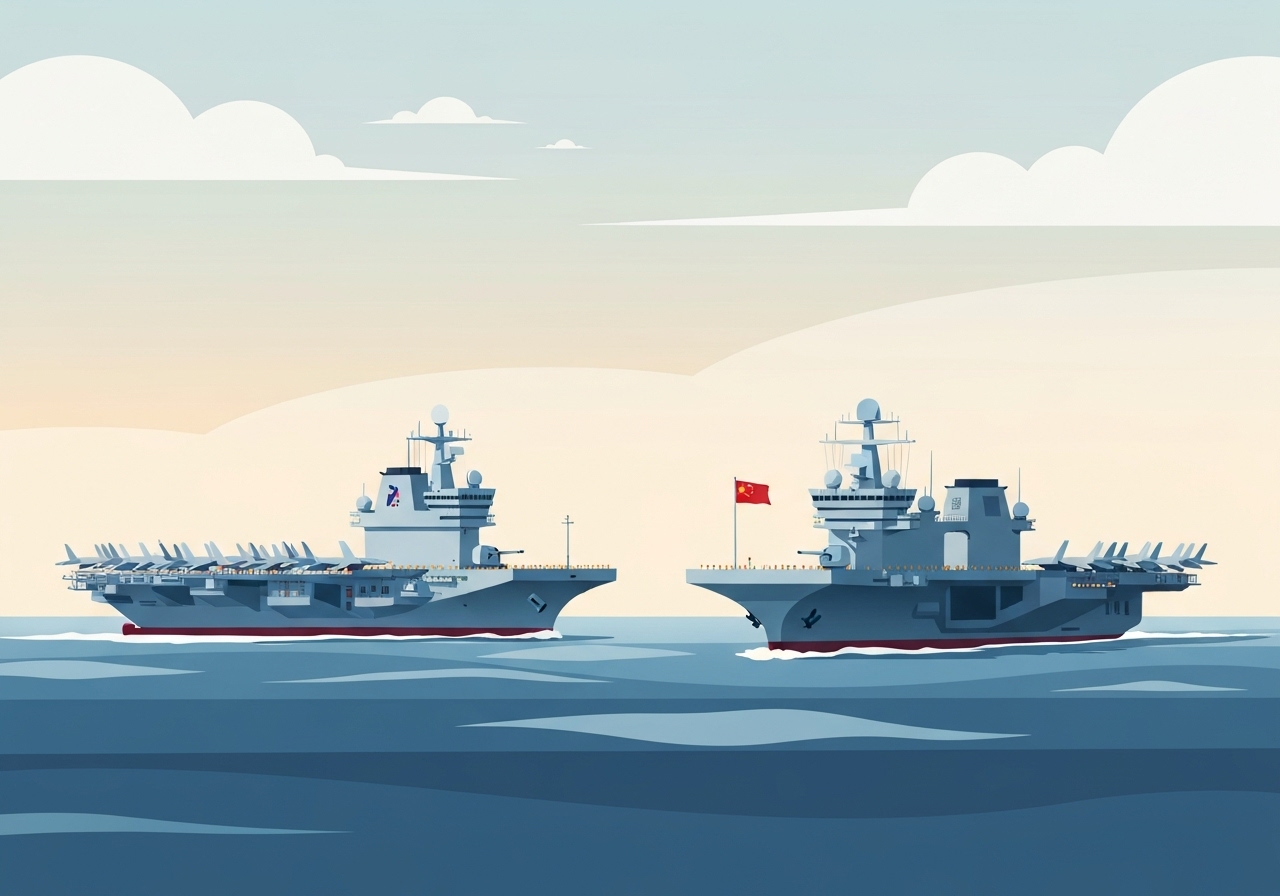
Lead: China’s newly launched Fujian—an 80,000-tonne carrier more than 300 metres long, able to carry roughly 60 aircraft and built at a reported cost of £5.4bn—was formally unveiled in early November 2025 with President Xi Jinping in attendance. The ship elevates China to three carriers versus the United States’ 11, yet developments thousands of miles away in the Black Sea have shown that small, low-cost sea drones can inflict serious operational setbacks on much larger fleets. Washington and Beijing nevertheless continue to treat super-carriers as central instruments of power projection, diplomacy and deterrence; the US has repeatedly used its carrier presence as a deliberate signal, most notably when the USS Gerald R. Ford was ordered to sail near Venezuela. The debate now focuses on how carriers’ strategic utility balances against rising missile and drone threats, high costs and changing naval doctrine.
- China’s Fujian is reported at about 80,000 tonnes, over 300 metres long, with capacity for roughly 60 aircraft and a construction cost of £5.4bn; it is the country’s third carrier.
- The United States operates 11 nuclear-powered aircraft carriers; the USS Gerald R. Ford class carries up to about 70 aircraft and was built at an estimated $12.8bn per hull with peak sortie rates around 125 daily.
- Ukraine’s use of swarming sea drones in the Black Sea demonstrated that smaller, cheaper systems can cause a “functional defeat” for certain naval forces, challenging assumptions about platform survivability.
- The UK completed two carriers for roughly £6.2bn and has used them largely for alliance signalling rather than high-end combat operations.
- Anti-ship missiles and layered defences (destroyers, air defences, electronic warfare) are central to modern carrier group doctrine, but critics point to growing vulnerability against asymmetric systems.
- Russia has not maintained an operational carrier since Admiral Kuznetsov’s 2017 withdrawal; the vessel’s future was described by a Russian shipbuilding official as likely scrapping or sale.
Background
Aircraft carriers have long been seen by great powers as mobile sovereign territory: they enable air operations from international waters, contribute to crisis diplomacy and provide commanders with flexible response options. The US built and sustained a carrier fleet during the 20th century that underpins its ability to project sustained air power and support expeditionary operations worldwide. China’s naval programme has accelerated in the 2010s and 2020s—moves that are as much about securing sea lines of communication and regional influence as they are about global reach.
Costs are substantial and span procurement, sustainment and associated force structures such as escorts, logistics and basing. China’s first commissioned carrier, the Liaoning, entered service in 2012 after conversion from a Soviet-era hull; subsequent vessels reflect a rapid learning curve in shipbuilding and carrier aviation. The UK’s two new carriers, completed for around £6.2bn, were as much an industrial policy project as a military one, preserving shipyard work and signalling capability to partners despite limited deployment in recent regional conflicts.
Main Event
The Fujian’s launch in November 2025 was a high-profile event that highlighted Beijing’s investment in blue-water capabilities. State media and official attendance underscored the ship’s symbolic value: a visible marker that China intends to field a carrier force able to operate beyond coastal waters. The vessel’s size, flight deck features and reported air wing numbers mark a step-change from earlier carriers converted from older hulls.
In parallel, the US continues to demonstrate the political utility of carriers. The USS Gerald R. Ford class—reported construction cost about $12.8bn—has been deployed as a strategic signal on several occasions; one notable instance was a presidential order to position the Ford near Venezuela, a move widely read as coercive diplomacy. Carrier strike groups are accompanied by destroyers and other escorts that specialise in air and missile defence, anti-submarine warfare and electronic protection—components intended to blunt a range of threats.
Yet recent conflicts have complicated the picture. In the Black Sea, Ukrainian forces used massed and precision sea drones to damage and disorganise portions of Russia’s naval presence, a result described in open reporting as a “functional defeat” for parts of the fleet. Separately, Houthi forces attacked the USS Harry S. Truman carrier group in the Red Sea earlier in 2025; the most visible loss was a $70m F/A-18E Super Hornet that went overboard during an evasive manoeuvre rather than direct catastrophic damage to the ship itself.
Analysis & Implications
Carriers remain powerful tools of statecraft because they combine mobility, sovereign airpower and symbolic weight. For Beijing, fielding multiple carriers is intended to change both regional calculations around Taiwan and wider perceptions of China’s naval reach. For Washington, a numerically superior carrier force underwrites global response options and reassures allies who rely on sustained US air and sea presence.
However, the rise of long-range anti-ship missiles, unmanned surface and subsurface systems, and improved sensors narrows the safety margin for large-deck carriers. These technologies enable adversaries to threaten carrier strike groups at greater standoff distances, forcing changes in tactics, dispersal, investments in layered defences and increased reliance on escorts and land-based assets. The net effect is to raise operating costs and complicate fleet-level planning.
Economics and industrial policy also matter. Building and sustaining carriers supports shipbuilding jobs and associated industries, which partly explains why nations continue to finance expensive hulls even when their direct military utility for specific contingencies is debated. Smaller, cheaper naval strike systems, conversely, offer asymmetric returns—Ukraine’s drone campaign is a contemporary example—and encourage investments in counter-drone measures and resilient logistics that can blunt those asymmetric tools.
Comparison & Data
| Country | Active carriers | Representative tonnage | Approx. air wing | Notable cost per hull |
|---|---|---|---|---|
| United States | 11 | ~100,000+ t (nuclear supercarriers) | ~60–70 aircraft | $12.8bn (Gerald R. Ford class) |
| China | 3 | Fujian ~80,000 t | ~60 aircraft (est.) | £5.4bn (Fujian est.) |
| United Kingdom | 2 | ~65,000 t (Queen Elizabeth class) | ~40–50 aircraft | £6.2bn (two ships total) |
| Russia | 0 (no functioning carrier since 2017) | N/A | N/A | Admiral Kuznetsov withdrawn 2017 |
The table summarises active carrier counts, representative sizes and approximate air wings; figures combine reported specifications, open-source estimates and publicly stated programme costs. These numbers make clear why carriers are expensive strategic choices and why states weigh political signalling and industrial policy alongside direct military utility.
Reactions & Quotes
“Carriers remain a central tool for nations that want independent global reach and influence,”
Nick Childs, International Institute for Strategic Studies (paraphrase)
“Sea drones have shown they can impose outsized operational costs on larger fleets when used massed and precisely,”
Analysis attributed to battlefield assessments in the Black Sea (paraphrase)
Unconfirmed
- Whether the Admiral Kuznetsov will be scrapped or sold remains subject to official confirmation beyond statements from a shipbuilding official.
- The effectiveness of sea-drone tactics against a fully equipped, peer-level carrier strike group with intact layered defences is not yet proven in peer-on-peer combat.
- Any future plan by China to use carriers as a coercive instrument toward Taiwan is a strategic risk frequently discussed by analysts but remains speculative in terms of specific operational timelines.
Bottom Line
Large-deck aircraft carriers continue to matter because they provide sovereign airpower, operational flexibility and high-visibility signalling that few other platforms match. For states such as China and the US they are instruments of both hard power and diplomacy: investments that reach across military, economic and industrial policy domains. At the same time, the rise of low-cost unmanned systems and long-range missiles forces a rethink of how carriers operate, how they are defended and what missions they should prioritise.
Policymakers must balance the prestige and strategic options carriers provide with their expense and vulnerability. Future naval planning will likely emphasise distributed forces, improved missile defence, electronic resilience and continual evolution of doctrine so that carriers remain useful without becoming prohibitively risky or politically costly assets.
Sources
- The Guardian — news reporting on Fujian launch, carrier diplomacy and Black Sea events (news)
- International Institute for Strategic Studies (IISS) — think tank analysis and expert commentary (think tank)
- US Navy — technical and programme details for the Gerald R. Ford class and carrier operations (official)
- Royal Navy — public information on UK carrier capabilities and deployments (official)