
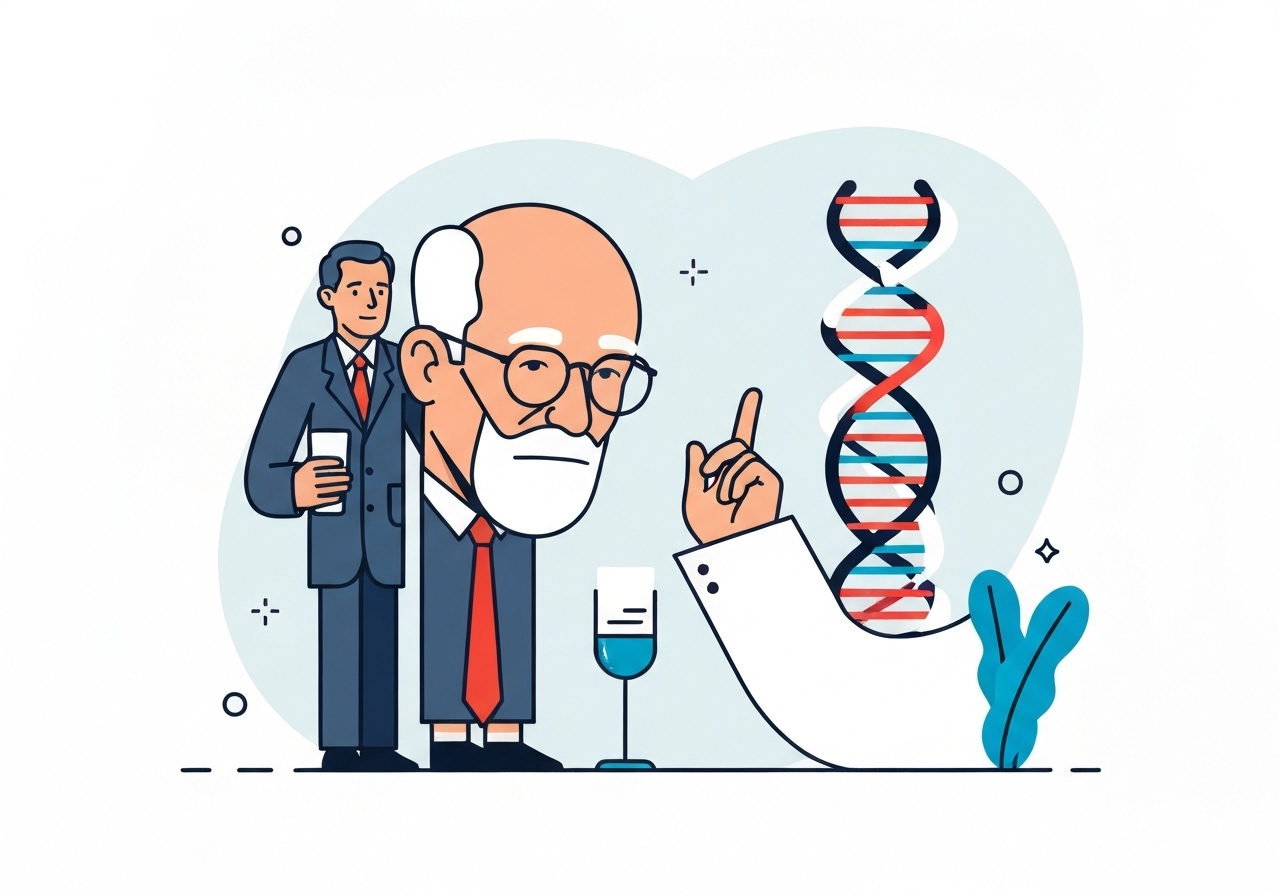
Lead: James D. Watson, the American molecular biologist who co-discovered the double-helix structure of DNA in 1953, has died at age 97. He passed away in hospice care after a brief illness, his son said, and the research laboratory where he worked confirmed he died a day earlier. Watson’s 1953 insight and a shared 1962 Nobel Prize with Francis Crick and Maurice Wilkins transformed genetics, spawning advances from gene therapy to forensic DNA. In later years he drew sustained condemnation and professional censure for public statements about race that many scientists and institutions called offensive.
Key Takeaways
- James D. Watson died at age 97 in hospice care after a brief illness; his son Duncan Watson and his former lab confirmed the timing of his death.
- Watson, at 24, helped identify the double-helix structure of DNA in 1953 and shared the 1962 Nobel Prize in Physiology or Medicine with Francis Crick and Maurice Wilkins.
- The double helix immediately suggested how genetic information is stored and copied, enabling later breakthroughs in gene therapy, forensics, genealogy and genomics.
- Watson directed parts of the U.S. human genome initiative from 1988 to 1992 and was present at the 2000 White House announcement of a working draft covering roughly 90% of human genes.
- In 2007, Watson made public remarks about race and intelligence that led to his suspension and rapid retirement from Cold Spring Harbor Laboratory; the lab later revoked honorary titles.
- Watson received one of the first personal whole-genome reports in 2007 and auctioned his Nobel medal in 2014 for $4.7 million, a record at the time; the medal was later returned.
Background
In the early 1950s, the chemical nature of heredity and the three-dimensional structure of DNA were central unsolved problems in biology. X-ray diffraction images, biochemical data and model-building converged in Cambridge, England, where a young James Watson and Francis Crick combined approaches to propose that DNA consists of two complementary strands wound into a double helix. That model immediately offered a mechanistic explanation for replication and how genetic information is passed between generations.
The double helix became an enduring symbol of modern biology and set the stage for decades of research: mapping genomes, manipulating genes for therapy or agriculture, and using DNA to identify people in forensic and ancestry work. Those technical advances have repeatedly raised ethical questions about altering heritable traits, privacy around genetic data, and the social implications of linking genetics to behavior or aptitude.
Watson’s career blended discovery, institution-building and public engagement. He authored influential textbooks and a best-selling memoir, helped shape molecular biology programs at Harvard and Cold Spring Harbor Laboratory (CSHL), and played a leadership role in launching the public Human Genome Project. Yet his later public comments on race and intelligence overshadowed parts of his reputation and prompted institutional responses that remain central to assessments of his legacy.
Main Event
Watson’s death was reported by his son, Duncan Watson, who said his father died after a short illness in hospice care; the laboratory that had been his long-time affiliation confirmed he died a day earlier. Watson rose to prominence after the 1953 structural proposal for DNA and the subsequent 1962 Nobel Prize, achievements that propelled him to a position of lasting influence in molecular biology and science policy.
After Cambridge, Watson held positions at the California Institute of Technology and Harvard, where he helped build one of the earliest molecular biology programs before moving to Cold Spring Harbor Laboratory. At CSHL he served in leadership roles for nearly four decades, transforming the Long Island campus into a major center for research, education and fundraising focused on cancer and molecular genetics.
Watson played a public role in the early Human Genome Project, directing federal efforts from 1988 to 1992 and announcing a large ethics component at the program’s outset. He stood at the White House in 2000 when a working draft of the human genome—covering an estimated 90% of human genes—was unveiled, a milestone he had championed.
Controversy punctuated his later years. In 2007, remarks reported by the Sunday Times about race and intelligence led to international outcry, his suspension as CSHL chancellor and a swift retirement. When a 2019 documentary captured him repeating those views, CSHL revoked honorary titles and many colleagues publicly criticized the statements as unsupported and harmful.
Analysis & Implications
Watson’s scientific contribution—the double-helix model—remains foundational. It provided the conceptual framework that made molecular genetics a coherent discipline and enabled practical advances ranging from PCR-based forensics to CRISPR gene editing. The practical payoff is visible in medicine, where gene therapies and genomics-guided treatments have become routine in some contexts, and in forensic science, where DNA profiling transformed criminal investigations.
At the same time, Watson’s public commentary highlights persistent tensions between scientific authority and social responsibility. When prominent scientists make claims that touch on race, intelligence or behaviour, the statements can fuel misunderstanding and mistrust of science. Institutions responding to such remarks have weighed the value of a scholar’s achievements against the harm of their public words—CSHL’s revocations and other censure signal how scientific communities now approach ethical and reputational risks.
The episode also reflects broader governance challenges in genomics: how to balance open research and public discussion of sensitive findings with the need to prevent misuse or misinterpretation. As genomic data become cheaper and more accessible, policymakers, funders and scientific leaders face pressure to strengthen ethics oversight, improve public communication and ensure diverse participation in research so that benefits and risks are fairly distributed.
Looking ahead, Watson’s life underscores both the power of a scientific idea and the limits of personal authority. Scientific progress built on his insight will continue, while the field increasingly emphasizes multidisciplinary oversight—bioethics, law and community engagement—to manage social consequences of genomic technologies.
Comparison & Data
| Year | Event |
|---|---|
| 1953 | Watson and Crick propose DNA double-helix |
| 1962 | Nobel Prize in Physiology or Medicine (Watson, Crick, Wilkins) |
| 1988–1992 | Watson directs parts of U.S. Human Genome Project effort |
| 2000 | Working draft of the human genome announced (~90% coverage) |
| 2007 | Controversial race-related remarks lead to suspension and retirement |
| 2014 | Nobel medal auctioned for $4.7 million; later returned |
The timeline shows a career with concentrated early scientific impact and sustained institutional influence that extended into public policy. The 2007 controversy represents a clear inflection: institutional honors and roles were re-evaluated even as the scientific community continued to rely on the conceptual tools his work provided.
Reactions & Quotes
The following reactions illustrate how colleagues, family and institutions contextualized Watson’s life and work.
“He never stopped fighting for people who were suffering from disease.”
Duncan Watson, son
His son framed Watson’s motivation around medical benefit and personal experience, referencing the family’s engagement with severe mental illness and Watson’s own interest in genomics as a route to medical answers.
“His outbursts, particularly when they reflected on race, were both profoundly misguided and deeply hurtful.”
Dr. Francis Collins, former NIH director
Collins offered a measured rebuke that separates scientific accomplishment from public statements that many found harmful, reflecting how national research leadership responded to the controversy.
“[Watson’s statements were] reprehensible and unsupported by science.”
Cold Spring Harbor Laboratory (institutional statement)
CSHL’s response led to revocation of honorary titles and symbolized institutional limits on tolerance for statements judged to undermine equitable scientific norms.
Unconfirmed
- That specific genetic variants can be cleanly mapped to complex traits such as intelligence or criminal behavior remains scientifically contested and is not established as a direct causal rule.
- The extent to which Watson’s private motivations (for example, helping his son) directly shaped major funding decisions or research priorities is plausible but not fully documented in public records.
Bottom Line
James Watson’s 1953 model of DNA was a defining discovery of 20th-century biology that created the conceptual basis for genomics, biotechnology and forensic DNA. The discovery’s practical and cultural reach is vast: it reshaped medicine, enabled new investigative tools, and became an iconic scientific image.
At the same time, Watson’s public statements on race and other sensitive topics complicated his legacy, prompting institutions to distance themselves and prompting broader discussion about how scientific authority should be exercised in public. Future governance of genetic science will likely continue to balance the enormous promise of genomics with ethical safeguards and inclusive dialogue.
Sources
- Associated Press — news organization (original obituary and reporting)
- Cold Spring Harbor Laboratory — institutional statement and archive
- The Sunday Times Magazine — news magazine (2007 interview reference)
- The Nobel Prize — foundation/award record (1962 laureates)