
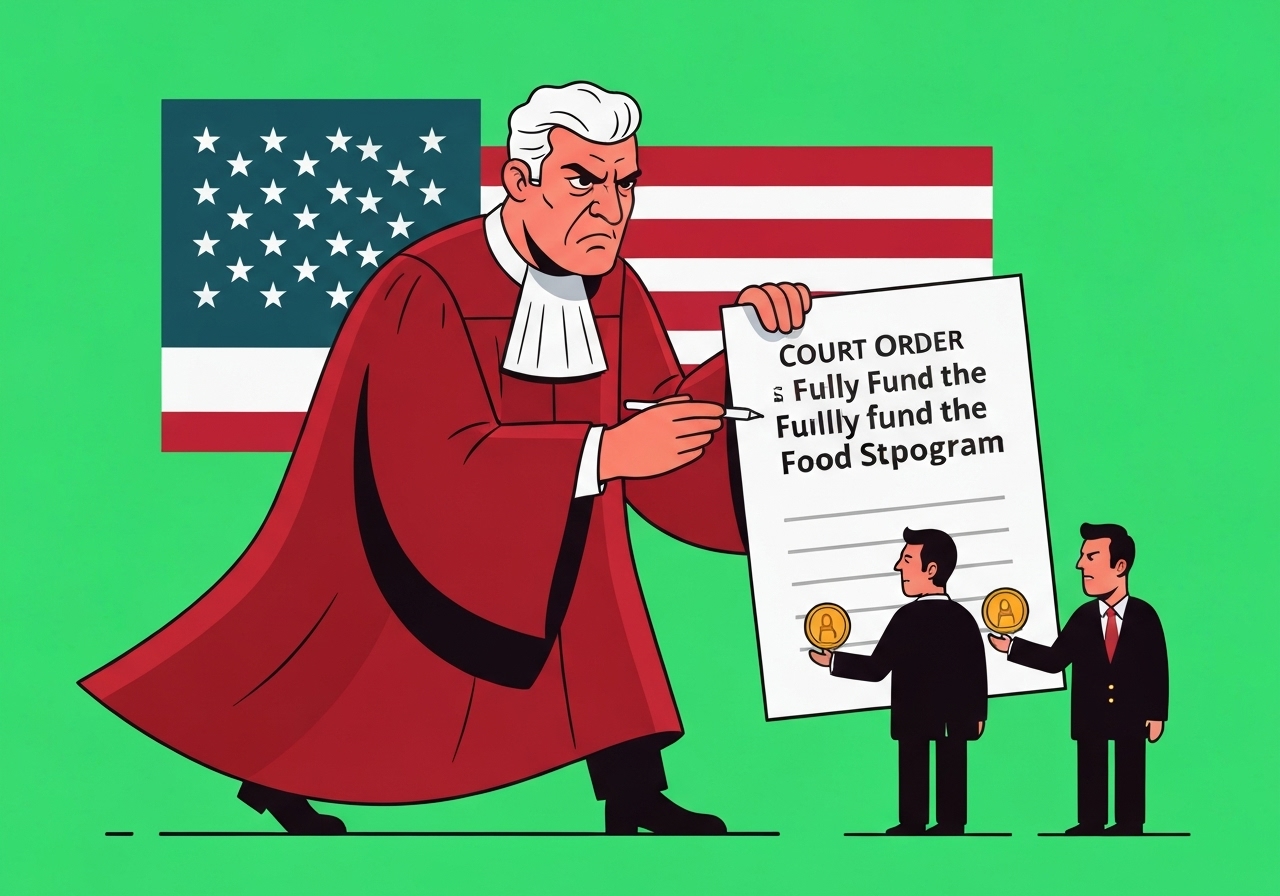
Lead: On 7 November 2025 a federal judge in Rhode Island, John J. McConnell Jr., ordered the Trump administration to secure funding to fully pay Supplemental Nutrition Assistance Program (SNAP) benefits for November for roughly 42 million low-income Americans by the court deadline. The ruling rebuked an administration plan to provide only partial payments during the federal government shutdown, warning that reduced aid would cause “needless suffering.” The decision arrived as the shutdown entered its 38th day and as lawmakers continued negotiations with no immediate resolution.
Key Takeaways
- The Rhode Island district judge ordered full SNAP funding for November by 7 November 2025, affecting about 42 million recipients nationwide.
- The administration had proposed a partial, reduced-payment approach for November; the judge said that approach risked “irreparable harm.”
- Feeding America warned that one in eight people in the U.S. currently struggle with food insecurity, underscoring demand pressure on food banks.
- The federal shutdown extended to its 38th day, complicating agency operations and prompting judicial intervention on benefit flows.
- The FAA directed reductions at about 40 major airports, with flight cuts starting at 4% and rising toward 10%, potentially cancelling roughly 1,800 flights and 268,000 seats (Cirium estimate).
- House Democrat Nancy Pelosi, aged 85, announced she will not seek re-election in 2026 after 20 terms, prompting an early contest for party leadership roles.
- Tesla shareholders approved a $1tn compensation package for Elon Musk; analysts note the size exceeds the GDP of several mid-sized countries.
Background
The U.S. federal government entered a partial shutdown after Congress and the White House failed to reach agreement on funding, forcing many federal operations to run with limited resources. SNAP payments are federally funded but administratively distributed by states; disruptions arise when Treasury or USDA funding mechanisms are constrained during budget impasses. Courts have periodically been asked to adjudicate benefit shortfalls when administrative decisions risk immediate public harm.
Historically, judges have intervened when funding gaps produce demonstrable hardship — particularly for programs affecting basic needs like food and housing. Advocacy groups and food banks frequently see demand spikes during economic stress and political stalemates; Feeding America and other nonprofits maintain networks that can stretch resources but warn of overload when federal assistance is reduced. The current shutdown—reported as the longest on record at 38 days—has amplified those concerns.
Main Event
On 7 November 2025, District Judge John J. McConnell Jr. issued an order requiring the administration to find money to fully fund SNAP benefits for November. The judge reviewed evidence submitted by states and advocacy groups showing likely spikes in hunger and food bank demand if benefits were reduced. He described the projected outcomes as constituting “irreparable harm,” endorsing expedited relief for affected recipients.
The administration had indicated a plan to deliver only partial SNAP payments for November while the shutdown continued, a move officials framed as a temporary measure in the absence of full appropriations. The judge rejected that rationale for November, emphasizing the immediate human impact and ordering a funding solution by the court deadline. The ruling did not resolve longer-term appropriations disputes but compelled the executive branch to prioritize benefit payments.
The order arrives amid broader service disruptions linked to the shutdown. The Federal Aviation Administration issued guidance requiring flight reductions at about 40 busy airports to maintain safety while federal staffing is stretched. Airlines began implementing cuts that industry data (Cirium) estimates could reach 1,800 flights and roughly 268,000 seats across the affected network, beginning at 4% reductions and rising toward 10%.
Analysis & Implications
The judge’s intervention highlights the judiciary’s role as a backstop when executive decisions risk immediate public harm. Ordering full SNAP payments for November addresses an acute, time-bound need, but it does not solve structural funding gaps that persist while the shutdown continues. If the shutdown extends, similar orders or ad hoc remedies may be required for other programs with direct human impacts.
Practically, directing the administration to find funds forces reprioritization within limited resources or the identification of emergency transfer mechanisms. That path can relieve immediate hunger risks but may generate accounting or legal questions about reallocation of funds across agencies. States and nonprofit providers will still face operational strain as cash flow timing and local distribution logistics adjust to court-mandated changes.
The FAA-directed flight reductions illustrate how the shutdown’s ripple effects extend beyond direct benefit programs to infrastructure and commerce. Even modest percentage cuts at major hubs can cascade into delays, cancellations and lost capacity across airline networks. Economically, this can depress business travel, cargo throughput and local tourism revenues while amplifying consumer inconvenience during a holiday travel window.
Comparison & Data
| Item | Figure / Detail |
|---|---|
| SNAP recipients affected | ~42 million people (nationwide) |
| Shutdown length (at time of report) | 38 days |
| Airports with reductions | ~40 major airports |
| Planned flight reductions | 4% rising to 10% |
| Estimated flights/seats affected | Up to ~1,800 flights / ~268,000 seats (Cirium) |
The table aggregates figures cited in court filings, industry notices and analytics estimates. These numbers illustrate the scale of immediate human need (SNAP) and operational impacts (aviation). They should be read as snapshots tied to the specific November payment window and the current span of the shutdown; both sets of figures could change if negotiations or administrative actions shift.
Reactions & Quotes
Advocates and experts responded quickly after the judge’s order, framing it as a necessary check on policies that would have left many without full benefits.
“The evidence shows that people will go hungry, food pantries will be overburdened, and needless suffering will occur.”
Judge John J. McConnell Jr.
Food-security organizations emphasized the scale of need and the operational strain on charities.
“One in eight people in our country right now don’t have enough to eat.”
Linda Nageotte, Feeding America (nonprofit)
Industry and political figures framed the aviation cuts and broader disruptions as consequences of the funding standoff.
“Thanks, guys.”
Elon Musk, in response to Tesla shareholder vote (brief remark)
Unconfirmed
- Whether individuals killed in the recent Caribbean strike were definitively drug traffickers remains contested in independent reporting and has not been fully corroborated in open-source investigations.
- Details surrounding the death of the Dallas Cowboys defensive end remain under local police review; official cause and contributing factors have not been publicly finalized.
- Potential successors to Nancy Pelosi and the final field of candidates for her seat are still emerging; nominations and formal announcements remain incomplete.
Bottom Line
The court’s order forcing full November SNAP payments is a time-limited remedy that prioritizes immediate human needs over the procedural calculus of budget negotiations. It underscores judicial willingness to intervene where government action — or inaction — presents an imminent risk to millions of people who rely on monthly benefits for basic sustenance.
While the order alleviates one near-term pressure point, it does not end the shutdown or resolve the broader fiscal and policy disputes driving these disruptions. Lawmakers and the administration still face decisions with wider economic and operational consequences, from air travel to federal program continuity; absent a congressional appropriations agreement, similar crises may recur.
Sources
- The Guardian (news report) — original coverage and compilation of developments.
- Feeding America (nonprofit) — statements and data on food-bank demand and food insecurity.
- Federal Aviation Administration (FAA) (U.S. federal agency) — advisories on air traffic reductions during the shutdown.
- Cirium (aviation analytics firm) — estimates of flight and seat impacts from scheduled reductions.
- Office of Representative Nancy Pelosi (official congressional site) — announcements regarding career plans and public statements.