
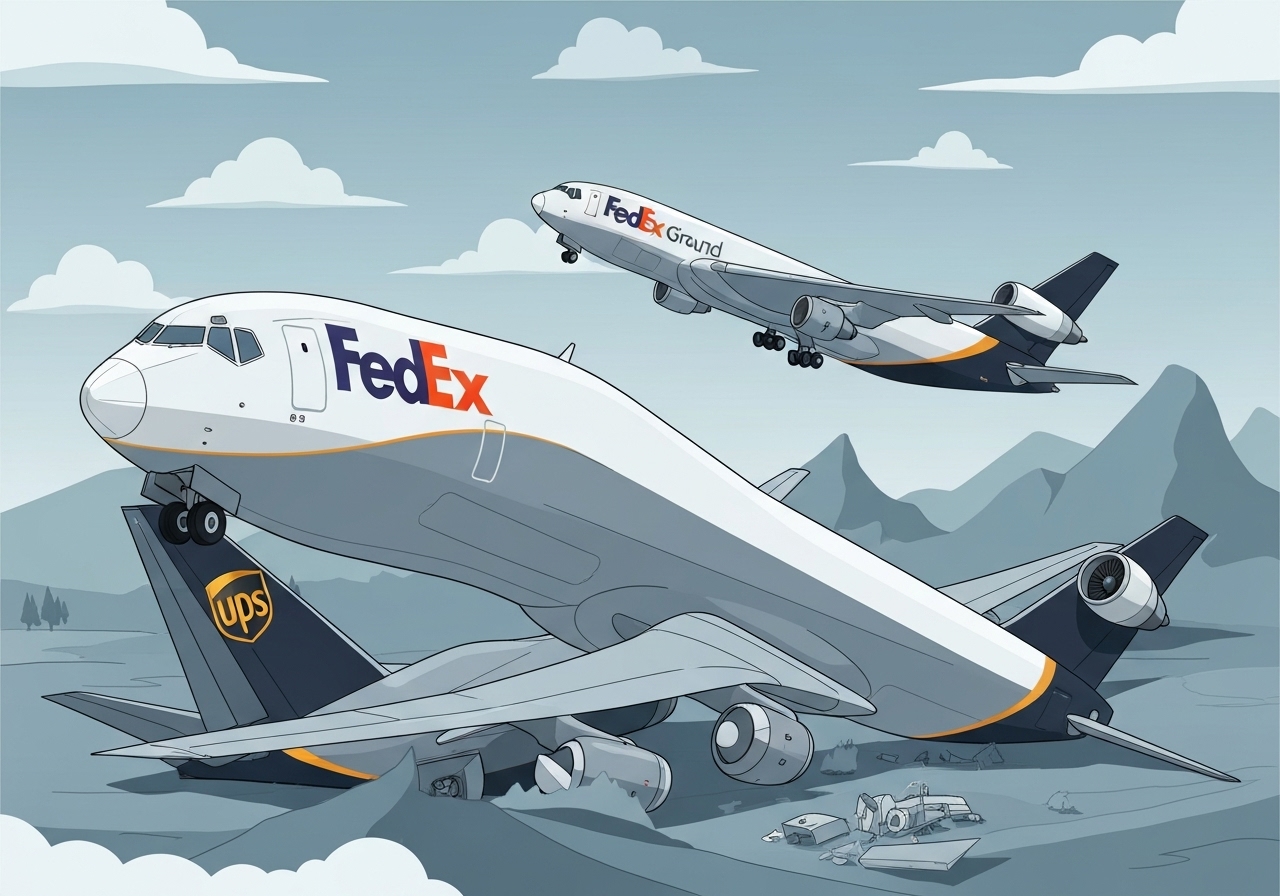
Lead: On Nov. 8, 2025, UPS and FedEx announced they were temporarily grounding their MD-11 cargo aircraft following a deadly crash in Louisville, Kentucky. The move came after Boeing, which now owns the MD-11 design, urged operators to suspend MD-11 flights while it conducts further engineering analysis. The decision follows a Nov. 5 crash shortly after takeoff from Muhammad Ali International Airport that killed three crew members and 11 people on the ground. National investigators reported that the left engine separated from the wing, prompting a multiagency probe and immediate fleet precautions by carriers.
Key Takeaways
- On Nov. 8, 2025, UPS and FedEx grounded their MD-11 freighters after Boeing recommended suspending operations pending analysis.
- The crash occurred on Nov. 5 at Muhammad Ali International Airport in Louisville, Kentucky; three pilots and 11 people on the ground were killed.
- The National Transportation Safety Board (NTSB) reported separation of the aircraft’s left engine from the wing as a notable evidence point under investigation.
- About 70 MD-11 freighters remain in service worldwide; FedEx operates 28 MD-11s, roughly 4% of its fleet.
- UPS said MD-11s represent about 9% of its fleet; both carriers have activated contingency plans to limit service disruption.
- Western Global Airlines, the third operator of MD-11 freighters, had not provided a public response by the evening of Nov. 8.
- Boeing described the grounding as a precautionary step while it performs additional engineering analysis on the type.
Background
The MD-11 was developed by McDonnell Douglas and entered service in the 1990s; Boeing acquired McDonnell Douglas later that decade and inherited the MD-11 type. While the MD-11 has been used extensively in cargo service for decades, the design is older than many modern freighters and is now operated mainly by a small group of cargo carriers. Over its service life the MD-11 has been involved in several high-profile incidents, but it also has a long record of routine cargo operations across global logistics networks.
Cargo carriers value the MD-11 for its payload and range characteristics, which fit certain transcontinental and intercontinental routes. Operators adapted MD-11s for freighter use as passenger demand declined for that type; many remaining airframes have been retrofitted and maintained under long-term programs. Regulators and carriers maintain oversight through scheduled inspections, mandatory reporting and airworthiness directives when concerns arise, creating multiple layers of safety review before aircraft are returned to service after groundings.
Main Event
On Nov. 5, a UPS MD-11 departed Muhammad Ali International Airport in Louisville and crashed moments after takeoff. Emergency responders found that the aircraft’s left engine had detached from the wing, a condition the NTSB highlighted early in its preliminary findings. The crash resulted in the deaths of the three-person flight crew and 11 people on the ground, and it triggered an immediate safety review by investigators and operators.
Following initial disclosures from investigators, Boeing recommended that the three operators of MD-11 freighters suspend flight operations while the manufacturer conducts further engineering analysis. UPS and FedEx each issued statements late on Nov. 8 saying they would temporarily ground their MD-11 fleets “out of an abundance of caution” and activate contingency plans to reduce disruptions to cargo flows. Western Global Airlines had not responded to media requests that evening.
Operationally, the grounding affects a minority of each carrier’s capacity but touches long-haul and high-volume routes where MD-11s are commonly scheduled. FedEx confirmed it operates 28 MD-11s (about 4% of its fleet) and said it would reassign cargo to other aircraft and partners. UPS said MD-11s are approximately 9% of its fleet and that it would use alternate aircraft and routing to maintain service levels.
Analysis & Implications
The immediate implication is logistical: carriers must reallocate cargo and adjust schedules while the grounding is in effect. Because MD-11s are used primarily on select long-range routes, carriers can cover many flights with other types or through wet-leases, but capacity constraints and timing could increase costs and delay deliveries in the short term. Shippers and supply chains that count on overnight and next-day freight between major hubs will be most sensitive to temporary shortfalls.
From a safety and regulatory perspective, the NTSB investigation and Boeing’s engineering review will be central. If the engine separation stems from a structural or maintenance-related cause, regulators may issue airworthiness directives requiring inspections, repairs or parts replacement. Conversely, if the event proves to be a unique mechanical failure or maintenance lapse specific to one airframe, remedial steps could be narrower but still influential for operator maintenance protocols and inspection frequencies.
Financially, the grounding could produce modest but immediate costs: grounding swaps, lease or crew repositioning, and potential compensatory logistics. Insurers and lessors will monitor the NTSB findings closely. In the longer term, repeated or systemic findings could accelerate retirement plans for older freighters and push operators toward newer, more common types—altering secondary markets for used cargo aircraft.
Comparison & Data
| Operator | MD-11 Fleet | Share of Operator Fleet |
|---|---|---|
| FedEx | 28 aircraft | ≈4% |
| UPS | Not specified (MD-11 portion ~9%) | ≈9% |
| Western Global Airlines | Portion of remaining MD-11s | Not publicly specified |
| Global total (in service) | ~70 MD-11 freighters | — |
The table summarizes publicly disclosed figures: FedEx’s count (28) and industry estimates of roughly 70 MD-11 freighters still operating. UPS provided only the share of its fleet represented by MD-11s (about 9%) rather than an absolute MD-11 count. Western Global and other smaller operators account for the remainder of the global total. These figures shape how disruptive a full grounding could be and how readily carriers can absorb the aircraft out of service.
Reactions & Quotes
Company and manufacturer statements emphasized caution and cooperative investigation. Boeing framed its recommendation as a temporary safety measure while engineers examine available evidence and data, signaling deference to investigative authorities and a priority on risk mitigation.
“With safety as our top priority, we recommended to the three operators of the MD-11 Freighter that they suspend flight operations while additional engineering analysis is performed.”
Boeing (manufacturer statement)
Both carriers said the grounding is a precaution and that contingency plans are in place to reduce disruption. UPS highlighted immediate steps to reroute freight and maintain customer service levels while authorities investigate.
“Out of an abundance of caution and in the interest of safety, we have made the decision to temporarily ground our MD-11 fleet.”
UPS (company statement)
FedEx similarly described the action as a temporary measure taken on the manufacturer’s recommendation while the company cooperates with investigators and reviews safety procedures.
“Out of an abundance of caution we have made the decision to immediately ground our MD-11 fleet as we conduct a thorough safety review based on the recommendation of the manufacturer.”
Heather Wilson, FedEx spokeswoman
Unconfirmed
- The precise mechanical cause of the left-engine separation has not been established; investigators have not released a final root-cause determination.
- It is unconfirmed whether maintenance history, a design issue, a component failure or foreign-object damage precipitated the separation.
- Western Global Airlines’ specific grounding decision and MD-11 count remained unconfirmed as of Nov. 8, 2025.
Bottom Line
The immediate grounding by UPS and FedEx is a precautionary response to a rare and tragic accident in Louisville that killed 14 people and revealed an apparent engine separation. Given the MD-11’s smaller presence in modern cargo fleets, the operational impact is manageable in the near term but will impose extra costs and require logistical adjustments for time-sensitive shipments. The priority for airlines, investigators and manufacturers is to identify the root cause quickly so airworthiness directives or operator-specific fixes can be applied and normal operations can resume with documented safeguards.
Longer term, the episode highlights how aging aircraft types remain integral to global cargo capacity and why robust maintenance oversight, transparent data-sharing and manufacturer cooperation are essential. Stakeholders should watch for the NTSB’s upcoming technical reports and any Boeing engineering bulletins that could shape inspection requirements across the MD-11 fleet and influence operators’ fleet-planning decisions.
Sources
- The New York Times — News report detailing carrier statements and initial investigation (media).
- National Transportation Safety Board — U.S. federal accident investigation agency (official).
- Boeing — Manufacturer statement and engineering resources (official).
- UPS — Company statements and press releases (official).
- FedEx — Company statements and press releases (official).