
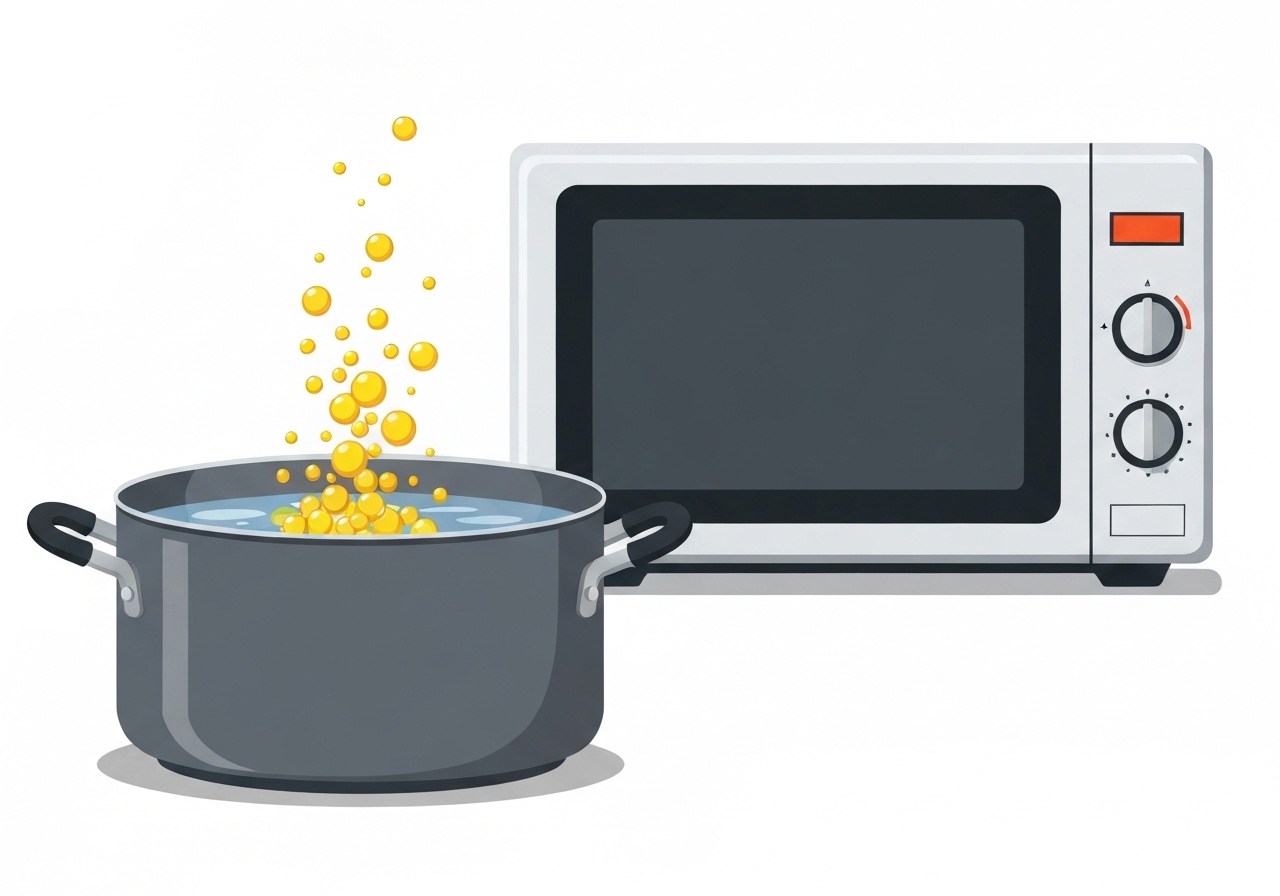
Lead: When water is heated on a stove, the first visible sign of approaching a boil is a swarm of small bubbles that grow and merge until a rolling boil at 212 degrees Fahrenheit (100 degrees Celsius). In a microwave, however, that familiar sequence often vanishes: water can heat above its nominal boiling point without producing bubbles, then suddenly erupt when disturbed. Researchers attribute the difference to how bubbles form (nucleation) and the role of surface tension, together with the distinct heating patterns of stovetops versus microwaves. The mismatch can produce superheated liquid — sometimes up to about 36 F (20 C) higher than 212 F — and a sudden, forceful release of vapor.
- Boiling is a phase change driven by chemical potential: at or above 212 F (100 C) water vapor is thermodynamically favored over liquid water.
- Cavities and surface irregularities act as nucleation sites that let bubbles begin; smooth, clean containers reduce these sites and raise the energy barrier to bubble formation.
- Surface tension imposes an energetic cost on the gas-liquid interface; very small bubbles are unstable because surface area relative to volume is large.
- On a stovetop, heat is delivered from the bottom, creating hot spots and promoting edge nucleation; on a microwave, energy penetrates the volume and heats more uniformly, removing local hotspots.
- Because microwaves suppress nucleation, water can superheat by roughly 36 F (20 C) above the normal boiling point before a violent bubble forms and releases stored energy.
- Scientists quoted include Jonathan Boreyko (Virginia Tech) and Mirko Gallo (Sapienza University of Rome), who explain the balance of chemical potential, surface tension and nucleation.
- Superheating is not unique to water: liquids with higher surface tension show stronger effects, and any smooth, uniform heating can produce similar risks.
Background
Boiling in thermodynamic terms occurs when molecules prefer the gas phase to the liquid phase; at 212 F (100 C) that preference flips for pure water at sea level. But thermodynamic favorability alone does not ensure immediate bubble formation. To become vapor, a pocket of gas has to be created inside the liquid, and creating that pocket costs energy because of the new gas-liquid surface.
Surface tension is the property of the liquid that penalizes creating surface area; a tiny spherical bubble has a large surface-area-to-volume ratio, and the surface energy cost can outweigh the thermodynamic advantage of forming vapor. That means water often must exceed the formal boiling point to supply the activation energy needed for a bubble of stable size to nucleate and grow.
Main event
On a stove, heat flows from the pot to the water at the bottom, establishing temperature gradients and localized hot spots. Those hot spots and the roughness of pot walls provide preferential sites where small gas pockets can form against an edge or crevice; a half-spherical bubble attached to a boundary has less surface area for the same gas volume and therefore a lower energy cost to nucleate.
Microwave heating differs: electromagnetic waves couple to water molecules and deliver energy throughout the volume rather than from one contact surface. In a smooth glass cup or bowl this produces a very even temperature distribution with few strong local hotspots and minimal irregular nucleation sites, so bubbles do not form at the usual threshold.
Without early nucleation, the liquid can cross the boiling temperature and continue warming in a metastable, superheated state. Disturbing the container — inserting a spoon, lifting the cup, or even a small vibration — can trigger the sudden formation of a large vapor cavity and an explosive release of energy: the classic microwave scalding event.
Analysis & implications
The physical explanation divides into two linked constraints: thermodynamics (the chemical potential that favors vapor above 212 F /100 C) and kinetics (the energy barrier associated with creating a gas-liquid interface). Surface tension determines how costly that interface is, and nucleation geometry (edge-attached versus free spherical bubbles) changes the barrier height materially.
Practically, this explains why cold or impure water boiled on a stovetop shows abundant bubbling earlier: dissolved gases and tiny impurities provide many nucleation seeds. Conversely, de-gassed, very pure water in a smooth container is a prime candidate for superheating in a microwave.
Safety implications are immediate for household and lab settings. Because superheated liquid retains significant latent energy, an abrupt bubble formation can eject scalding liquid. Simple mitigations — heating with a non-smooth or intentionally seeded container, placing a wooden stir stick or a nonmetallic object in the cup, or letting microwaved water stand briefly before handling — reduce the risk by offering nucleation sites.
From an engineering perspective, the interplay between heating mode and nucleation is relevant for microwave-assisted chemical reactions, industrial drying, and culinary techniques: uniform volumetric heating can be an advantage, but designers and operators must account for reduced nucleation and potential runaway vapor events.
| Parameter | Stovetop (conductive) | Microwave (volumetric) |
|---|---|---|
| Primary heating pattern | Bottom-up, local hotspots | Bulk, more uniform |
| Typical nucleation sites | Wall crevices, impurities, dissolved gas | Few in smooth glass; reduced impurities effect |
| Superheating potential | Small — usually near 212 F (100 C) | Can reach ~36 F (20 C) above 212 F |
| Common container types | Metal pots, rough surfaces | Glass or smooth ceramics |
The table summarizes how heating geometry and container surface interact to alter the ease of bubble formation. The microwave column shows elevated superheat risk when nucleation sites are scarce; the stovetop column highlights why edge nucleation typically prevents large metastability.
Reactions & quotes
The boiling point means that above that temperature molecules are happier as vapor, but making a bubble requires energy to create the gas-liquid interface, so boiling can be delayed.
Jonathan Boreyko, Virginia Tech (fluid dynamics researcher)
Dissolved gases, impurities and container surfaces supply nucleation points that lower the energy barrier for bubble formation, which is why bubbles usually start at the pot boundary.
Mirko Gallo, Sapienza University of Rome (fluid dynamics researcher)
Unconfirmed
- The frequently cited maximum superheat of about 36 F (20 C) is an approximate upper bound from laboratory observations and will vary with container, water purity and microwave power.
- The exact role and threshold of dissolved gases depend on water history (how recently it was boiled and cooled) and are often not reported in casual home experiments.
- Claims that a specific cup or brand of container will always cause superheating are not supported without controlled testing of surface roughness and wetting behavior.
Bottom line
The absence of early bubbles in microwaved water is a predictable consequence of how bubbles form: surface tension creates an energy penalty for tiny bubbles, and uniform, volumetric microwave heating removes the local hotspots and rough surfaces that normally seed nucleation. That combination makes superheating possible and explains sudden, hazardous eruptions when the liquid is disturbed.
For users, the simplest precautions are effective: introduce a nucleation aid (a wooden stir stick or a nonmetallic object), avoid overheating, and allow a short rest after microwaving before inserting utensils or pouring. In scientific and industrial contexts, designers must consider container texture and heating modality to prevent unintended metastable states.
Sources
- Live Science — journalism article summarizing interviews with researchers and background on superheating.
- Virginia Tech — academic institution; source for Jonathan Boreyko affiliation and research specialty (fluid dynamics).
- Sapienza University of Rome — academic institution; source for Mirko Gallo affiliation and expertise (fluid dynamics).