
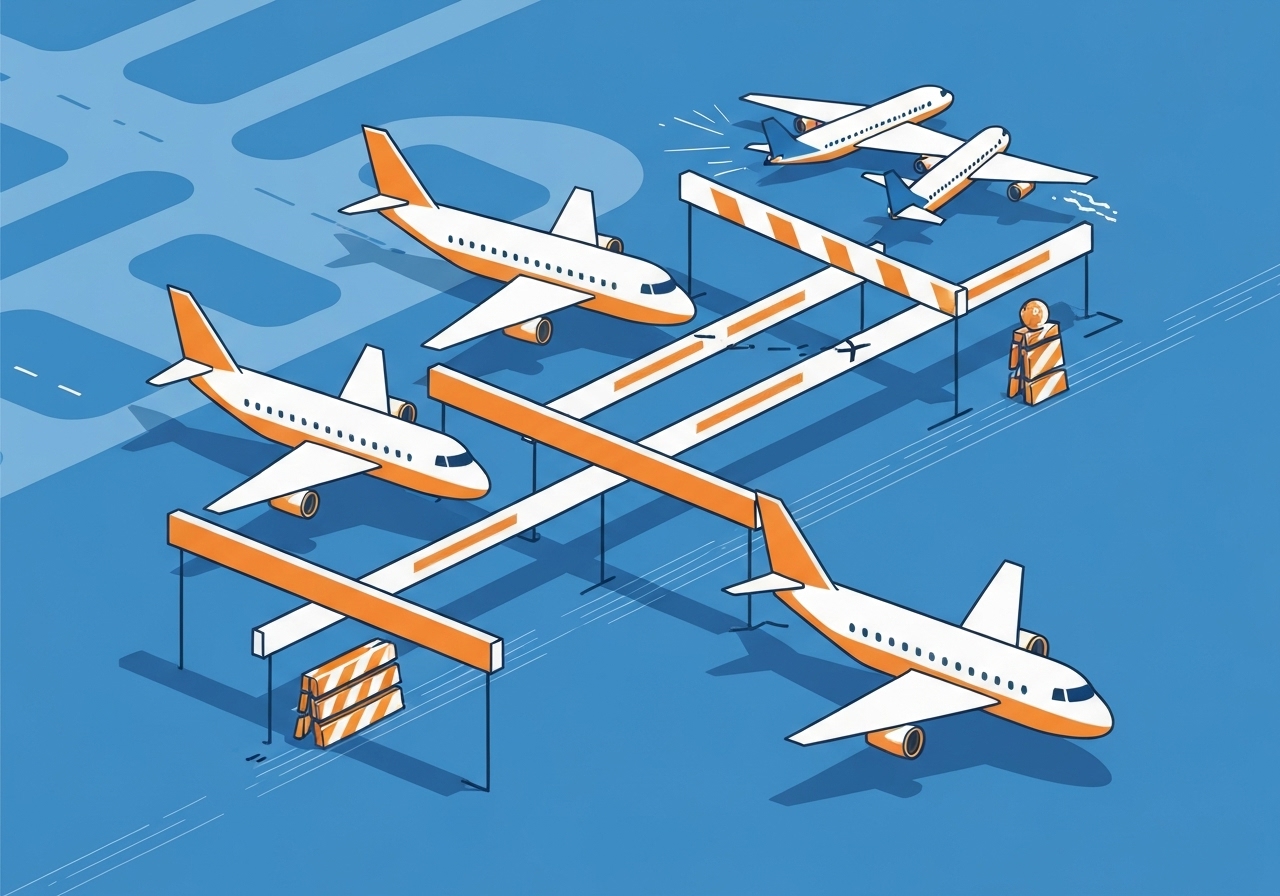
Lead: Federal restrictions on operations at the nation’s busiest airports, imposed by the Federal Aviation Administration beginning Friday, Nov. 7, 2025, produced contained cancellations over the weekend but are scheduled to deepen this week. The FAA ordered a 4 percent cut at 40 major airports initially, with limits set to climb to 10 percent by the coming Friday, raising the risk of wider disruption as the Thanksgiving travel peak approaches. Major U.S. carriers and their regional partners canceled hundreds of flights from Friday through Sunday, affecting thousands of passengers while airlines scrambled to rebook travelers and reposition crews and aircraft. The coming days will test carriers’ ability to manage growing complexity and protect revenue and service levels ahead of a forecasted 31 million-person travel surge around the holiday.
Key Takeaways
- The FAA directed a 4 percent cut in flights at 40 busiest U.S. airports starting Friday, Nov. 7, 2025; that ceiling is planned to rise to 10 percent by the following Friday.
- American Airlines canceled more than 325 flights Saturday, about 6 percent of its schedule; United canceled over 210 flights (about 5%); Delta cut roughly 175 flights (more than 4%), per Cirium.
- Regional operators bore a large share of reductions: SkyWest had roughly 180 flights removed for a given day and Republic about 100, amounts equal to about 9 percent and 12 percent of their daily schedules respectively.
- United reported roughly half of affected customers were rebooked onto flights that departed within four hours of their original times; early-November low load factors helped absorb many displaced travelers.
- Industry groups say more than 3.5 million passengers experienced delays or cancellations linked to controller staffing limits since the federal shutdown began in early October.
- Fitch Ratings warned that approaching Thanksgiving travel will leave limited room to reaccommodate passengers, raising customer-service costs and revenue losses.
Background
Air traffic management in the United States depends on a staffed and rested workforce of air traffic controllers, and the FAA says recent staffing constraints have strained safe operations. The agency exercised authority to reduce scheduled flights at the busiest airports to relieve pressure on controllers who, amid the federal government shutdown that began in early October, worked without pay. The FAA characterized the move as an exercise in safety management rather than a punitive restriction.
Airlines and trade groups counter that the timing of limits will intensify disruption as the Thanksgiving travel period—one of the busiest of the year—approaches, with about 31 million travelers expected over approximately a dozen peak days. Carriers contend they can manage limited cuts through targeted schedule adjustments, but the industry notes margins for rebooking and repositioning shrink sharply when limits grow and load factors rise.
Main Event
Beginning Friday, Nov. 7, carriers implemented FAA directives by selectively trimming flights at hubs and other constrained airports. Over the initial weekend many cancellations were concentrated among American, Delta and United, which collectively dominate schedules at several of the 40 named airports. Airlines used software tools and crisis teams to identify flights that could be cut while preserving aircraft and crew flows, prioritizing higher-capacity trunk routes over small regional links.
Regional provider SkyWest was assigned roughly 180 of the canceled flights on a busy day, and Republic Airways accounted for about 100 cancellations; those figures equated to approximately 9 percent and 12 percent of the carriers’ daily schedules respectively. Because regional jets typically seat 50–75 passengers, carriers focused some reductions on those thin routes while keeping most larger city-to-city flights in service. For example, Delta removed certain single-frequency routes, including a one-off trip between Asheville, North Carolina, and New York.
Airlines limited passenger impact in part because early November demand is lighter than peak-Thanksgiving travel, enabling many customers to be rebooked onto nearby flights. United said about half of weekend customers affected were placed on flights departing within four hours. Nonetheless, hundreds of flights were scrapped each day at major hubs including Atlanta, Dallas, Denver, Chicago and New York, disrupting itineraries and prompting some travelers to seek alternate modes of transport.
Analysis & Implications
The FAA’s stepwise caps reflect a safety-first posture: reducing operations can lower controller workload and the chance of error in a stressed system. But the policy’s operational mechanics ripple through airline networks. Every canceled flight changes aircraft and crew positioning, which can create cascading mismatches across subsequent rotations. As limits rise toward 10 percent, carriers will face a steeper optimization problem with fewer robust options for re-accommodating displaced passengers.
Economically, deeper cancellations in the run-up to Thanksgiving risk materially higher revenue loss and customer-service expense. Fitch warned that the holiday leaves little slack for rebookings, so carriers will likely incur both lost fare revenue and elevated costs for hotels, ground transport and passenger care. The financial pressure is unequal: large network carriers may absorb some losses by redeploying aircraft and leveraging scale, while regional contractors and smaller operators could see proportionally larger operational and cash-flow strains.
Politically and operationally, the episode has amplified calls to resolve the underlying federal shutdown. Airlines and industry groups have urged Congress to restore pay and staffing levels to normalize airspace capacity. Lawmakers are divided: some request the FAA share data justifying the caps; others, including the head of the National Transportation Safety Board, have publicly endorsed the FAA’s risk-management decision.
Comparison & Data
| Operator | Approx. Cancellations (single busy day) | Share of Daily Schedule |
|---|---|---|
| American Airlines | 325+ | ~6% |
| United Airlines | 210+ | ~5% |
| Delta Air Lines | ~175 | ~4% |
| SkyWest (regional) | ~180 | ~9% |
| Republic Airways (regional) | ~100 | ~12% |
The table above uses Cirium tallies and carrier statements reported during the Nov. 7–9 weekend. It shows how nominal percentage cuts translate into differing operational impacts: a 5–6 percent reduction at a major network carrier affects many more passengers than a similar percentage at a regional operator because aircraft sizes and route densities differ. Early-November lighter loads helped airlines place many displaced passengers on nearby flights; that buffer will shrink as passenger volumes rise toward Thanksgiving.
Reactions & Quotes
Airlines’ operations leaders described the logistical complexity of canceling flights and moving crews and equipment. JetBlue’s operations chief warned that each cancellation raises the chance of misaligned crews and aircraft later in the day, complicating recovery plans.
Every flight removed increases complexity for crew and equipment positioning and for subsequent rotations.
Steve Olson, JetBlue head of system operations and airports
Industry trade groups framed the situation as a consequence of the federal shutdown, urging an urgent political resolution. Airlines for America pointed to millions of impacted passengers and pressed Congress to reopen the government to restore normal operations.
We implore Congress to act with extreme urgency to get the federal government reopened, get federal workers paid and get our airspace back to normal operations.
Airlines for America (trade group)
Safety officials and at least one federal investigator supported the FAA’s approach as routine safety management under stress conditions. The NTSB chair described the move as consistent with managing systemic safety pressures rather than a discretionary restriction.
This is safety management, the very foundation of our aviation system, and it’s the right thing to do.
Jennifer Homendy, chairwoman, National Transportation Safety Board
Unconfirmed
- Some media reports speculated that limits might exceed 10 percent later in the month; the FAA has not publicly committed to that level and no formal higher cap has been announced.
- Rumors circulated that specific long-haul international services would be targeted; carriers and the FAA said most international and hub-to-hub flights were being preserved, but details vary by airport and carrier.
Bottom Line
The FAA’s incremental flight cuts that began Nov. 7, 2025 were designed to reduce controller workload and preserve safety during a period of unusual personnel strain caused by the federal shutdown. Over the initial weekend airlines managed to limit customer disruption by prioritizing cuts on lower-demand, regional services and by leveraging lighter early-November loads to rebook travelers quickly.
But the scheduled increase in caps to 10 percent by the coming Friday will sharply reduce the system’s flexibility exactly as demand rises for Thanksgiving. That combination increases the risk of more widespread cancellations, higher rebooking costs and passenger inconvenience. The most immediate lever to reduce this risk remains a political resolution that restores pay and staffing for air traffic control personnel; absent that, airlines and travelers should expect more operational pain in the weeks ahead.
Sources
- The New York Times — media report summarizing FAA action and carrier data
- Cirium — aviation data firm referenced for daily cancellation counts
- Federal Aviation Administration — official agency guidance and news on flow restrictions (official)
- Airlines for America — industry trade group statements on passenger impacts (industry)
- Fitch Ratings — credit rating agency research note on holiday impacts (ratings agency)
- SkyWest Airlines — carrier statements on managed cancellations (carrier)