
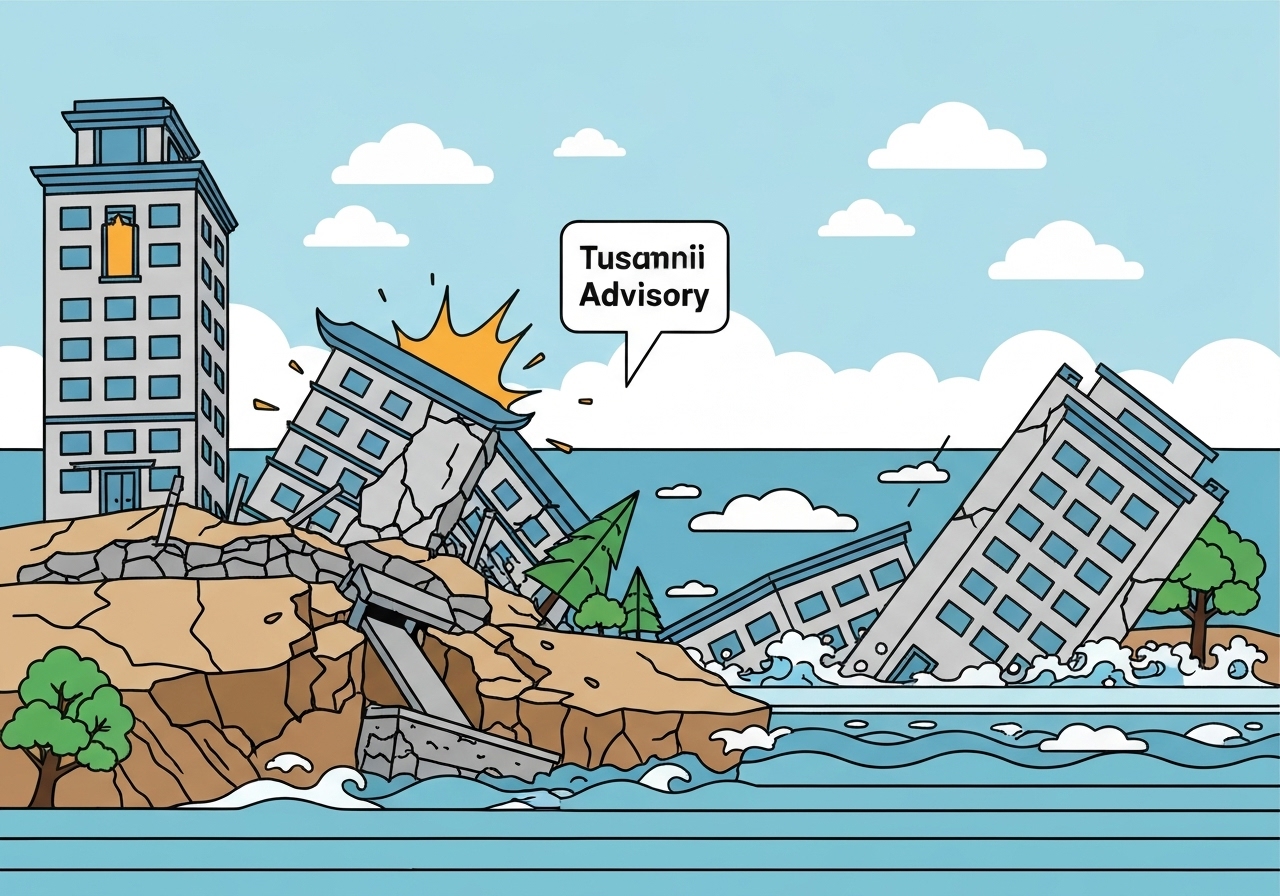
Lead
On Nov. 9, 2025, a magnitude 6.9 earthquake occurred off the coast of Iwate Prefecture at 5:03 p.m. Japan time, with a depth of about 20 kilometers. The Japan Meteorological Agency (JMA) issued tsunami advisories for parts of the northern coast and later downgraded several to forecasts; the advisory was lifted roughly three hours after the initial event. There were no immediate reports of casualties, structural damage or abnormalities at two nearby nuclear power plants. Local authorities warned residents to avoid coastal areas as aftershocks and further sea-level changes remained possible over the coming week.
Key Takeaways
- The main quake registered magnitude 6.9 and struck at 5:03 p.m. Japan time on Nov. 9, 2025, at a depth of about 20 km (12 miles).
- JMA initially warned of tsunami heights up to 3 meters (9 feet) in some locations but issued targeted advisories of up to 1 meter (3 feet) before downgrading many to forecasts of about 0.2 meters (8 inches).
- Measured tsunami arrivals included about 10 cm (4 inches) at Ofunato, Ominato port, Miyako and Kamaishi, and peaks of roughly 20 cm (8 inches) near Kuji and later Ofunato.
- No immediate reports of injuries or confirmed structural damage; two nearby nuclear plants reported no abnormalities in initial checks.
- JR East reported temporary delays to bullet train services in the affected region.
- JMA advised the region remained at elevated seismic risk for about a week, with the next two to three days considered especially volatile.
- Northeastern Japan remains sensitive to large quakes, recalling the 2011 Tohoku disaster that caused nearly 20,000 deaths and severe damage at Fukushima Daiichi.
Background
Northeastern Honshu, including Iwate Prefecture, occupies a tectonically active sector of the Pacific “Ring of Fire” where the Pacific Plate dives beneath the Okhotsk and Eurasian plates. That subduction boundary makes the coast prone to both large earthquakes and tsunami generation. The region’s most devastating recent event occurred on March 11, 2011, when a magnitude-9.0 quake off Tohoku unleashed a massive tsunami that killed nearly 20,000 people and severely damaged the Fukushima Daiichi nuclear plant.
Years after 2011, many residents remain displaced from restricted zones around Fukushima and periodic protests continue over nuclear safety and government response. Local infrastructure and disaster-response systems have been upgraded since 2011, including improved early-warning protocols, but the physical and social scars of the triple disaster—quake, tsunami and nuclear crisis—still shape public risk perception and emergency planning in Iwate and neighboring prefectures.
Main Event
The Japan Meteorological Agency recorded the epicenter offshore of Iwate Prefecture at 5:03 p.m. JST on Nov. 9, 2025. The agency revised the magnitude to 6.9 and set the hypocentral depth at about 20 kilometers (12 miles). Within minutes, JMA issued tsunami advisories for sections of the northern coast where waves up to 1 meter were initially expected; some forecasts briefly warned of possible 3-meter waves before adjustments.
Sea-level sensors registered modest tsunami activity: approximately 10 centimeters at locations including Ofunato, Ominato port, Miyako and Kamaishi, with readings later reaching about 20 centimeters in Kuji and then Ofunato. JMA described the later readings as consistent with downgraded tsunami forecasts indicating slight sea-level changes of roughly 0.2 meters in some areas.
The advisory remained in effect for about three hours before JMA cancelled it, though officials cautioned that aftershocks and additional tsunami waves can occur for several hours after an event. Regional rail operator JR East reported temporary bullet-train delays as a precaution while monitoring infrastructure, and local emergency services stayed on alert while conducting shoreline checks and rapid assessments.
Analysis & Implications
Seismically, a magnitude-6.9 event at 20 km depth is capable of producing strong ground motion near the epicenter but typically generates far smaller tsunamis than much larger megathrust events. The limited observed tsunami heights (decimeters) indicate this quake did not cause the catastrophic ocean displacement seen in the 2011 Tohoku rupture. Still, even small tsunamis can be hazardous near harbors and shorelines due to currents and repeated wave action.
Public reaction to any coastal shaking in northeastern Japan is shaped by the collective memory of 2011. Authorities therefore maintain a cautious posture: rapid advisories and conservative messaging prioritize safety and evacuation readiness even when the most severe outcomes are unlikely. That approach reduces immediate risk but can sustain high vigilance and social anxiety for days after an event.
Economically and logistically, short rail interruptions, port checks and coastal closures impose modest immediate costs but are part of routine resilience protocols. The longer-term policy debate—especially around nuclear safety in a seismically active region—may resurface in public forums and local politics, particularly given ongoing displacement and periodic protests in areas affected by the 2011 crisis.
Comparison & Data
| Event / Location | Magnitude | Depth (km) | Observed tsunami |
|---|---|---|---|
| Nov. 9, 2025 — Off Iwate | 6.9 | 20 | 10–20 cm (4–8 in) at local ports |
| March 11, 2011 — Tohoku | 9.0 | ~29 | Several meters to 40+ m in local inundation zones (catastrophic) |
The table contrasts the 2025 Iwate event with the 2011 Tohoku megathrust quake to show scale differences: 6.9 is a strong but far smaller rupture than the 9.0 event in 2011, which produced catastrophic tsunamis. The local tsunami readings on Nov. 9, 2025 were measured in centimeters, consistent with JMA’s downgraded forecasts.
Reactions & Quotes
Authorities and operators emphasized preparedness and surveillance while noting the limited immediate impact.
“We have monitored sea-level changes and there are no reports of anomalies at nearby nuclear facilities,”
Japan Meteorological Agency (briefing)
JMA’s statement accompanied the advisory and subsequent downgrade, underscoring continuous monitoring and the temporary nature of the evacuation warnings.
“Train services were delayed briefly as a safety measure while inspections were completed,”
JR East (operator statement)
JR East framed the service interruptions as precautionary steps to verify track and station safety before resuming normal schedules.
“Aftershocks can continue for days; residents should follow official guidance and avoid coastal areas until alerts are cleared,”
Local disaster-management official
Local officials reiterated routine instructions on evacuation routes, shoreline avoidance and the importance of heeding official notices for the next several days.
Unconfirmed
- Whether the Nov. 9 quake altered long-term stress on faults linked to the 2011 rupture remains unconfirmed and would require detailed seismic analysis.
- Any reports of delayed or unreported localized damage beyond initial rapid checks are still being verified by municipal authorities.
Bottom Line
The Nov. 9, 2025 offshore Iwate earthquake was a significant local seismic event (M6.9, 20 km depth) that produced measurable but modest tsunamis and prompted temporary safety measures. Immediate impacts appear limited—no confirmed injuries, major damage or nuclear abnormalities—but authorities correctly maintained heightened vigilance given the region’s seismic history.
Residents and infrastructure operators should expect elevated seismic activity for days after the event, with continued monitoring by JMA and local agencies. The episode underscores the importance of readiness in northeastern Japan, where strong ground motion and tsunami risk remain persistent realities.