
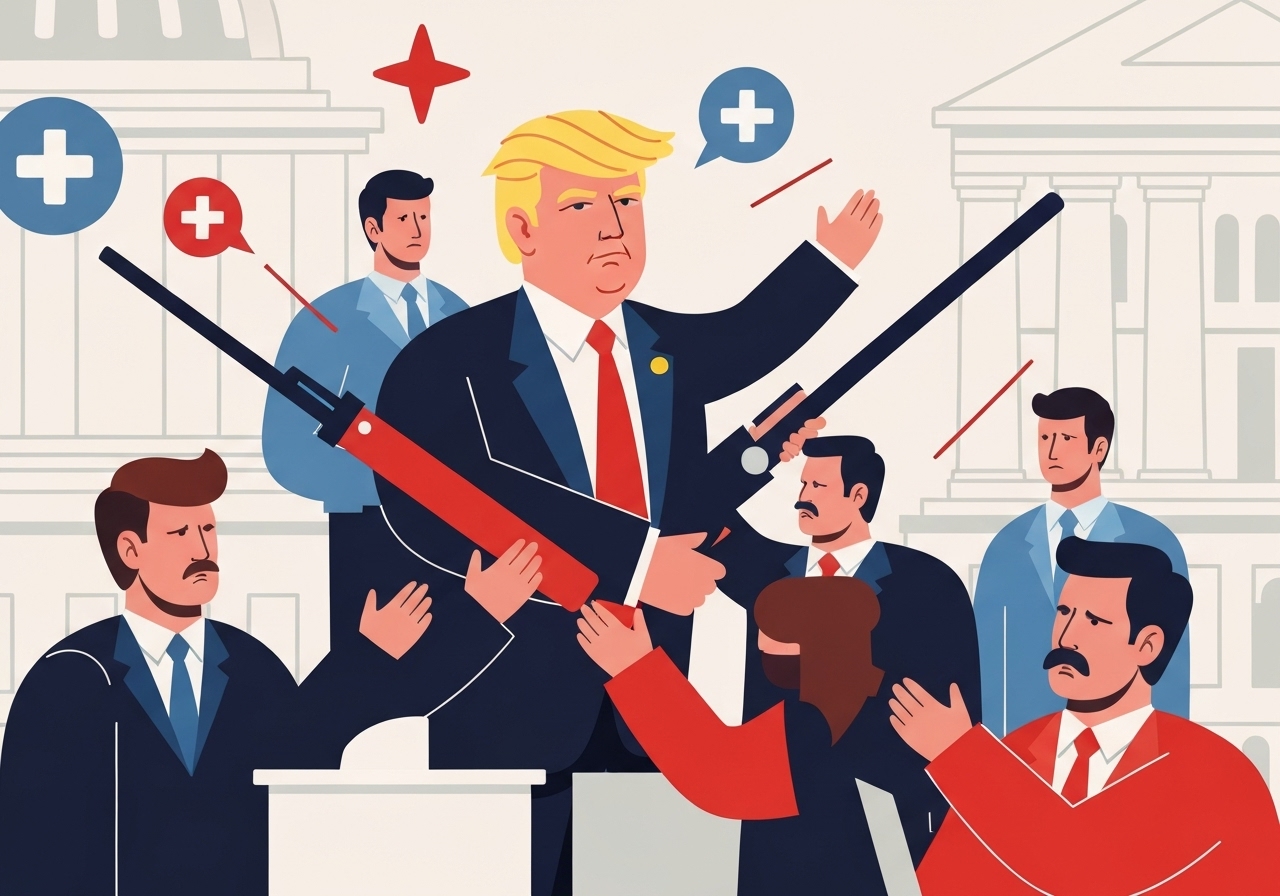
— President Donald Trump escalated his effort to end a government shutdown this weekend by renewing public attacks on the Affordable Care Act and proposing that federal subsidy money flow directly to consumers rather than insurers. Through social media posts, Mr. Trump framed the law’s premium tax credits as a windfall for insurance companies and said he would negotiate a fix “once the Government is open.” Democrats have sought an extension of subsidies as part of a shutdown deal; Republicans have so far resisted, and talks have stalled despite a narrowed Democratic offer. Treasury Secretary Scott Bessent told ABC’s This Week there is no formal proposal before the Senate.
Key Takeaways
- On Nov. 9, 2025, President Trump renewed criticism of the Affordable Care Act (ACA), arguing subsidies have benefited insurers more than consumers.
- Trump said he would work with both parties to redirect funds to individuals “once the Government is open,” tying negotiations to reopening efforts.
- Democrats offered a one-year extension of ACA subsidies on Friday as a concession to end the shutdown; Republicans rejected that offer.
- Trump has pushed options including urging Senate Republicans to end the filibuster, a move Republicans worry could have political blowback.
- Treasury Secretary Scott Bessent stated publicly that no formal plan had been submitted to the Senate as of the ABC interview.
- Senator Lindsey Graham publicly endorsed Trump’s idea on social media, calling the concept “simply brilliant.”
- The Affordable Care Act marked its 15th year since enactment in 2010; critics and supporters disagree on its effects on premiums and insurer profits.
Background
The Affordable Care Act, enacted in 2010, established premium tax credits that lower monthly costs for many marketplace enrollees. Over the past 15 years the law has been a persistent political flashpoint, with Republicans repeatedly pledging repeal or replacement and Democrats defending expanded coverage and subsidies. In 2025 the subsidies remain central to debates over affordability; lawmakers on both sides dispute whether the payments primarily reduce consumer costs or bolster insurer revenue and market stability.
The current partial government shutdown began more than a month ago after Congress failed to agree on funding measures. Negotiations have revolved around health-program concessions, border policy and spending priorities. Democrats sought an extension of ACA premium tax credits as part of a funding package; Republicans and the White House have resisted concessions they view as long-term entitlements absent broader fiscal compromises.
Main Event
Over the weekend President Trump used posts on social platforms to press his argument that ACA subsidies should be redirected away from insurers and toward individuals. He repeated claims that premiums and insurer share prices have grown substantially since the law’s passage and framed the current shutdown as leverage to extract changes. He wrote that he stands ready to “work with both Parties” but conditioned negotiations on the government reopening.
Mr. Trump suggested sending funds directly to people so they could “purchase their own, much better, healthcare,” but offered no detailed mechanism for how those payments would be administered or how they would avoid flowing back to insurance markets. Treasury Secretary Scott Bessent, in an interview on ABC’s This Week, said there was no formal plan presented to the Senate, underscoring the absence of legislative detail behind the president’s proposal.
Democrats on Friday narrowed their demands and offered a one-year extension of subsidies to end the shutdown, a move intended to produce a compromise. Republican congressional leaders declined the offer quickly, keeping the stalemate in place. Separately, Mr. Trump urged Senate Republicans to consider eliminating the filibuster to pass funding with a simple majority, an option GOP senators are wary of because of potential future political consequences.
Analysis & Implications
Tying major health-policy changes to the resolution of a funding standoff elevates political risk. Redirecting subsidies to direct payments would require new administrative rules or legislation and could disrupt insurance markets that rely on subsidies to lower premiums for enrollees. Without a concrete structure, claims that direct payments would meaningfully reduce costs for consumers remain speculative.
Removing or altering the filibuster to pass appropriations or policy riders would have far-reaching implications for Senate norms and the balance of power. Republicans’ hesitation reflects fear that the tactic could be used against them if control of the chamber shifts. The debate highlights a strategic calculation: pursue short-term wins now or preserve institutional protections that protect a minority party’s leverage later.
Economically, shifting how subsidies are delivered could affect insurer revenue streams, premiums, and the risk pool. If payments were predictable and tied to individuals, insurers might still capture much of the benefit through adjusted pricing unless the policy explicitly changes benefit structures or provider payment rates. Any abrupt change could also increase uncertainty in the marketplace, potentially driving up premiums or reducing plan participation in some areas.
Comparison & Data
| Year | ACA Status | Notable Development |
|---|---|---|
| 2010 | Enacted | Affordable Care Act signed into law |
| 2025 | 15 years | Debate over subsidy extension amid government shutdown |
| Nov. 2025 | Shutdown ongoing | Democrats offer one-year subsidy extension; Republicans decline |
Context: This table maps the policy milestone and the immediate dispute. Detailed actuarial or premium-growth figures are publicly available from agencies such as the Congressional Budget Office and CMS; proponents and critics cite divergent datasets to support competing claims about premium trajectories and insurer profits.
Reactions & Quotes
“I stand ready to work with both Parties to solve this problem once the Government is open.”
President Donald Trump (social media post, Nov. 2025)
Trump framed reopening the government as a precondition for negotiations and asserted his willingness to engage after that step. The line was repeated across his social feeds and picked up by allies on Capitol Hill.
“There has been no formal proposal to the Senate”
Scott Bessent, Treasury Secretary (ABC’s This Week)
Bessent’s comment signaled to legislators and markets that the administration had not yet translated public rhetoric into a bill or formal legislative text for consideration by senators.
“I am completely onboard with your recommendation — simply brilliant.”
Senator Lindsey Graham (social media)
Senator Graham quickly endorsed the idea, demonstrating GOP appetite among some members for novel approaches to the subsidy issue even as leadership has been cautious.
Unconfirmed
- The precise design of a program to send subsidy funds directly to consumers has not been released and remains unformulated.
- Whether direct payments could be structured to prevent insurers from capturing the bulk of the benefit is unproven without legislative or regulatory detail.
- It is unclear whether Senate Republicans will risk changing filibuster rules to pass a funding measure tied to health-policy changes.
Bottom Line
The weekend’s escalation underscores how health policy and appropriations are intertwined in the current shutdown, with the White House using public messaging to push a theoretical alternative to the ACA subsidy model. Absent a detailed legislative blueprint, the proposal remains a political talking point rather than an actionable plan, leaving markets and vulnerable enrollees in uncertainty.
For negotiations to move forward, one or both sides will have to accept compromises or present concrete legislative text. How lawmakers reconcile short-term pressure to reopen government with long-term consequences for insurance markets and Senate procedure will shape both the resolution of the shutdown and health-policy debates well beyond 2025.