
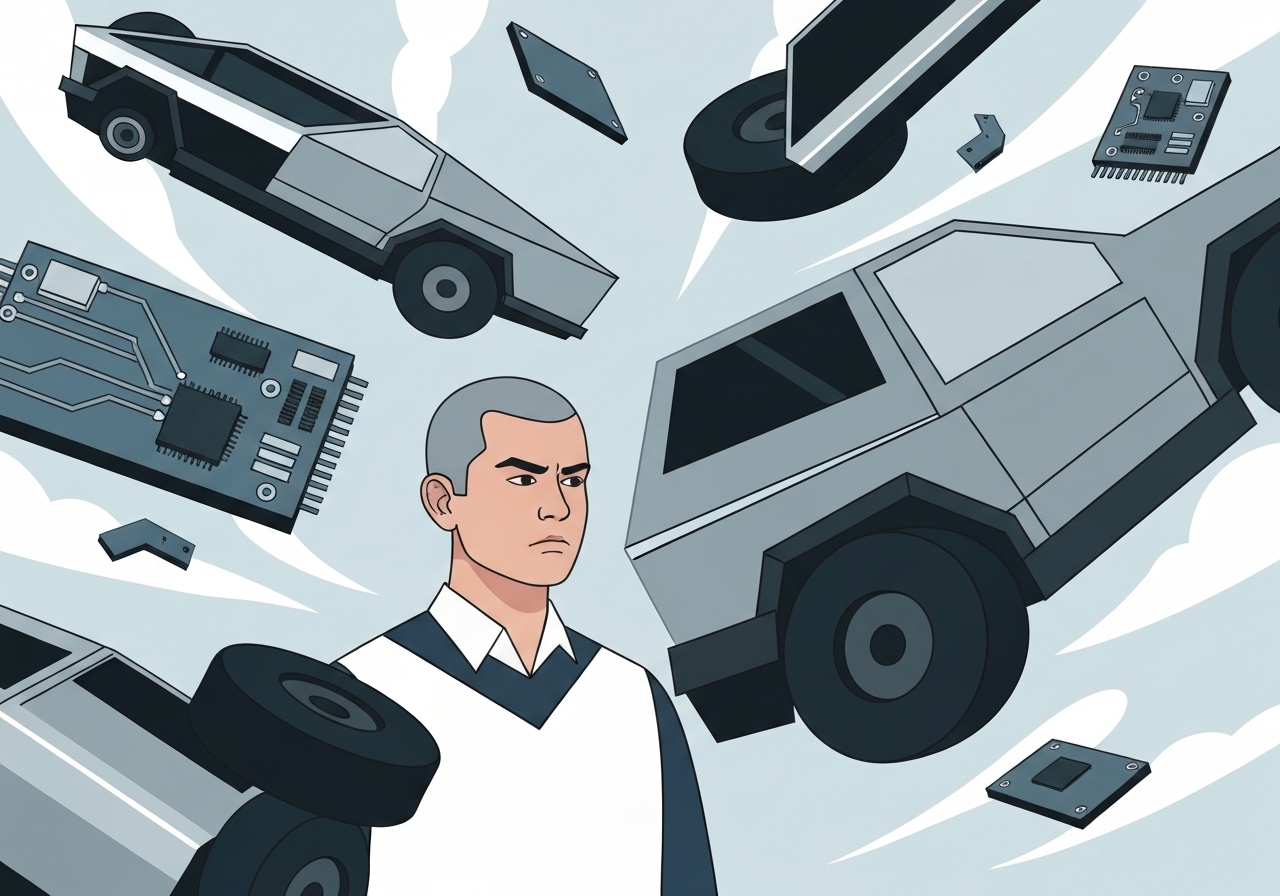
Lead: On November 10, 2025, Siddhant Awasthi—who led development and the production ramp of Tesla’s Cybertruck as program manager for three years—confirmed he has left the company in a LinkedIn post. His departure follows a series of senior exits across Tesla’s Cybertruck, Model 3 and Model Y programs amid volatile sales and an uncertain outlook for the electric-vehicle maker. Awasthi, who joined Tesla as an intern in 2017, transferred to the Model 3 program in July 2025 before departing. The exit adds to concerns about leadership continuity at one of Tesla’s highest-profile vehicle programs.
Key Takeaways
- Siddhant Awasthi confirmed his departure on November 10, 2025; he served three years as Cybertruck program manager and joined Tesla in 2017.
- Awasthi moved to the Model 3 program in July 2025, indicating internal role shifts months before his exit.
- The departure is one of several senior exits across Cybertruck, Model 3 and Model Y teams in 2025 as Tesla navigates volatile sales figures.
- Cybertruck remains a strategic, high-profile program for Tesla, with ramp-up and production challenges continuing to draw scrutiny.
- Investors and industry watchers view repeated leadership changes as a potential risk to delivery timelines and product refinement.
Background
Tesla introduced the Cybertruck as a flagship electric pickup aimed at expanding the company’s footprint in the lucrative truck market. The vehicle has been operationally demanding: its unconventional design, new manufacturing tooling and planned low-volume, high-demand launch created complex engineering and production workstreams. Program managers play a central role in aligning engineering, supply chain and factory ramp teams to meet projected timelines and quality targets.
Since 2024 and into 2025, Tesla has experienced swings in global sales and shifting demand patterns across segments. Those market dynamics, combined with aggressive internal targets, have coincided with a series of high-level personnel changes across multiple vehicle programs. Stakeholders inside and outside the firm monitor leadership stability closely because program leads influence vendor relationships, production cadence and software-hardware integration.
Main Event
On November 10, 2025, Siddhant Awasthi posted that he had left Tesla after a career that began with an internship in 2017. He had been the Cybertruck program manager for three years, a period that covered late development and the vehicle’s ramp toward broader production. In July 2025 he was reassigned to the Model 3 program, signaling internal redeployments as the company adjusted resources across its lineup.
The company did not simultaneously announce a replacement. That gap compounds short-term uncertainty for teams still driving Cybertruck refinement and scale-up. Awasthi’s role historically involved coordinating cross-functional teams—engineering, production, testing and supplier management—tasks that require continuity during a vehicle ramp.
Industry observers note that program manager turnover during a ramp can slow decision cycles and complicate supplier negotiations. For a high-profile launch like Cybertruck, even brief pauses in leadership can ripple into production yields, quality metrics and delivery timelines. Tesla’s recent pattern of senior departures has been reported across the Cybertruck, Model 3 and Model Y programs in 2025, reinforcing market attention on the firm’s organizational stability.
Analysis & Implications
Leadership continuity matters most during late-stage development and early production ramps. Program managers act as the integrators of design intent and factory execution; losing a leader with three years’ continuity in that role can increase risk to on-time deliveries and planned output levels. Even if technical teams retain institutional knowledge, external partners and vendors often rely on named points of contact to resolve production defects and supply constraints.
For investors, repeated exits raise questions about managerial bandwidth and succession planning. Tesla’s stock and credit-sensitive stakeholders monitor not only sales figures but also execution risk tied to people. If leadership churn persists, analysts may model wider ranges for delivery forecasts and margin pressure, particularly for new or complex models like the Cybertruck.
Operationally, the immediate impact depends on how quickly Tesla names a successor or redistributes responsibilities among senior engineers and manufacturing leads. Short-term mitigation is possible if a formal transition plan exists and deputies have domain experience. However, strategic priorities—such as scaling Cybertruck production while sustaining Model 3 and Model Y volumes—will test the company’s capacity to absorb multiple leadership changes simultaneously.
Comparison & Data
| Milestone | Timing |
|---|---|
| Awasthi joins Tesla (intern) | 2017 |
| Served as Cybertruck program manager | ~2022–Nov 2025 (3 years) |
| Reassigned to Model 3 program | July 2025 |
| Public confirmation of departure | November 10, 2025 |
The table summarizes verifiable timeline points tied to Awasthi’s tenure and role movements in 2025. While the dates are factual, the operational consequences—on production yield or delivery schedules—depend on internal transition details Tesla has not disclosed publicly.
Reactions & Quotes
He expressed appreciation for his time at the company and noted a move to new opportunities in a public post.
Siddhant Awasthi (LinkedIn)
Observers say the string of exits could heighten execution risk during critical ramp phases unless succession plans are swiftly implemented.
EV industry analyst (comment)
Tesla did not immediately provide a public comment detailing successor plans or the operational handover for the Cybertruck program.
Tesla (company response as of Nov. 10, 2025)
Unconfirmed
- Whether Awasthi has accepted a role at a competitor or another automaker has not been publicly confirmed.
- The internal reasons for his reassignment to Model 3 in July 2025 and subsequent departure remain undisclosed.
- The precise impact of his exit on Cybertruck production schedules and delivery forecasts is not yet verifiable.
Bottom Line
Siddhant Awasthi’s exit on November 10, 2025, is factually confirmed and punctuates a broader pattern of senior-level turnover at Tesla during a period of market volatility. For the Cybertruck program, the immediate operational risk hinges on how rapidly Tesla names a successor or reallocates responsibilities to experienced deputies.
For investors and partners, repeated leadership changes elevate execution risk, which could influence near-term delivery projections and margin assumptions. Monitoring Tesla’s official communications about succession and production metrics will be essential to assess whether the firm can sustain its ambitious product roadmap while stabilizing its leadership ranks.
Sources
- Bloomberg – Tesla’s Cybertruck Chief Is Departing Electric-Vehicle Maker (news reporting)
- Tesla Pressroom (official company site)