
Lead
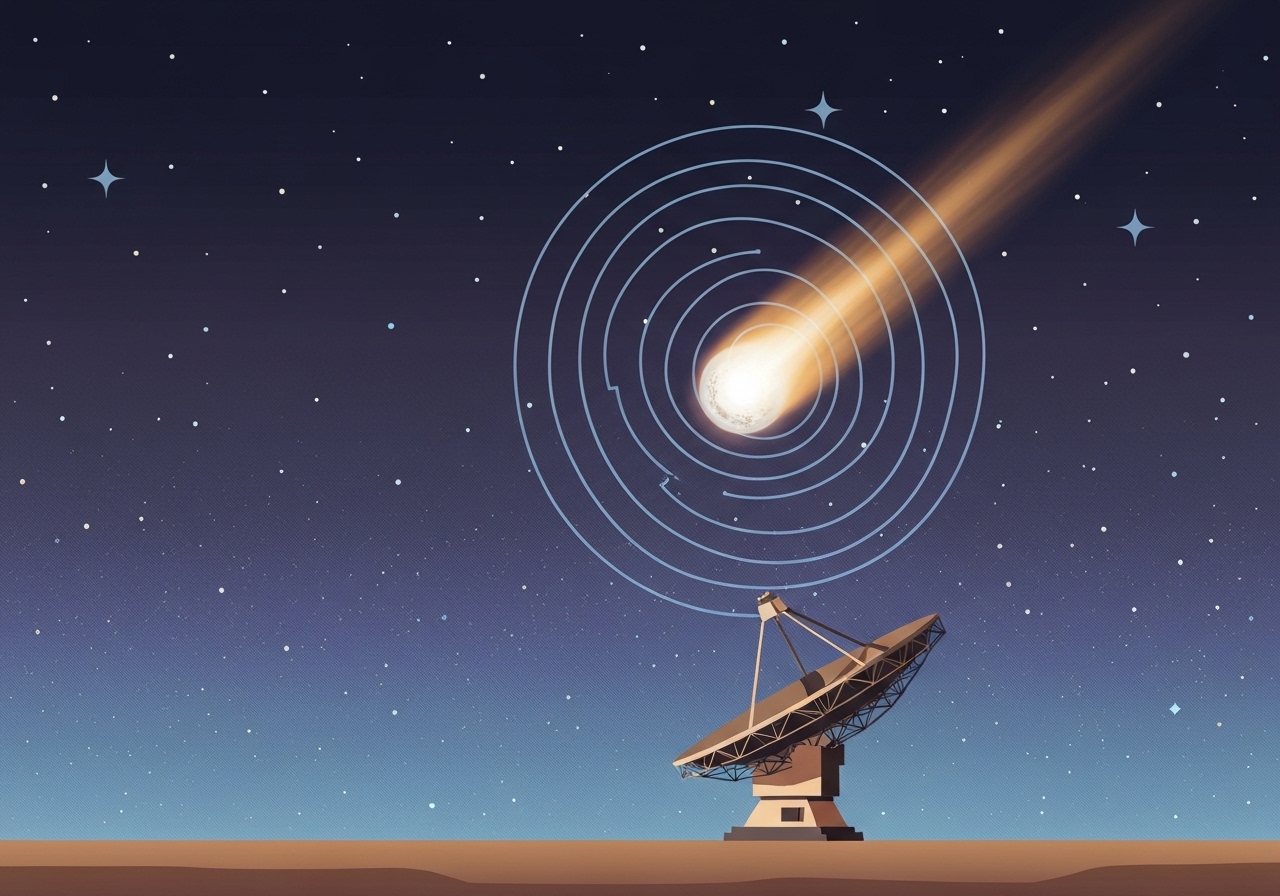
South Africa’s MeerKAT radio array recorded the first radio emission tied to interstellar comet 3I/ATLAS on Oct. 24 as the object passed near the Sun. The signal was measured by the 64-dish array and, after analysis, was attributed to hydroxyl (OH) absorption in the comet’s coma rather than any engineered transmission. 3I/ATLAS — the third confirmed interstellar object — reached perihelion on Oct. 29 while moving at roughly 130,000 mph (210,000 km/h). The detection reinforces observations of active outgassing and water breakdown, consistent with a natural cometary body.
Key Takeaways
- MeerKAT’s 64-dish array in South Africa detected radio features from 3I/ATLAS on Oct. 24 during its perihelion window.
- The radio features match absorption by hydroxyl (OH) radicals, produced when solar radiation breaks down water vapor in the comet’s coma.
- 3I/ATLAS is the third-known interstellar object (ISO), first noticed in early July with precovery images dating back to May; its inbound speed exceeded 130,000 mph (210,000 km/h).
- NASA observed strong water ejection from the comet in early October, describing it as extremely vigorous outgassing.
- Claims that the signal was an artificial transmission—promulgated by a small group of proponents—are not supported by the spectral data.
- The comet showed transient brightening and color changes around its solar flyby, and reports of tail loss were clarified by follow-up imagery.
- A separate object, C/2025 V1 (Borisov), reached its closest approach to Earth on Nov. 11 and is unrelated to 3I/ATLAS despite some confusion in public reporting.
- The broader astronomical community remains unified in considering 3I/ATLAS a natural comet likely ejected from another star system billions of years ago.
Background
3I/ATLAS is the third interstellar visitor confirmed within the modern observing era, following 1I/‘Oumuamua (2017) and 2I/Borisov (2019). It was first identified publicly in early July 2025, though earlier images from May were later located in archival data. Estimates place the object’s origin in a distant stellar neighborhood of the Milky Way and suggest it could be as old as 7 billion years, giving astronomers a rare window into material formed in another system.
When first tracked, 3I/ATLAS approached the Sun at more than 130,000 mph (210,000 km/h), and its passage through the inner system produced classic cometary signs: a developing tail, strong outgassing, and spectral signatures indicative of volatile compounds. These behaviors align with established cometary physics—ices vaporizing under solar heating produce gas and dust that form comae and tails—rather than engineered activity.
Main Event
On Oct. 24, shortly after the comet passed behind the Sun from Earth’s perspective, MeerKAT detected narrow-band radio absorption features coinciding with wavelengths where hydroxyl radicals absorb. Hydroxyl (OH) arises when water molecules released by the comet’s nucleus are dissociated by solar ultraviolet radiation. The timing—near perihelion on Oct. 29—matched expectations for peak outgassing and photodissociation.
Earlier in October, NASA observers reported exceptionally strong water release from 3I/ATLAS, describing the flow as unusually intense. Follow-up optical and spectroscopic monitoring recorded temporary brightening and a color shift during the solar flyby; subsequent imaging clarified that the comet retained its tail although morphology changed. The combined radio and optical evidence supports a scenario of robust water-driven activity rather than a technological source.
Claims that the radio signature indicated an artificial transmission were amplified in some corners of the public discussion, particularly by a small group of proponents who have previously suggested extraterrestrial explanations for other interstellar visitors. The MeerKAT spectral profile, however, is consistent with known cometary chemistry—specifically OH absorption bands—undermining the engineered-signal hypothesis.
Analysis & Implications
The MeerKAT detection is scientifically important because radio observations probe molecular and atomic processes in a comet’s coma that optical telescopes can miss. Hydroxyl absorption features give direct evidence of water photodissociation rates and can be used to estimate the water production rate from the nucleus. In the case of 3I/ATLAS, the radio data corroborate independent optical and ultraviolet measurements that flagged strong water loss.
From a broader perspective, confirming OH-related radio signatures on an interstellar comet helps establish continuity between local comet physics and material arriving from other star systems. If 3I/ATLAS indeed formed billions of years ago in a different stellar environment, its present-day behavior offers a test of theories about volatile retention and long-term exposure to interstellar space. The results imply that at least some interstellar small bodies retain substantial volatile inventories despite long voyages.
The episode also illustrates the interplay between extraordinary claims and ordinary science in high-profile events. Allegations of technological origin for interstellar objects attract public attention, but they impose an additional burden of proof. Robust, multiwavelength observations—like MeerKAT’s radio spectra combined with NASA’s optical monitoring—help separate natural processes from unsupported speculation and reinforce methodological standards for future ISO studies.
Comparison & Data
| Object | Year Detected | Key Traits |
|---|---|---|
| 1I/‘Oumuamua | 2017 | Unusual shape, non-gravitational acceleration, no clear gas coma |
| 2I/Borisov | 2019 | Clear cometary activity, abundant volatiles, typical comet morphology |
| 3I/ATLAS | 2025 | Strong outgassing, OH radio absorption (Oct. 24), perihelion Oct. 29 |
The table highlights how 3I/ATLAS aligns more closely with 2I/Borisov in showing active volatile release, distinguishing it from 1I/‘Oumuamua’s more ambiguous signature. Together, these cases expand the taxonomy of interstellar visitors and underscore the value of coordinated, multi-instrument campaigns.
Reactions & Quotes
The spectral features are consistent with hydroxyl absorption from water photodissociation in the comet’s coma, not engineered signals.
MeerKAT team (SARAO, official analysis)
Observers noted the Oct. 24 radio detection publicly; proponents of an artificial origin acknowledged the observation but did not present spectral evidence for technology.
Avi Loeb (personal blog, acknowledgment reported)
Unconfirmed
- The idea that the radio features are deliberate transmissions from an alien probe remains unsupported by spectral evidence and is unconfirmed.
- Claims that 3I/ATLAS ejected a separate probe during perihelion have no observational backing and are unverified.
- Reports that the comet exploded because of excessive mass loss are not confirmed; follow-up observations show continued cometary activity rather than a catastrophic breakup.
Bottom Line
MeerKAT’s detection of radio features from 3I/ATLAS is a milestone: it is the first radio-linked measurement for an interstellar comet and it strengthens the case that this ISO is a natural, water-rich body undergoing vigorous solar-driven activity. The spectral profile points to hydroxyl produced by water breakup—not to signals of artificial origin.
Going forward, this event underscores the need for rapid, multiwavelength follow-up when interstellar visitors are discovered. Combining radio, optical, ultraviolet and infrared data will remain essential to characterize composition, activity and dynamical behavior—and to quickly evaluate extraordinary claims. For now, 3I/ATLAS provides a rare laboratory for studying material from beyond our solar system under direct solar heating.