
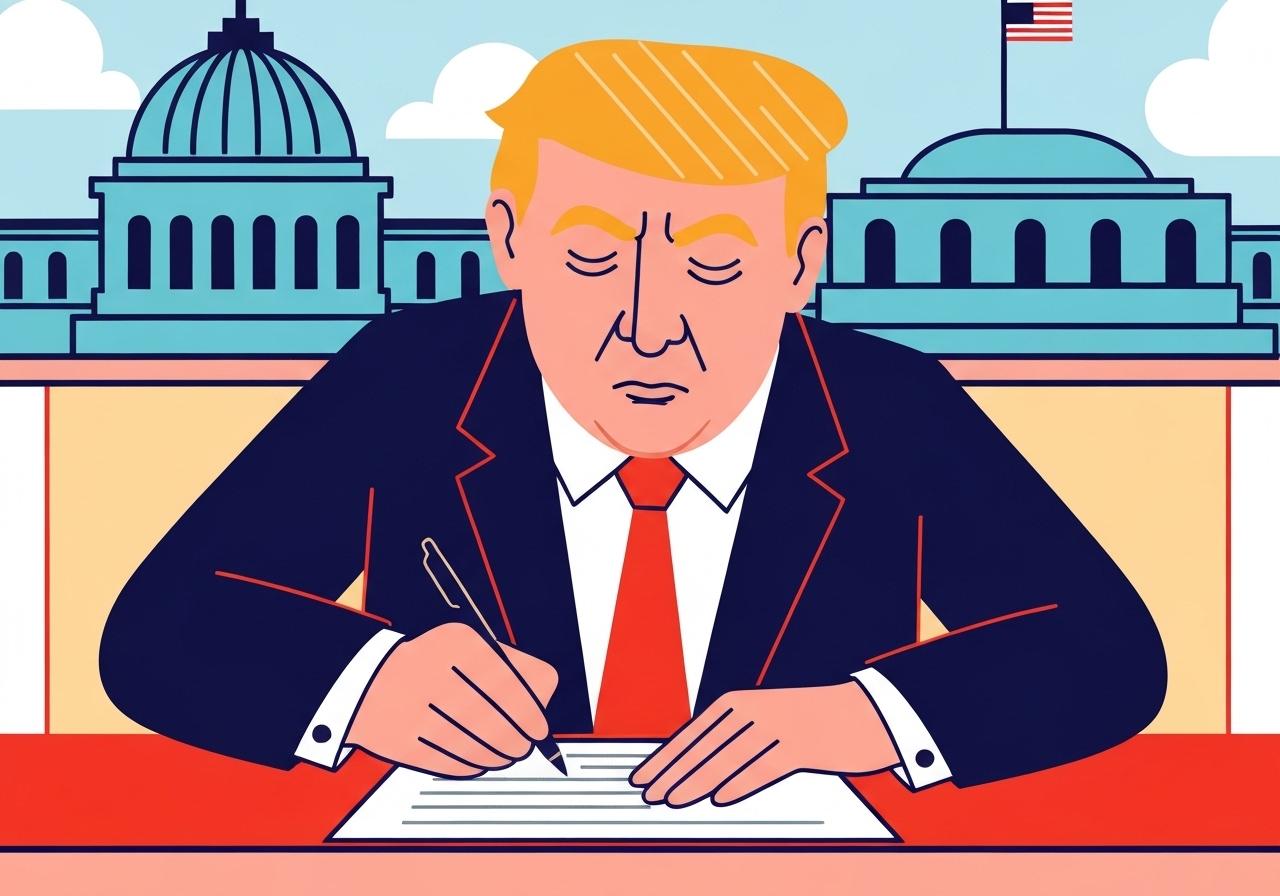
Lead President Donald Trump signed a congressionally approved funding bill on the evening after a 43-day federal funding lapse that began on 1 October, formally ending the longest US government shutdown on record. The signing in the Oval Office restores funding to agencies, guarantees back pay to furloughed and unpaid federal employees, and allows many public services to resume. Large programs such as SNAP food benefits are expected to be fully available immediately, while other services and contract work will take days or weeks to normalize. The deal leaves several disputed policy items unresolved and sets the stage for further votes and political fallout.
Key takeaways
- The shutdown lasted 43 days, surpassing the previous record of 35 days from 2018-19.
- An estimated 670,000 government employees were furloughed and about 730,000 were required to work without pay during the lapse, according to the Bipartisan Policy Center.
- The signed 328-page continuing resolution funds most federal agencies through 30 January and extends funding for some departments through September next year.
- SNAP benefits for roughly 42 million people are expected to resume immediately; other programs like LIHEAP serving about 6 million households may take weeks to restart.
- The bill reverses hemp deregulation enacted in 2018 and includes a provision limiting secret searches of senators’ phone records with potential payouts up to $500,000 per violation, retroactive to 2022.
- The House passed the measure 222-209, with six Democrats joining Republicans to approve the stopgap funding.
- Air travel was disrupted during the shutdown, and the FAA had ordered flight reductions at 40 of the nation’s largest airports because some air traffic controllers refused to work without pay.
Background
The shutdown began on 1 October after a funding impasse tied to disagreements over health insurance subsidies and other policy demands. Senate Democrats had pushed for an extension of expiring healthcare tax credits affecting about 24 million Americans; Republicans declined to enshrine that extension in the stopgap measure and instead agreed to a separate vote in December. Previous shutdowns have produced similar fights over leverage and policy tradeoffs, but this episode became the longest in US history at 43 days.
Key stakeholders included White House officials, congressional Republican and Democratic leaders, rank-and-file members who faced constituent pressure, federal workers and contractors affected by lost pay, and program beneficiaries dependent on services such as SNAP and LIHEAP. The political stakes were high for both parties: Democrats sought policy concessions and protections for low-income families, while Republicans prioritized reopening the government without the subsidies they opposed. The impasse also had operational effects across federal agencies, national parks and air travel infrastructure.
Main event
The House of Representatives voted to reopen the government with a 222-209 margin after several intense hours of debate, bipartisan lobbying and last-minute negotiations. Six Democrats crossed party lines to support the Republican-led continuing resolution, while at least one Democrat, Jared Golden of Maine, was among those who switched in earlier stages of the vote. The bill then moved to the White House, where the president signed it in the Oval Office and offered brief remarks, calling it ‘a great day’ as staff and reporters were cleared from the room.
The legislation is a 328-page continuing resolution that restores funds to most federal agencies through 30 January and extends appropriations for some programs, including agriculture and veterans affairs, to September. It guarantees back pay for federal workers furloughed or required to work without pay and reverses many of the shutdown-related personnel actions. At the same time, the package inserts policy changes that were not part of the shutdown dispute, including a reversal of the 2018 hemp deregulation and new limits on how federal prosecutors may access senators’ phone records.
Operationally, the immediate effect is a gradual return to normalcy: agencies will recall staff, national parks and museums will begin to reopen, and SNAP benefits should be made fully available to about 42 million people. But officials and agency leaders warned that some services, contract work and program resumption will take days to weeks as payroll systems, vendor contracts and seasonal programs are restored. Airports and air traffic control will also work to recover from disruptions caused by controllers refusing to work without pay.
Analysis & implications
Politically, the resolution ends an acute crisis but leaves unresolved tensions that could reshape midterm messaging and intra-party dynamics. Democrats who backed the shutdown strategy in the Senate hoped to extract guaranteed extensions of health insurance tax credits; instead they secured only a promise of a future vote, triggering anger from the party’s left flank and criticism from prominent state-level figures. Republicans, including House leadership, framed the reopening as a validation of their position and a public relief that resets the timetable for other policy fights.
For federal employees and the agencies that serve the public, the short-term priority is administrative recovery: issuing back pay, restoring contractor schedules and reactivating programs. Some programs are poised for rapid restart, with electronic benefit transfers for SNAP available almost immediately, while programs that rely on seasonal staff or complex enrollment systems, such as LIHEAP and Head Start, will require more time. The differential timing risks uneven relief for low-income households entering winter months when heating assistance is most needed.
The bill’s non-shutdown provisions carry legal and economic consequences beyond the immediate reopening. The rollback of hemp deregulation could affect an industry that grew rapidly after the 2018 change, potentially disrupting producers and retailers of low-THC products. The senators’ phone-record protection, retroactive to 2022, opens potential litigation and signals congressional concern about oversight limits; its retroactivity could allow affected lawmakers to sue over past investigations. These technical provisions may produce downstream court challenges and policy debates independent of the shutdown itself.
Comparison & data
| Shutdown | Year | Duration | Main trigger |
|---|---|---|---|
| Current | 2023-2024 | 43 days | Dispute over health-subsidy extensions and budget terms |
| Previous record | 2018-2019 | 35 days | Border wall funding dispute |
The table places this shutdown in recent historical context, showing it exceeded the 35-day record set in 2018-19. Quantitatively, about 670,000 employees were furloughed and 730,000 were required to work without pay, per the Bipartisan Policy Center, and roughly 42 million people rely on SNAP. Flight disruptions were widely reported, and the FAA restricted flights at 40 large airports during the lapse because of staffing shortfalls.
Reactions & quotes
White House remarks emphasized relief at reopening and political vindication for the president and congressional allies while also casting blame on Democrats for causing the stoppage. Supporters highlighted the return of paychecks and services; critics focused on missed leverage and unresolved policy questions.
‘It’s a great day,’ the president said as he signed the bill, framing the vote as a restoration of government function and relief for affected households and workers.
President Donald Trump
House leadership presented the vote as a necessary correction and a relief for families and agency operations. The Speaker described the end of the shutdown as a predictable resolution and faulted the opposing party for the impasse.
‘We feel very relieved tonight,’ said the House Speaker after the chamber passed the bill, describing the end of the funding lapse as a restoration of services and criticizing the earlier shutdown strategy.
Speaker of the House
Prominent Democratic critics and some state leaders denounced the outcome as insufficient on policy, arguing that the party surrendered leverage without securing concrete protections for healthcare subsidies.
‘This deal was pathetic and a surrender,’ said a Democratic governor and national figure, reflecting frustration among progressives that the vote produced few immediate policy concessions.
State governor and Democratic leader
Unconfirmed
- The administration’s claim that over 20,000 flights were delayed or cancelled during the shutdown is reported by officials but has not been independently verified in a comprehensive dataset.
- The exact timetable for full reopening of national parks, Smithsonian museums and some agency field offices is unclear; similar reopenings in past shutdowns took several days to a week.
- Potential lawsuits enabled by the phone-records provision and their outcomes are speculative until such cases are filed and adjudicated.
Bottom line
The signed continuing resolution ends the immediate operational crisis created by the 43-day funding lapse, restoring pay and restarting many federal services. However, the underlying policy battles that produced the shutdown remain unresolved, with promises of future votes rather than codified guarantees on key items such as health-subsidy extensions.
Practically, Americans can expect a staggered return to normal for services and programs: SNAP recipients should see benefits quickly, while other programs and contract-driven operations will take longer to recover. Politically, both parties will shape narratives about responsibility and effectiveness in the run-up to upcoming elections, and the bill’s non-budget provisions may spawn legal and regulatory disputes in the months ahead.
Sources
- BBC Live coverage (news)
- Bipartisan Policy Center (policy research)
- Federal Aviation Administration (federal agency)
- Smithsonian Institution (federal museum system)