
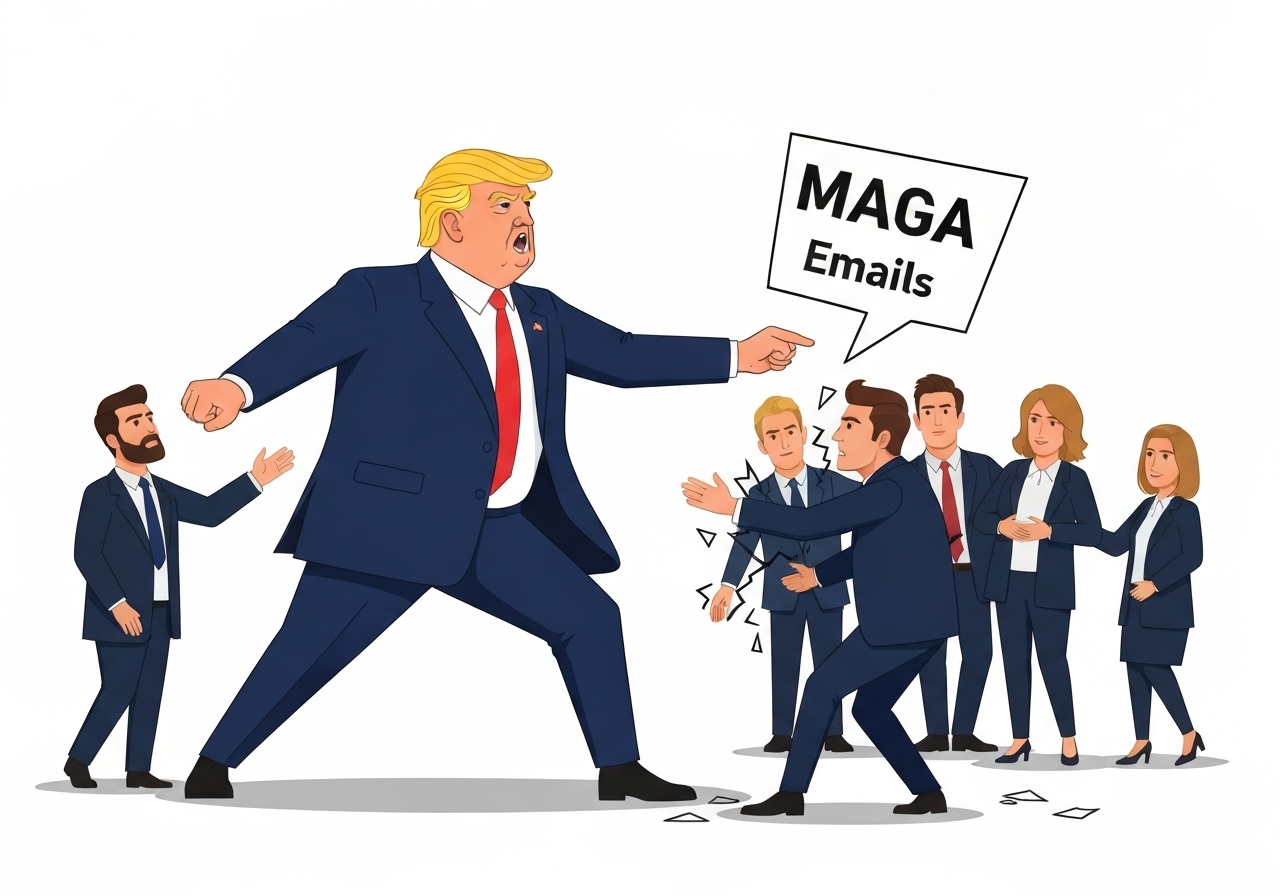
Former president Donald Trump is engaged in a high-stakes struggle to retain influence over the MAGA grassroots as newly surfaced Jeffrey Epstein-related emails intensify divisions within the movement. The correspondence, made public amid litigation and reporting, has prompted some conservative figures to distance themselves while others rally behind Trump’s leadership. The clash has unfolded across party apparatuses, social media and conservative media outlets, producing an uneven coalition and contested claims about loyalty and direction. The result is a sharper contest over who defines MAGA’s agenda going into the next electoral cycles.
Key Takeaways
- Newly disclosed emails connected to Jeffrey Epstein have deepened fissures inside the MAGA-aligned conservative movement, prompting recriminations among prominent allies.
- Donald Trump has stepped up efforts to assert control, combining public messaging with behind-the-scenes outreach to party activists and donors.
- Some conservative operatives and media figures have publicly criticized the handling of the emails, citing political and reputational risk to the movement.
- The dispute is playing out on multiple fronts: campaign infrastructure, donor networks and online platforms where MAGA voters organize.
- Legal and media developments surrounding the emails have shifted the tactical calculations of both Trump loyalists and rivals within the party.
- Observers warn that the schism could complicate candidate recruitment, fundraising and unified messaging ahead of national elections.
Background
The MAGA coalition grew around a blend of populist policy positions, a personality-driven leadership style and a network of sympathetic media outlets and donor groups. Since 2016, the movement has been defined as much by its organizational flexibility as by the figure of Donald Trump, who remains its most prominent public face. Internal tensions have periodically surfaced over strategy, endorsements and the role of allied media in shaping priorities.
The recent release of emails tied to the Jeffrey Epstein archive arrives against this history of factional disputes. Epstein-related material has previously triggered reputational fallout for figures across the political spectrum, and renewed disclosures tend to prompt defensive calculations by those with any reported proximity. Within MAGA circles, the emails have been interpreted through partisan lenses—either as an attack on allies or as an unavoidable legal and ethical liability requiring distance.
Main Event
Publication and reporting on the emails set off rapid reactions. Some prominent conservative commentators and activists publicly urged caution, arguing that association with Epstein-linked correspondence posed a political liability. At the same time, Trump loyalists framed criticism as part of a hostile effort to undermine the movement and its future candidates.
Trump himself increased visible efforts to shore up loyalty, combining public statements that emphasized continuity with the movement’s agenda and private overtures intended to reassure donors and activists. Campaign and allied organizations adjusted talking points to refocus attention on policy and perceived Democratic vulnerabilities rather than the Epstein-related disclosures.
The schism is not merely rhetorical: it has led to realignment in endorsement discussions, shifts in the calculus of some influential donors, and heightened scrutiny of the networks that amplify MAGA messages. Local and national organizers reported fractious meetings and heated exchanges as they attempted to navigate conflicting signals from national figures and grassroots activists.
Analysis & Implications
The widening split has immediate political risks. A divided base can hamper turnout and damp fundraising momentum at critical moments before primaries and general elections. If influential donors and media amplifiers withdraw or scale back support, candidates aligned with the movement could face resource constraints that affect staffing, advertising and get-out-the-vote operations.
Strategically, the episode underscores the fragility of movements built around a dominant personality rather than institutional infrastructure. Trump’s efforts to reassert control highlight a tension: centralizing authority can restore short-term cohesion but may alienate independent operators who prize autonomy. That push-and-pull will shape candidate selection and messaging choices in the months ahead.
Internationally, observers note the episode has limited direct foreign policy impact, but it affects perceptions of U.S. political stability and the coherence of conservative governance plans. Policymakers watching from allied governments may be cautious about engaging with a fractured coalition, complicating diplomatic outreach if the movement were to regain executive power.
Comparison & Data
| Area | Pre-disclosure | Post-disclosure |
|---|---|---|
| Public unity signals | Frequent coordinated messaging | More mixed messages and public distancing |
| Donor engagement | High, centralized outreach | Signs of hesitation among some funders |
| Media amplification | Dominant outlets largely aligned | Emergence of divergent narratives |
The table summarizes observable shifts in coordination and sentiment since the emails became headline news. While quantifiable polling shifts are still emerging, campaign operatives report strategic re-evaluations around endorsements and spending priorities. These operational changes can have outsized downstream effects even if headline polling remains stable in the near term.
Reactions & Quotes
“The release of these materials is being used to chip away at support for our movement,” said a senior Trump ally, framing the disclosures as a partisan attack.
Senior Trump ally (paraphrase)
That perspective has been countered by others who argue that distancing and clearer vetting are necessary to preserve long-term electoral viability. Multiple organizers noted that new scrutiny forces a recalibration of whom the movement elevates publicly.
“Conservative leaders must weigh reputational risk against short-term loyalty,” a veteran Republican strategist observed, urging a pragmatic approach to endorsements.
Republican strategist (analysis)
Unconfirmed
- Any direct, substantive coordination between Donald Trump and the authors of the disclosed emails has not been confirmed by independent evidence.
- The long-term impact of the emails on primary-level voter behavior remains undetermined and requires further polling data.
- Reports of significant donor withdrawals tied solely to the email disclosures are currently anecdotal and not independently verified.
Bottom Line
The emergence of Epstein-related emails has sharpened pre-existing tensions within the MAGA movement, transforming debates about tactics and leadership into a broader contest over who defines the coalition’s future. Donald Trump’s intensified efforts to reassert control reflect both the centrality of his standing and the movement’s vulnerability to reputational shocks.
How the schism resolves will depend on competing incentives: the desire for short-term cohesion around a dominant figure versus the need to protect electoral viability through disciplined vetting and stable donor relationships. In the months ahead, observers should watch endorsements, donor commitments and messaging consistency as early signals of whether the movement can reconcile these pressures.
Sources
- Financial Times (news report)