
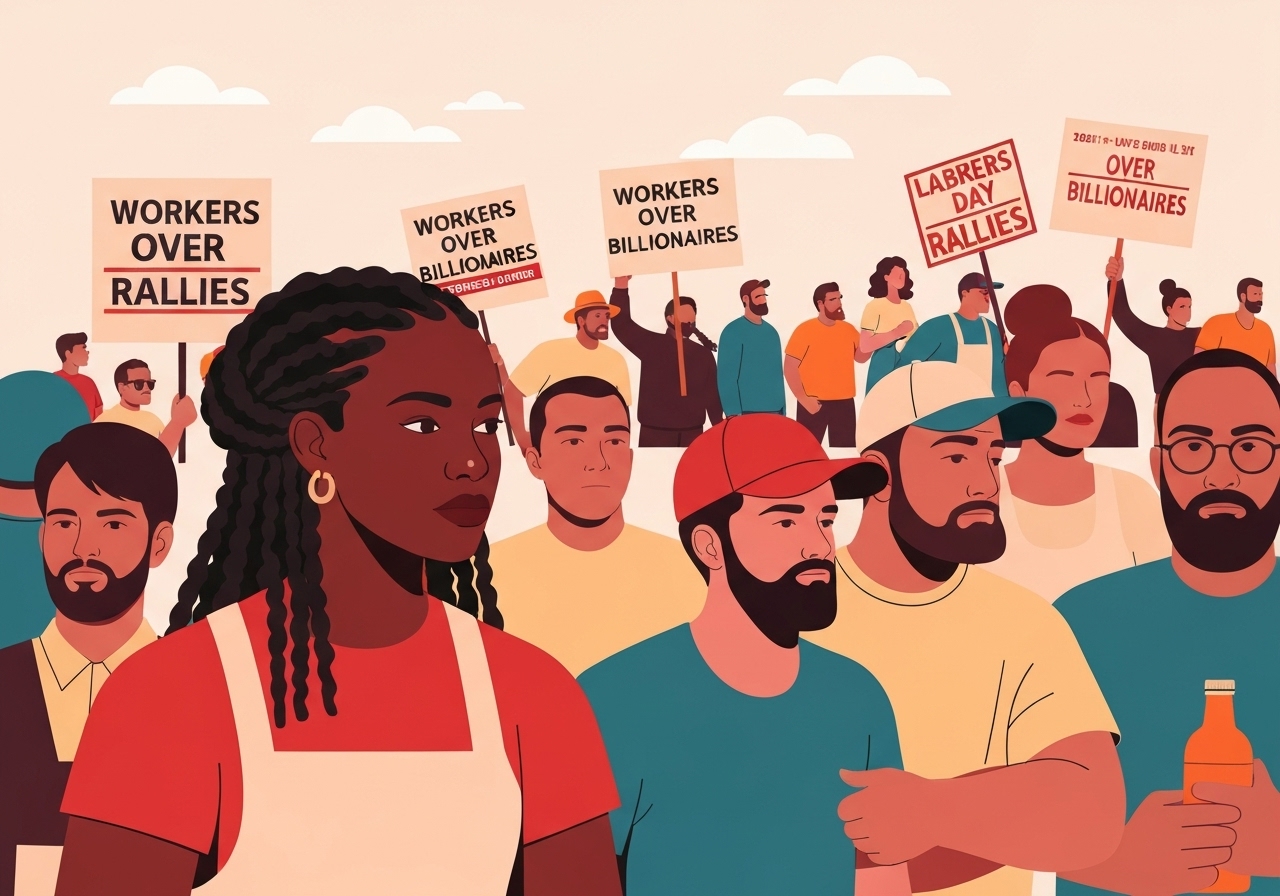
On Labor Day , hundreds of coordinated Workers Over Billionaires rallies rolled through cities across the United States, with Chicago’s mayor Brandon Johnson publicly rejecting a reported federal plan to send troops to the city amid an immigration crackdown as demonstrators pressed for stronger social safety nets and public investment.
Key Takeaways
- Chicago’s mayor Brandon Johnson rejected any federal troop deployment to the city during a West Loop rally.
- Rallies, marches, and creative actions spanned major hubs and smaller cities, from New York and Washington DC to Los Angeles, Cleveland, and Greensboro.
- The nationwide action was organized by May Day Strong with support from AFL-CIO, One Fair Wage, and other labor groups.
- In DC, roughly 1,000 people joined a Freedom Run protesting a federal takeover; in New York, crowds gathered near Trump Tower.
- Bay Area participants formed a 17-mile human chain from Redwood City to Santa Clara; thousands marched in Los Angeles.
- Houston’s Hilton Americas-Houston workers launched a nine-day strike, seeking a $23 minimum wage, up from $16.50.
- Donald Trump marked the holiday on Truth Social with a message celebrating American workers.
Verified Facts
In Chicago, Johnson told a Workers Over Billionaires crowd in the West Loop that the city would not accept federal troops connected to an immigration crackdown. He later led chants opposing a troop presence and calling for investment in local services; the New York Times reported on the chants and additional demonstrations outside Trump Tower in River North, where protesters held anti-Trump signs.
The day’s actions were part of a coordinated national effort organized by May Day Strong, a coalition of labor groups, alongside the AFL-CIO and the nonprofit One Fair Wage. Organizers emphasized protections for programs such as Social Security and funding for public schools, healthcare, and housing. AFL-CIO president Liz Shuler characterized the mobilizations as grassroots-driven and intentionally decentralized beyond Washington DC.
In New York, USA Today reported hundreds gathered across from Trump Tower in Midtown, with additional events across the state, including in Albany where Senator Kirsten Gillibrand praised the labor movement’s role in building the middle class. In Washington DC, WUSA9 reported nearly 1,000 people ran and walked in a Freedom Run opposing a federal takeover, with participants citing concern for deployed National Guard families and recent dismissals of federal employees.
Local station KTLA said thousands marched in the Los Angeles area, followed by a community picnic and performances. In the Bay Area, NBC Bay Area reported residents formed a 17-mile human chain linking Redwood City to Santa Clara as part of the day’s actions.
Separately, the Houston Chronicle reported that workers at the Hilton Americas-Houston hotel walked off the job for a nine-day strike after talks with Unite Here Local 23 failed to produce a deal. More than 400 workers are involved, seeking a minimum of $23 an hour, with the strike scheduled to run through 10 September. On social media, Donald Trump posted a Labor Day message on Truth Social featuring an image with a caption celebrating American workers.
Context & Impact
This year’s Labor Day arrives early in the current Trump administration, with worker groups mobilizing around core economic issues they say are at risk: pensions and Social Security, public-school funding, access to healthcare, and affordable housing. Organizers sought visibility outside Washington, arguing that policy decisions are felt most acutely in cities and neighborhoods.
The scope of the action reflects a broader resurgence of labor activism seen in recent years, including industry-specific strikes and wage campaigns, particularly in hospitality and service sectors. If the Houston strike achieves gains, it could embolden similar efforts in large hotels and convention centers nationwide.
Politically, sustained street and workplace actions can shape local agendas—pressuring city leaders on policing and immigrant support services—and may influence national narratives on labor rights, public investment, and federal-state relations heading into key policy fights.
Where actions were reported
| City | Action | Reported scale | Source |
|---|---|---|---|
| Chicago, IL | Rally; mayor rebuked troop plan | Large crowd | New York Times |
| New York, NY | Protest near Trump Tower | Hundreds | USA Today |
| Washington, DC | Freedom Run protest | ≈1,000 | WUSA9 |
| Los Angeles, CA | March and community picnic | Thousands | KTLA |
| Redwood City–Santa Clara, CA | Human chain | 17 miles | NBC Bay Area |
| Houston, TX | Hotel workers strike | 400+ workers | Houston Chronicle |
Official Statements
No federal troops in the city of Chicago.
Mayor Brandon Johnson, Chicago
This is grassroots organizing, centered where impacts are felt.
Liz Shuler, AFL-CIO
We celebrate working people whose efforts built the middle class.
Sen. Kirsten Gillibrand, New York
Unconfirmed
- Specific legal authority, timing, or scope of any federal troop deployment to Chicago has not been detailed publicly.
- Exact turnout figures for many cities were not independently verified beyond local reports.
- Whether the Hilton Americas-Houston strike will secure a $23 hourly minimum remains unresolved.
- Details of what protesters termed a federal takeover of Washington DC were not fully described in available reports.
Bottom Line
Labor Day 2025 became a broad show of force for worker advocates, merging street protests with workplace actions and sharpening debates over federal policy and local autonomy. Organizers signal this is an opening salvo, not a one-off, suggesting more coordinated labor activity in the weeks ahead.