
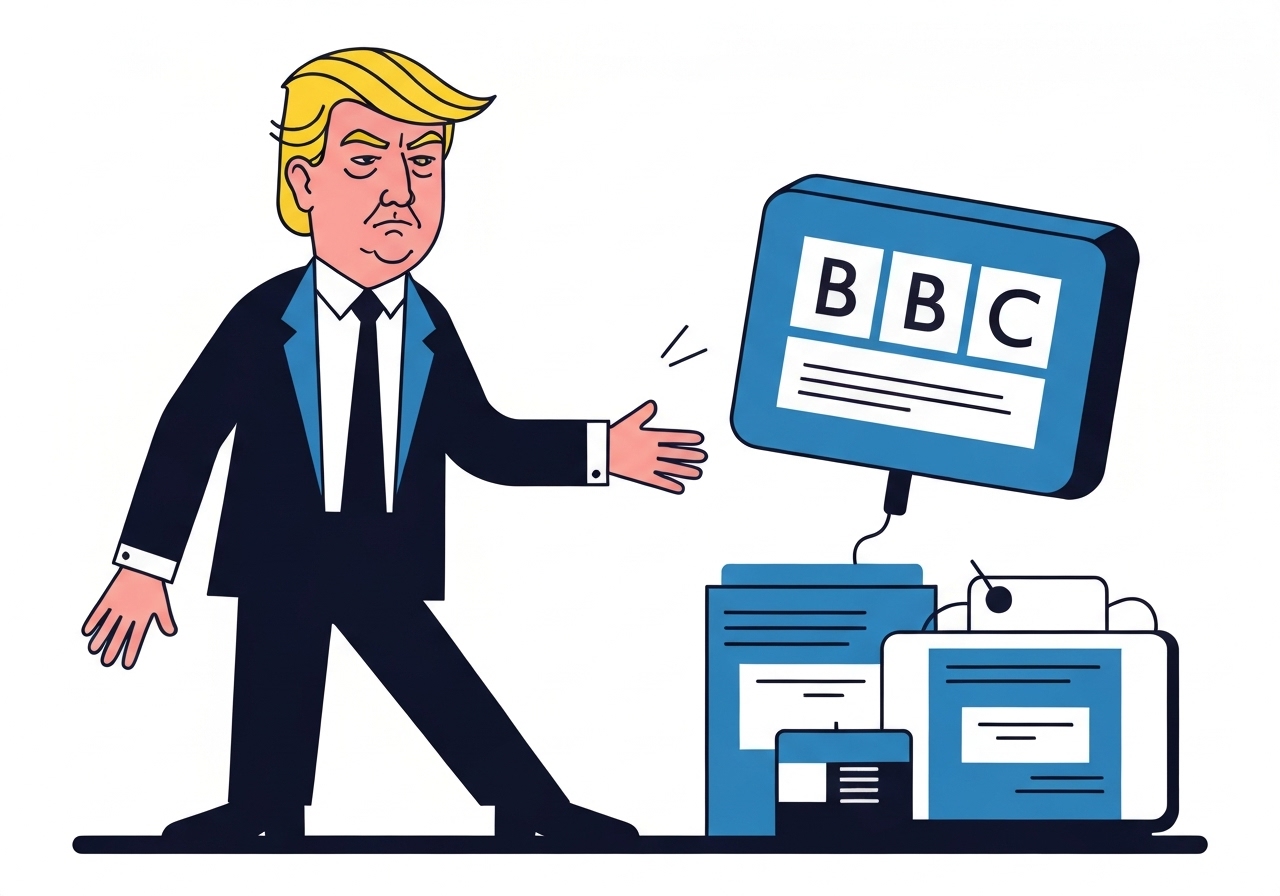
Lead: On 15 November 2025, US President Donald Trump told reporters aboard Air Force One he plans to sue the BBC next week over a Panorama edit, despite the corporation issuing a personal apology. Trump said he would seek damages ranging from $1bn to $5bn, and the BBC has agreed to stop airing the contested edition. The apology from BBC chair Samir Shah called the splice an “error of judgment,” while the broadcaster maintains it sees no legal basis for a defamation case.
Key Takeaways
- President Donald Trump announced on 15 November 2025 he intends to file suit against the BBC, seeking between $1bn and $5bn in damages.
- The BBC sent a personal apology from chair Samir Shah and has agreed not to rebroadcast the Panorama episode that contained a spliced clip.
- Trump’s legal team previously demanded $1bn (£760m), a retraction and compensation before pursuing litigation.
- The contested Panorama segment combined lines from Trump’s speech broadcast a week before the US election, splicing remarks made nearly an hour apart.
- Resignations followed the controversy: Director-General Tim Davie and BBC News chief Deborah Turness left their posts amid the fallout.
- Culture minister Lisa Nandy publicly described the BBC’s apology as “right and necessary,” signaling political pressure on the corporation.
Background
The Panorama episode at the centre of this dispute aired a week before the US presidential election and included an edited clip that suggested Trump urged supporters to march on the Capitol. The programme spliced sections of a speech given nearly an hour apart, which critics say altered the apparent meaning. In the weeks that followed, the BBC faced intense scrutiny from politicians, viewers and media commentators over editorial standards and oversight.
Legal teams for Trump labelled the segment defamatory and demanded a public retraction, an apology and at least $1bn in compensation. The BBC acknowledged the editorial mistake, issued a personal apology from its chair and withdrew the programme edition from future broadcasts. Still, the corporation maintains its position that the facts do not support a successful defamation suit under UK law.
Main Event
On the evening of 15 November 2025, speaking to reporters aboard Air Force One, Trump said: “we’ll sue them for anywhere between a billion and $5bn, probably sometime next week. We have to do it.” He framed the edit as deliberately misleading, describing the altered clip as beyond ordinary “fake news.” The White House said Trump planned to contact British Prime Minister Keir Starmer, though the president also said he had not yet discussed the matter with Starmer.
The BBC’s internal response included a personal apology from chair Samir Shah to the White House and an acknowledgment to lawmakers that the splicing was a lapse in judgement. Culture Secretary Lisa Nandy publicly supported the apology, calling it both necessary and appropriate. The broadcaster has also agreed not to show the Panorama edition again while investigations and internal reviews continue.
The resignations of Director-General Tim Davie and BBC News chief Deborah Turness followed the controversy, heightening institutional pressure on the BBC. Their departures underscore the seriousness with which the corporation’s governance and editorial controls are being examined. The move has prompted discussion in Westminster and across media circles about accountability at public-service broadcasters.
Analysis & Implications
If Trump proceeds with litigation in the weeks ahead, the case will test the boundary between high-profile political speech and libel standards in the UK and potentially in international venues. Large-damage claims, especially the $1bn–$5bn range cited by Trump, are uncommon and carry uphill legal and evidentiary burdens, particularly where public-figure speech and editorial discretion are involved. Even so, the threat of a high-value suit can produce reputational damage and financial pressure on a public broadcaster.
For the BBC, the episode exposes vulnerabilities in editorial oversight and risk management. The corporation’s swift apology and agreement to withhold the programme are crisis-control measures aimed at limiting legal exposure and restoring public trust. Yet the exit of senior leaders will likely accelerate governance reviews and could prompt parliamentary scrutiny of the BBC’s funding and regulatory arrangements.
Politically, the dispute has diplomatic overtones: a US president publicly threatening legal action against a major UK broadcaster is unusual and could complicate relations even as both leaders describe their bilateral ties as solid. Domestically, the episode will be used by critics and supporters alike to argue about media bias, standards and the role of public-service journalism in contested political moments.
Comparison & Data
| Item | Detail |
|---|---|
| Alleged damages | $1bn claimed previously; Trump mentioned $1bn–$5bn |
| Programme | Panorama edition aired one week before the US election; spliced lines from speech nearly one hour apart |
| Resignations | Tim Davie (Director-General), Deborah Turness (BBC News chief) |
The table contextualises the main figures and institutional impacts. While the dollar amounts cited are headline-grabbing, historical UK libel awards and the difficulty of proving reputational loss for a sitting head of state make sustained recovery of such sums unlikely without extraordinary evidence. That said, reputational fallout and governance consequences are immediate and measurable.
Reactions & Quotes
Officials and commentators responded quickly. Below are representative quotes with brief context.
“We’ll sue them for anywhere between a billion and $5bn, probably sometime next week. We have to do it.”
Donald Trump, US President (to reporters aboard Air Force One, 15 November 2025)
This statement set the legal threat’s timetable and scale, and was delivered publicly during travel, signalling the administration’s intent to pursue a high-profile response.
“I made a beautiful statement, and they made it into a not beautiful statement…This is beyond fake, this is corrupt.”
Donald Trump (interview on GB News)
Trump framed the edit as deliberate distortion in a televised interview, reinforcing the public messaging that preceded legal threats and formal demands from his lawyers.
“An error of judgment.”
Samir Shah, BBC Chair (personal apology to the White House)
The BBC chair used this phrase in a direct apology to the White House and to Parliament, acknowledging the mistake while stopping short of conceding legal liability.
Unconfirmed
- No formal lawsuit had been filed as of 15 November 2025; Trump indicated plans to sue “probably sometime next week,” which remains unverified.
- The exact legal venue and jurisdiction for any potential suit (UK, US or elsewhere) were not confirmed publicly; strategy could affect viability and potential award size.
- Whether Prime Minister Keir Starmer had been briefed directly before the president’s remarks was not confirmed; Trump said he had not yet spoken with Starmer.
Bottom Line
The immediate effect of Trump’s announcement is to prolong a media and political crisis for the BBC: an apology and withdrawal have not ended scrutiny, and senior resignations indicate institutional consequences. Legally, large headline damage figures face significant hurdles under defamation law and in cross-border litigation, but the reputational and political stakes are high regardless of courtroom outcomes.
Watch for a few developments in the coming weeks: any formal filing and choice of jurisdiction, further statements from the BBC’s legal team, and parliamentary or regulatory inquiries into editorial controls. Those outcomes will determine whether this remains a high-profile dispute over media standards or escalates into a sustained legal battle with broader diplomatic and institutional implications.
Sources
- The Guardian (news report)
- BBC (official media centre / apology and statements)
- Reuters (wire reporting)
- Agence France-Presse (AFP) (wire reporting)