
Lead
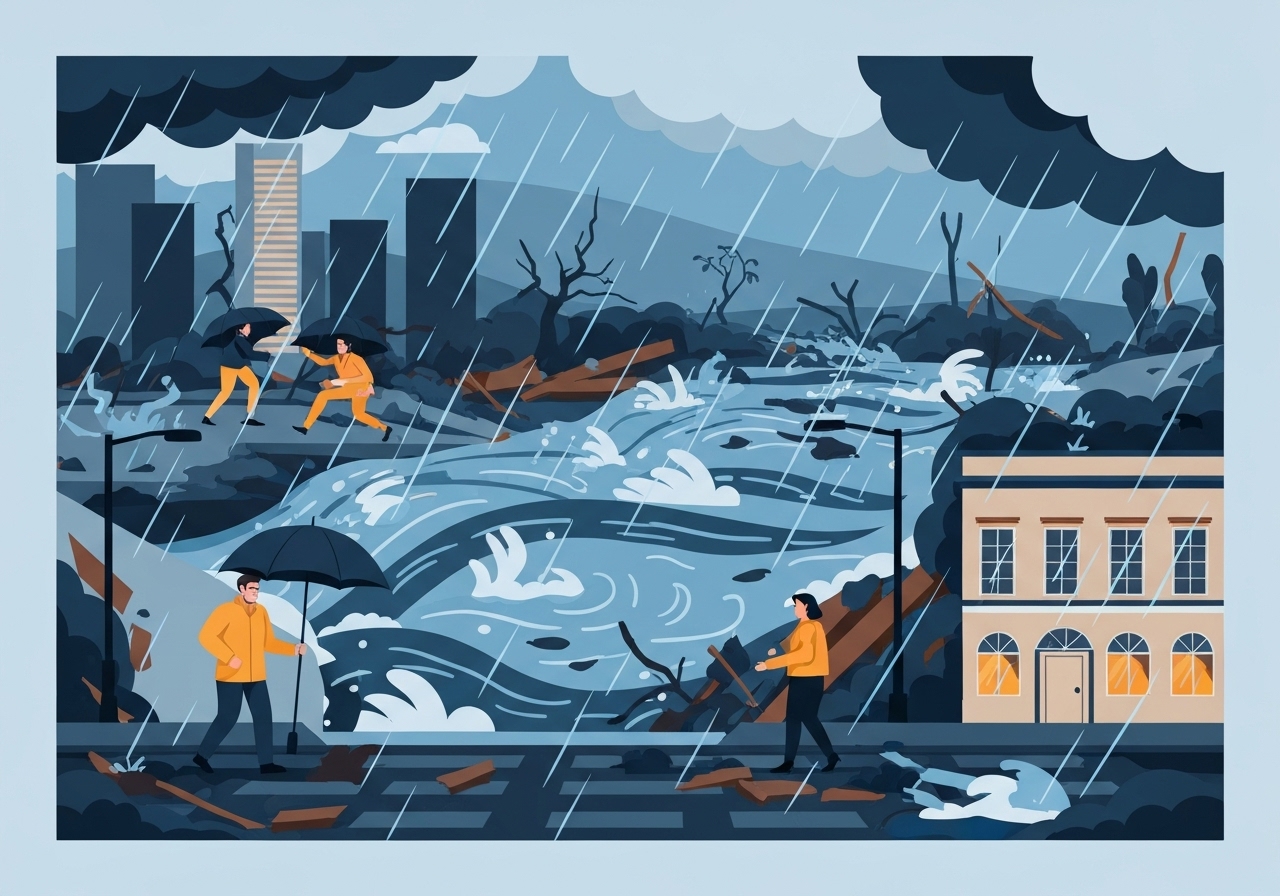
On Saturday, Nov. 15, 2025, a powerful Pacific storm brought rounds of heavy rain to Southern California, impacting more than 22 million residents and prompting flood watches and evacuation notices across the region. The first surge hit early Saturday morning, and meteorologists warned a second, potentially stronger, round was expected between 11 a.m. and 4 p.m. local time. Rainfall rates were forecast to reach up to 1 inch per hour, with mountain areas of Santa Barbara, Ventura and Los Angeles counties facing 4 to 6 inches of rain. Officials warned that wildfire burn scars were especially vulnerable to fast-moving debris flows, mudslides and dangerous flash flooding.
Key Takeaways
- More than 22 million people in Southern California were under rain impacts as of Nov. 15, 2025, with flood watches issued through Saturday evening in Los Angeles, Santa Barbara, Riverside and San Diego counties.
- Forecast rainfall rates could exceed 1 inch per hour, and the highest accumulations—4 to 6 inches—were expected in mountain areas of Santa Barbara, Ventura and Los Angeles counties.
- The National Weather Service placed Los Angeles and Santa Barbara areas at a level 3 out of 4 risk for excessive rainfall and flash flooding on Saturday.
- Wildfire burn scars are at elevated risk for debris flows and mudslides; some burn-scar zones received evacuation warnings and select areas had evacuation orders.
- Los Angeles typically averages about 0.8 inches of rain for the entire month of November, underscoring how anomalous the predicted short-term totals are for parts of the region.
- The storm was expected to wane by Saturday night, but forecasters warned an unsettled pattern could deliver more wet weather into early next week, prolonging hazards on saturated soils.
Background
Southern California winters are punctuated by Pacific storms that can deliver intense, short-duration precipitation. When heavy rain falls over soils already saturated from prior precipitation or over areas stripped of vegetation by wildfires, the speed and volume of runoff increase dramatically. In recent years, a series of large wildfires has left extensive burn scars across Santa Barbara, Ventura and Los Angeles counties; those scars reduce ground stability and increase the likelihood of debris flows during intense rain.
Local emergency management agencies and the National Weather Service use a mix of flood watches, warnings and evacuation guidance to communicate risk. Flood watches indicate conditions are favorable for flooding, while evacuation warnings and orders are issued by county or municipal authorities when specific neighborhoods or burn-scar zones face imminent danger. Southern California’s infrastructure—steep canyons, narrow arroyos and urban drainage systems—can concentrate flows quickly, turning ordinary streets into life-threatening torrents in minutes.
Main Event
The storm produced two primary pulses of rain on Saturday, with the first arriving before dawn and a second phase forecast for late morning into mid-afternoon. Radar and local observations showed bands of heavy precipitation moving onshore, and meteorologists cautioned that isolated thunderstorms embedded within those bands could locally increase rainfall rates and produce lightning and gusty winds. Flood watches remained in effect across multiple counties through Saturday evening.
Authorities highlighted the elevated dangers in and downstream of wildfire burn scars. In some neighborhoods adjacent to the Palisades Fire and other recent burn areas, officials issued evacuation warnings and in a few communities moved to evacuation orders where topography and recent burn patterns indicated heightened risk of debris flows. Emergency shelters and staging areas were readied by county responders, and road closures were reported in sections prone to runoff and slide debris.
Urban flash flooding also posed a threat beyond mountainous zones: persistent heavy rain can overwhelm storm drains and cause rapid street flooding in low-lying and poorly drained urban neighborhoods. Transportation agencies cautioned travelers about reduced visibility, standing water on freeways and the potential for sudden closures. The forecast indicated the heaviest rain should taper off by Saturday night, though officials said residual runoff and unstable slopes would continue to pose hazards for days.
Analysis & Implications
This storm underscores how a single atmospheric system can produce widely varying local impacts across a metropolitan region: coastal communities saw heavy rain and gusts, mountains faced high totals and burn scars triggered debris-flow risks, and urban centers experienced flash-flood hazards due to constrained drainage. The projected 4 to 6 inches in mountain zones represents multiple times the monthly November average for parts of Los Angeles, elevating the potential for rapid changes to streamflows and slope stability.
For emergency planners, the combination of saturated soils, recent wildfire damage and intense hourly rainfall complicates response. Debris flows can occur with little lead time and carry boulders, trees and other material, making evacuation timing and route planning particularly challenging. Local governments must weigh the risk of moving residents too early against the danger of leaving them in place if an event accelerates; clear, timely public messaging is therefore critical to reduce confusion and ensure compliance.
Economically, repeated early-season storms can strain municipal budgets and disaster relief systems. Infrastructure repairs—clearing debris from roadways, stabilizing slopes, and repairing damaged drainage—can be costly, while power outages and transportation disruptions affect commerce. On a broader scale, these events contribute to the evolving calculus for land-use planning near slopes and burn-scar zones, with potential implications for rebuilding standards and hazard mitigation investments.
Comparison & Data
| Area | Forecast Rainfall (Nov 15) | Typical Nov. Rainfall |
|---|---|---|
| Mountain zones (Santa Barbara/Ventura/LA) | 4–6 inches | Varies; significantly lower in many foothill locations |
| Los Angeles (city average) | localized heavy bands; hourly rates up to 1 in/hr | 0.8 inches for entire November (city average) |
| Population affected | More than 22 million across Southern California | N/A |
The table contrasts expected short-duration accumulations against typical monthly totals for context. In many parts of the region, a multiyear climate baseline shows November usually brings modest totals, so concentrated storm totals of several inches in hours is anomalous. That anomaly matters: runoff and slope failure probabilities rise sharply when rainfall in a few hours equals or exceeds long-term monthly means.
Reactions & Quotes
Officials and experts urged residents to heed official warnings and prepare for rapid changes in conditions. Emergency managers emphasized that evacuation guidance should be followed when issued, and that residents should avoid driving through flooded roadways.
“Take all flood and evacuation warnings seriously; treat moving water as dangerous and avoid travel if possible.”
National Weather Service (official advisory)
The National Weather Service advisory framed the storm in terms of rapid-onset hazards—flash flooding and debris flows—especially over burn scars. Local emergency agencies issued guidance on evacuation routes and shelter locations, coordinating with state and county resources to posture responders for rapid search-and-rescue if needed.
“We are actively monitoring burn-scar areas and will issue evacuation orders where the risk of debris flows is imminent.”
County emergency management officials (local)
County officials noted that decisions on evacuation orders were being made community by community, based on slope maps, recent burn intensity and predicted inflows to canyons and arroyos. Residents described disruptive conditions—heavy rain, brief power outages and localized flooding—underscoring the storm’s immediate community impacts even where widespread structural damage had not been reported.
Unconfirmed
- Exact damage tallies from the Nov. 15 storm remain preliminary; comprehensive assessments of structural damage and road closures were not yet available at press time.
- Forecast details for storms beyond early next week depend on evolving atmospheric patterns; whether additional organized systems will bring significant new totals remains uncertain.
Bottom Line
Saturday’s storm delivered intense, localized rainfall across Southern California and highlighted the acute vulnerability of wildfire burn scars to mudslides and debris flows. With hourly rates up to 1 inch and mountain totals of 4 to 6 inches in places, officials urged residents to follow evacuation guidance, avoid flooded roads and stay alert to rapidly changing conditions.
Although the heaviest rain was expected to end Saturday night, the region faced an unsettled pattern into early next week that could prolong hazards on saturated soils and sensitive slopes. Residents in affected counties should monitor official channels for updates, prepare for aftereffects such as road or infrastructure damage, and heed local emergency directives.
Sources
- ABC News — (national news outlet; original reporting)
- National Weather Service Los Angeles/Oxnard (NWS LOX) — (official forecast and hazard statements)
- Los Angeles County Emergency Management — (local government emergency information)