
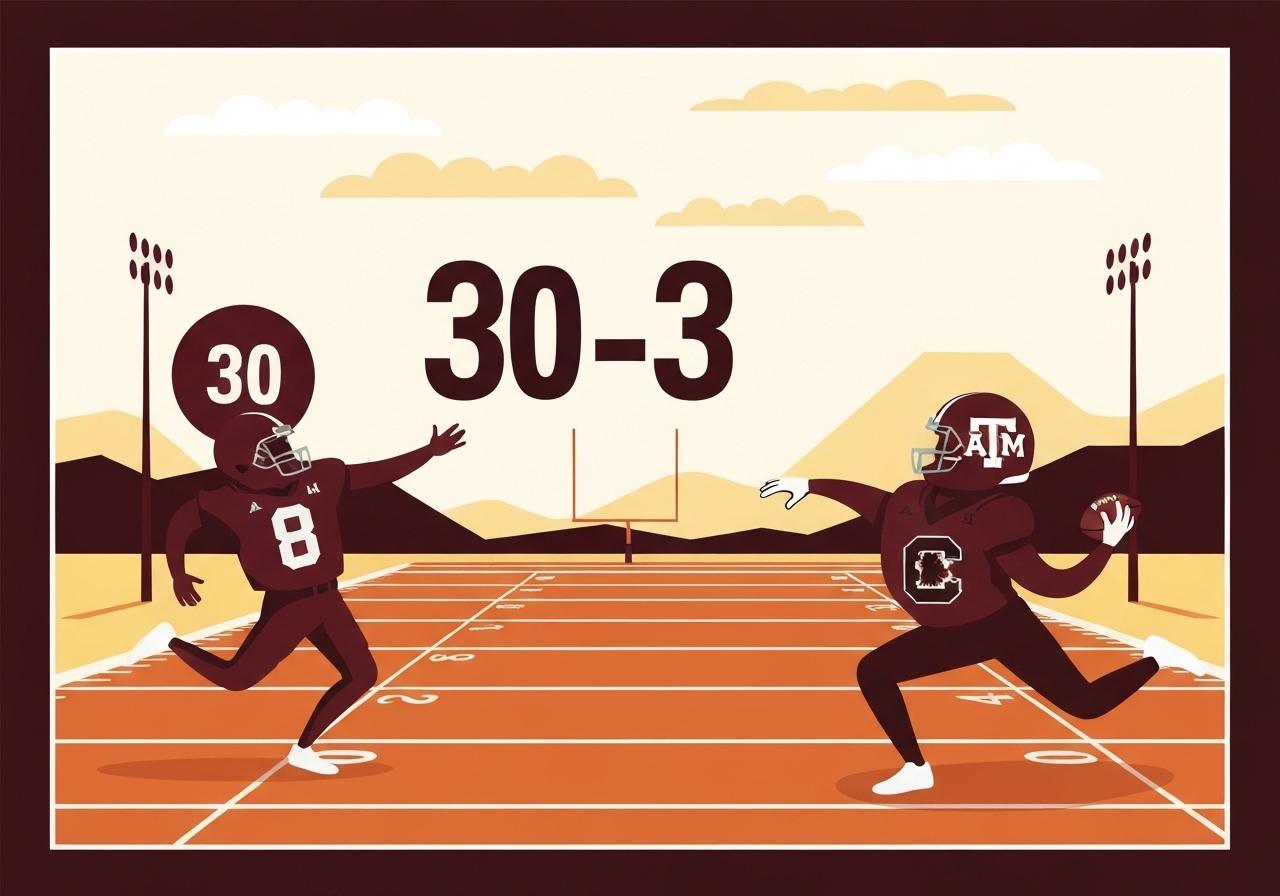
Lead: On Saturday in College Station, No. 3 Texas A&M staged a remarkable second-half comeback to defeat South Carolina 31-30 after trailing 30-3 at halftime. The Aggies outscored the Gamecocks 28-0 after the break, capped by a go-ahead E.J. Smith touchdown with 10:47 remaining. Marcel Reed salvaged the night with a huge passing performance, while South Carolina’s offense stalled in the fourth quarter. The result moved Texas A&M to 10-0 and preserved its SEC title hopes.
Key Takeaways
- Texas A&M trailed 30-3 at halftime but scored 28 unanswered points in the second half to win 31-30.
- E.J. Smith scored the go-ahead touchdown with 10:47 left on a 10-play, 99-yard drive that erased a near-meltdown situation.
- Quarterback Marcel Reed finished 22-of-39 for 439 yards after two first-half interceptions; he engineered three second-half touchdown drives before the final march.
- South Carolina finished with LaNorris Sellers 15-of-30 passing for 246 yards, two TDs and one interception, and the Gamecocks managed just 53 yards on their first five second-half drives.
- Kicker Randy Bond missed two field-goal attempts in the first half, including a 24-yarder after an interception return set Texas A&M up inside the 10.
- The comeback is the largest in Texas A&M program history, though it falls short of the FBS record comeback (Michigan State’s 2006 rally vs. Northwestern).
- Aggies improved to 10-0, keeping them in contention for the SEC title and strengthening their College Football Playoff résumé.
Background
Texas A&M entered the weekend as a top-three team with significant expectations for the SEC race and national playoff picture. A year ago the Aggies were on the cusp of contention before a loss to South Carolina in November contributed to a late-season slide that cost them the conference title opportunity. The program’s recent history has made any stumble in November particularly consequential, so Saturday’s collapse/recovery took on added importance.
South Carolina came into the game prepared to attack early and built a commanding 30-3 halftime lead by converting turnovers and explosive plays into points. The Gamecocks’ game plan produced a 50-yard passing touchdown and a defensive touchdown on a fumble return in the first half, while Texas A&M’s offense committed turnovers and missed scoring chances. The stage was set for what looked like a rout — until the second half.
Main Event
The second half opened with a dramatically different Aggies offense. Texas A&M scored touchdowns on its first four possessions of the half, combining efficient passing from Marcel Reed with timely runs and situational execution. Over three of those drives the Aggies covered 225 yards on 17 plays and turned two of those into passing touchdowns before the final 99-yard march that produced E.J. Smith’s go-ahead score.
Reed’s first-half struggles — two interceptions and several near-misfires that could have been more costly — gave way to a near-flawless second half as he completed 22 of 39 for 439 yards overall. Reed’s adjustments, improved protection and cleaner reads allowed A&M to methodically erase a 27-point deficit in less than 20 minutes of game clock.
South Carolina’s offense could not respond. After the break the Gamecocks managed only 53 yards across their first five drives, repeatedly stalling near midfield or turning the ball over on downs. A trick play near the goal line late in the game produced a fumble that briefly gave South Carolina a window to retake the lead, but the Aggies’ defense forced a turnover on downs soon after to preserve the advantage.
Analysis & Implications
From a team-dynamics standpoint, the comeback underscores Texas A&M’s depth and in-game coaching adjustments. Turning a 30-3 halftime deficit into a win required sustained offensive efficiency and multiple defensive stands; both units delivered in the second half. For the Aggies, the victory highlights an ability to adapt play-calling and reduce unforced errors when the margin for error is smallest.
For South Carolina, the loss will be dissected around missed second-half adjustments and an inability to maintain early-game momentum. The Gamecocks manufactured points through big plays and a defensive scoring play in the first half but could not convert that start into a full-game performance. Questions about late-game offensive play-calling and clock management are likely to surface in postgame evaluations.
In the broader SEC and national landscape, the result keeps Texas A&M’s conference title path open; as of Week 12 no SEC team had clinched a title-game spot. The win strengthens A&M’s position for a conference crown and the College Football Playoff conversation, but remaining work and key upcoming matchups — notably the season finale against Texas — will determine the final standing. Even with an 11-0 mark after next week’s expected win over Samford, the Aggies still require favorable outcomes elsewhere to secure certain scenarios.
Comparison & Data
| Team | Halftime Deficit | Final Score | Year / Note |
|---|---|---|---|
| Texas A&M | Down 27 (30-3) | Won 31-30 | 2025 — largest comeback in school history |
| Michigan State | Down 35 (38-3) | Won 41-38 | 2006 — FBS record comeback |
The table puts Saturday’s turnaround in historical context: A&M’s recovery is the program’s biggest-ever but remains eight points shy of the FBS record set by Michigan State in 2006. Stat lines show a dramatic swing in yards per play and third-down defense after halftime, with Texas A&M converting multiple third downs while South Carolina went cold offensively.
Reactions & Quotes
“An incredible team effort in the second half secured the win.”
Texas A&M athletics (postgame summary)
Texas A&M’s official postgame materials framed the comeback as a collective response: cleaner execution, fewer self-inflicted mistakes and defensive stops at critical moments. The program emphasized resilience and the turnaround’s boost to postseason positioning.
“Disappointed with how the game finished; proud of the fight, but we left things out there.”
South Carolina staff (postgame remarks)
South Carolina’s staff spoke to missed opportunities in the second half and the challenge of protecting a multi-score lead. Analysts noted the Gamecocks’ inability to sustain drives after halftime and the effect of two key sacks and failed short-yardage situations late in the game.
“This ranks among the most dramatic swings of the season and will be studied for both play-calling and momentum management.”
Independent college football analyst
Neutral analysts highlighted the game as a case study in momentum shifts, illustrating how turnovers, special-teams miscues and halftime adjustments can rapidly reverse expectations. The contest will feature in film-room breakdowns around the league.
Unconfirmed
- Specific internal communication or play-call miscommunication on South Carolina’s late fumbled trick play has not been independently confirmed.
- Whether certain penalties or replay reviews affected coaching decisions late in the fourth quarter remains unclear pending official play-by-play and coach explanations.
Bottom Line
Saturday’s result is a defining moment for Texas A&M’s 2025 season: a victory that preserves an unbeaten record and keeps the Aggies in the SEC title hunt. The comeback also serves as evidence that the team can overcome significant adversity in-game — a quality valued by playoff voters and conference decision-makers.
For South Carolina, the loss is a painful lesson in game management and sustaining advantage; the Gamecocks showed the ability to produce big plays but could not maintain it over four quarters. Both programs will head into the final weeks of the regular season with clearer priorities: A&M to maintain consistency and South Carolina to address second-half execution.
Upcoming matchups and conference permutations will ultimately define postseason destinations, but this game will be remembered in Aggie lore as a comeback that kept a national campaign alive.