
Lead
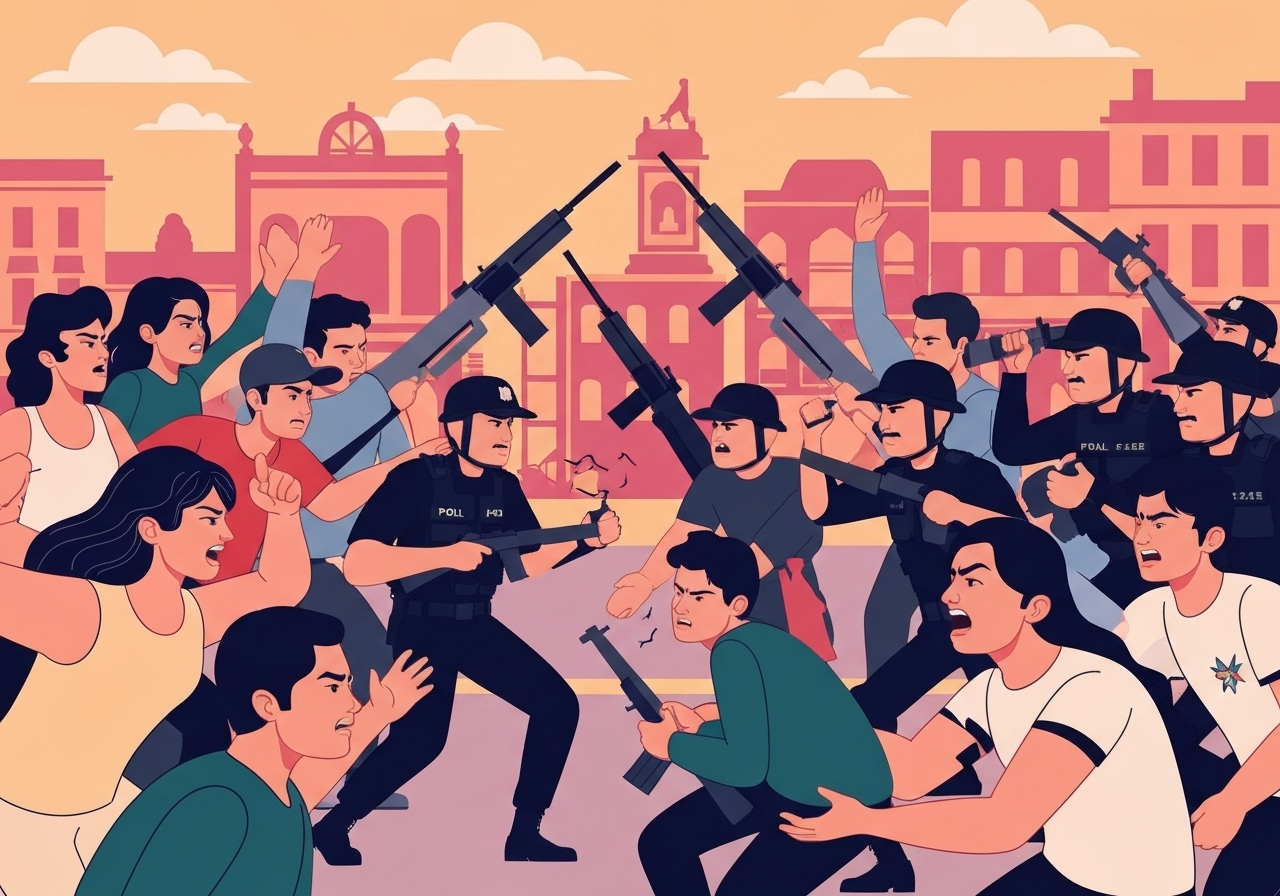
On 16 November 2025 thousands marched through Mexico City to protest the government of President Claudia Sheinbaum after the 1 November assassination of Uruapan mayor Carlos Alberto Manzo Rodríguez. The demonstration, organised initially by young activists from Generation Z, escalated near the National Palace and ended in clashes that left at least 120 people injured. Mexico City security officials said the majority of casualties were police officers, and police used teargas and fire extinguishers to disperse crowds. The unrest adds pressure to Sheinbaum’s administration amid sustained debate over security policy.
Key Takeaways
- At least 120 people were reported injured during the protest; city officials said about 100 were police officers.
- Of the police injured, 40 required hospital treatment for cuts and bruises; authorities reported 20 protesters were also hurt.
- The march began as a Gen Z-organised demonstration but drew support from older opposition sympathisers and regional visitors.
- Protesters gathered outside the National Palace, removing sections of metal fencing and banging on compound barriers.
- Police responded with teargas, shields and fire extinguishers after projectiles were thrown at security forces.
- Many demonstrators displayed banners and the pirate-skull symbol associated with recent Gen Z movements; some chanted demands for greater security.
- President Claudia Sheinbaum, in office since October 2024 and still polling above 70% approval in some surveys, has faced criticism tied to high-profile killings.
- The march was prompted by the 1 November killing of Carlos Alberto Manzo Rodríguez, the mayor of Uruapan, who had campaigned publicly against drug gangs.
Background
Mexico has seen a string of high-profile assassinations of local officials and activists in recent years, prompting public outrage and sustained debate about the federal government’s security strategy. Carlos Manzo Rodríguez, the Uruapan mayor, was killed on 1 November after leading local efforts to confront organised crime in the Michoacán municipality, an area with a long history of cartel activity. His death became a catalyst for civic anger, particularly among younger people who have adopted new protest symbols and digital organising methods.
Generation Z activists in Mexico have increasingly combined street actions with social-media mobilisation, adopting visual emblems such as the pirate-skull flag that have circulated at protests globally. Opposition parties and older activists have at times joined these protests, creating larger, more diverse crowds. President Sheinbaum, who took office in October 2024 and retains strong approval numbers in several polls, has nonetheless faced criticism from both rivals and some voters over continuing violence and impunity in some regions.
Main Event
The demonstration on 16 November began with peaceful marches and rallies in central Mexico City before moving toward the National Palace, the official residence and working site of President Sheinbaum. Organisers said their purpose was to demand stronger security measures and to honour the late mayor from Uruapan. Early in the day the crowd swelled with participants who had travelled from Michoacán and other states, many carrying photos of Carlos Manzo Rodríguez and wearing the pirate-skull emblem.
Authorities said the mobilisation remained calm for several hours until a subset of hooded individuals began breaking through metal fencing and throwing objects toward security personnel. Video and witness accounts showed protesters knocking down portions of the perimeter fencing around the National Palace; police then deployed teargas and used fire extinguishers, while officers also formed shield lines. Municipal security chief Pablo Vázquez described the pivot to violence as the action of a small, masked group within a larger demonstration.
City officials reported about 100 police injuries, with 40 officers taken to hospital for treatment of cuts and bruises; they said 20 protesters were treated for injuries. Protesters said law enforcement’s response—particularly the use of teargas—was heavy-handed. Chanting directed at security forces—such as “This is how you should have protected Carlos Manzo”—underscored grievances about perceived failures to prevent local political killings.
Analysis & Implications
The clashes underscore a widening rift between popular demand for more effective public security and the challenges of policing large, emotionally charged demonstrations. For Sheinbaum’s administration, the incident raises political risks: even with strong approval ratings in many polls, persistent high-profile murders and visible unrest can erode public confidence in long-term security gains. Opposition parties could use the episode to amplify criticism of federal policies, while the government may feel compelled to respond with new or accelerated security measures.
For the Gen Z movement, the event illustrates a double-edged dynamic: broad sympathy for Manzo’s killing and calls for safety have attracted new allies, but association with property damage and clashes can reduce public support for disruptive tactics. The presence of older opposition supporters suggests the protest tapped into wider political currents beyond youth-driven grievances, complicating the movement’s message and the government’s response options.
On policy, authorities face trade-offs between deploying stronger security forces to deter organised crime and avoiding tactics that can inflame civil unrest in urban centres. An escalatory cycle—violent crime prompting protests which then prompt forceful crowd control—could produce both political friction and operational strains on municipal police. International observers will be watching how Mexico balances accountability, protective action for vulnerable local leaders, and civil liberties for demonstrators.
Comparison & Data
| Category | Reported number |
|---|---|
| Total injured | At least 120 |
| Police injured | ~100 (40 hospitalised) |
| Protesters injured | 20 |
| Mayor killed | Carlos Alberto Manzo Rodríguez, 1 Nov 2025 |
The figures above reflect initial official tallies released by Mexico City security authorities. Earlier demonstrations in Mexico have produced a range of casualty totals depending on crowd size, policing tactics and whether clashes occurred near high-security sites; this event’s ratio of police-to-protester injuries is notable and will likely be referenced in internal reviews of crowd-control decisions.
Reactions & Quotes
City security chief Pablo Vázquez framed the episode as a largely peaceful mobilisation that was disrupted by a smaller violent faction.
“For many hours, this mobilisation proceeded and developed peacefully, until a group of hooded individuals began to commit acts of violence.”
Pablo Vázquez, Mexico City security chief
President Sheinbaum responded in the days before the march by accusing rightwing parties of attempting to co-opt the Gen Z movement and alleging foreign-promoted online campaigns. Her office described some social-media activity as amplified by bots; this assertion intensified debate over the protest’s organisers and motives.
“It is a movement promoted from abroad against the government,”
Claudia Sheinbaum, President (statement)
Among demonstrators, visitors from Michoacán emphasised Manzo’s anti-crime efforts as a reason for joining. One attendee described the mayor as a courageous local leader whose death galvanized public anger and demands for security reform.
“He had the guts to confront them,”
Rosa Maria Avila, protester from Michoacán
Unconfirmed
- Degree and specific identities of those described as the “hooded individuals” remain unclear; it is unverified whether they were linked to organised groups or were unaffiliated agitators.
- Claims that the Gen Z demonstration was primarily promoted from abroad and driven by bot networks have been asserted by government sources but lack independent verification.
- Some witness accounts of the sequence of events near the National Palace vary; precise timing and triggers for the deployment of teargas and other crowd-control measures are still under review.
Bottom Line
The 16 November protest in Mexico City reflects a volatile intersection of grief, civic mobilisation and long-standing security challenges. While the bulk of participants reportedly acted peacefully, the emergence of violent episodes during a high-profile demonstration raises questions about protest management and local protection for officials confronting organised crime.
For Mexico’s national leadership, the episode is a reminder that public trust hinges not only on broad approval ratings but on demonstrable results in reducing targeted political violence. The government’s next moves—whether enhanced protection for municipal leaders, new anti-crime operations, or engagement with protest organisers—will shape whether tensions ease or escalate ahead of further public demonstrations.
Sources
- The Guardian — (international news outlet; original reporting)
- Agence France-Presse — (international news agency; correspondent reports)
- Associated Press — (international news agency; field reporting)