
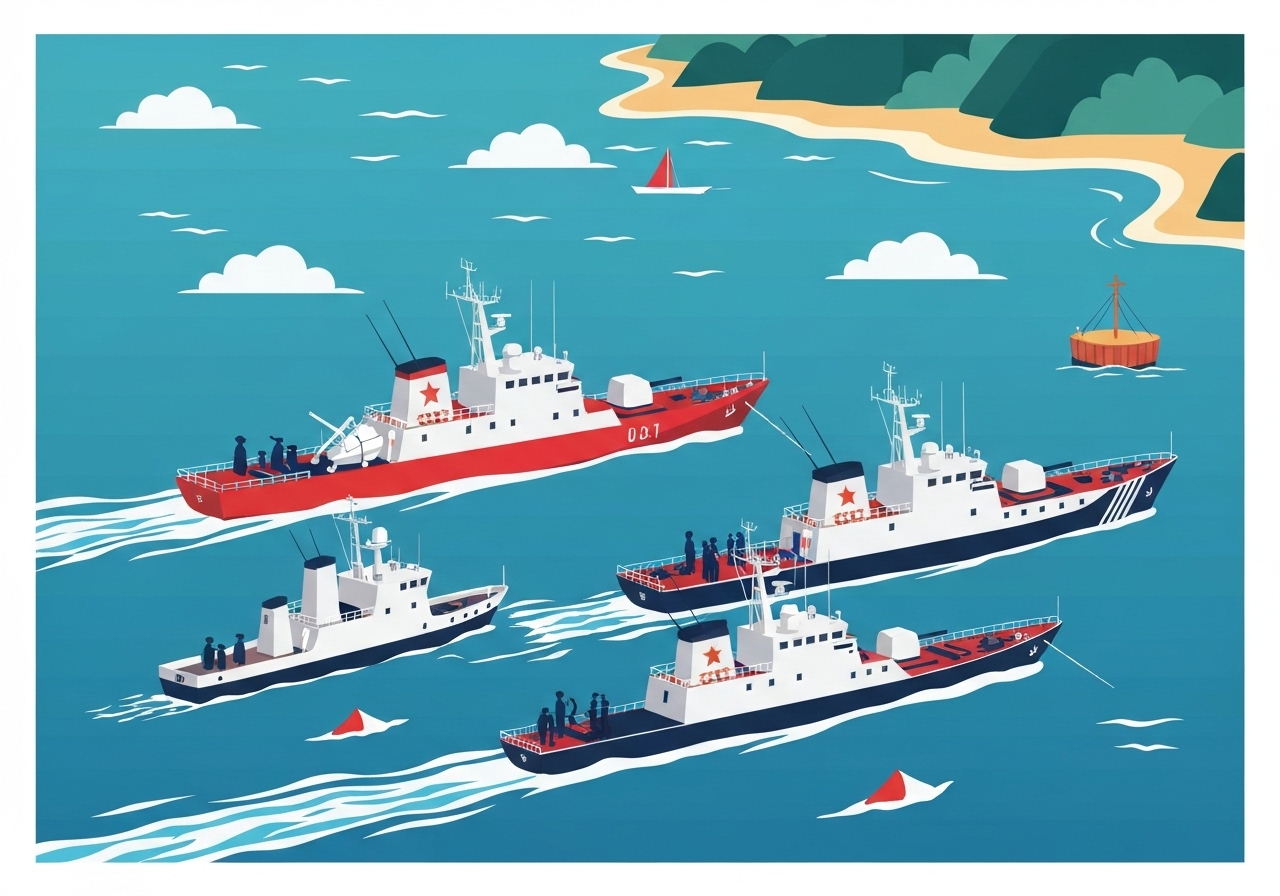
On November 16, 2025, four armed Chinese Coast Guard vessels transited waters administered by Japan near a cluster of uninhabited islands in the East China Sea, prompting renewed diplomatic strain after Japanese Prime Minister Sanae Takaichi’s remarks on Taiwan. State broadcaster CCTV, citing China’s Education Ministry, warned Chinese students planning to study in Japan to monitor local security conditions, and urged those already in the country to stay alert. Japan and China both assert sovereignty over the islands; the passage did not result in reported casualties or arrests but heightened tensions between Tokyo and Beijing. Authorities on both sides said the situation had de-escalated after the vessels left the area later the same day.
Key Takeaways
- Four armed Chinese Coast Guard vessels transited disputed waters on November 16, 2025, in an area administered by Japan in the East China Sea.
- CCTV, quoting the Education Ministry, advised Chinese students bound for or currently in Japan to closely monitor local security conditions.
- The incident followed diplomatic friction triggered by Japanese Prime Minister Sanae Takaichi’s public remarks on Taiwan earlier in November 2025.
- No injuries or detentions were reported; the ships left the area the same day, according to available reports.
- The islands in question are uninhabited but are the subject of overlapping sovereignty claims by China and Japan and have seen increased maritime encounters in recent years.
- Officials described the transit as a routine patrol by Beijing’s coast guard, while Tokyo reiterated it would defend administrative control and its territorial rights.
Background
The island cluster at the center of the dispute lies in the East China Sea and is administered by Japan, though Beijing maintains a competing claim. These islands have been a longstanding flashpoint in Japan-China relations, with recurring maritime incursions, airspace encounters and diplomatic protests over the past decade. Japan has administered the islands continuously in recent decades; China’s increased maritime activity around them has become a routine source of tension, particularly as both sides expand coast guard capabilities.
Diplomatic relations between Tokyo and Beijing have grown more fraught in 2025 after a series of political gestures and statements touching on sovereignty and security in the region. Comments by Prime Minister Sanae Takaichi on Taiwan earlier this month intensified a bilateral spat, prompting Beijing to respond in multiple diplomatic and public-health related channels. Against this backdrop, warnings to nationals abroad and visible coast guard movements can carry outsized symbolic and operational weight.
Main Event
According to state media and foreign reporting, four armed vessels from the China Coast Guard sailed through waters that Japan administers on November 16, 2025. The ships were observed in the vicinity of the uninhabited islands and remained in the area for several hours before departing. Japanese authorities monitored the passage, lodging diplomatic notes and tracking the vessels’ movements via maritime surveillance assets.
CCTV, citing China’s Education Ministry, issued guidance to Chinese students in Japan and those preparing to travel, advising heightened vigilance and situational awareness. The broadcaster framed the advisory as a precaution tied to the broader diplomatic tensions following Prime Minister Takaichi’s remarks on Taiwan. Tokyo’s response emphasized the islands’ administrative status and reiterated that it would take necessary measures to uphold its territorial administration.
There were no public reports of clashes, detentions or damage to vessels during the transit. Both sides characterized immediate operational activity as limited in scope: Beijing as coast guard routine, and Tokyo as an unwarranted intrusion in waters under its control. International observers and regional navies tracked the episode as part of a pattern of maritime signaling and presence operations in the East China Sea.
Analysis & Implications
The transit illustrates several intersecting dynamics: maritime signaling, domestic political posturing, and the risks of rapid escalation in contested waters. Coast guard deployments allow states to demonstrate presence without deploying naval combat units, but armed coast guard vessels still raise the stakes for incident management and rules-of-engagement. In this case, the absence of violence reduced immediate risk, but the pattern contributes to cumulative tensions.
For Beijing, visible coast guard movements can project resolve over territorial claims while avoiding the international optics of warship confrontations. For Tokyo, repeated transits test surveillance, legal defenses and crisis-response arrangements. Both capitals face domestic audiences attentive to sovereignty and national security, which can constrain diplomatic flexibility and increase incentives for reciprocal measures.
Regionally, frequent maritime encounters complicate broader stability across East Asia. Allies and partners — including the United States and regional maritime states — monitor such incidents for indications of shifting gray-zone tactics. If encounters become more frequent or are accompanied by escalatory steps (air intercepts, fishing vessel incidents, or physical boardings), the probability of miscalculation rises and crisis-management channels will be further stressed.
Comparison & Data
| Feature | Japan (Administering State) | China (Claimant) |
|---|---|---|
| Administrative control | Effective administration and routine patrols | Competing sovereignty claim, increased maritime activity |
| Recent incident (Nov 16, 2025) | Observed transit of 4 armed ships; monitoring and diplomatic note | Described as coast guard passage; state media issued advisories |
The table summarizes the immediate juxtaposition of administrative control and competing claims. While the islands are administered by Japan, China’s coast guard operations and state communications reflect an assertion strategy that uses maritime presence and public advisories to influence both domestic and international narratives. Tracking the frequency and nature of such transits is crucial for assessing trajectory of bilateral tensions.
Reactions & Quotes
Chinese students already in Japan and those planning to go there should closely monitor the local security situation,
CCTV (quoting China’s Education Ministry)
The state broadcaster framed the advisory as a precaution for nationals abroad amid bilateral tension. Chinese government channels used the guidance to signal concern for citizen safety while highlighting the diplomatic rift.
Such movements raise the risk of miscalculation in a crowded maritime environment,
Regional security analyst
Security analysts noted that even coast guard transits carry escalatory potential because of close approaches, differing rules of engagement, and civilian vessels in the same corridors. Analysts urged enhanced communication channels to manage incidents and prevent unintended clashes.
Unconfirmed
- Whether the Chinese vessels carried weapon systems beyond standard coast guard armaments has not been independently verified.
- The intent behind the transit—whether a planned demonstration, routine patrol, or retaliatory signal tied to Prime Minister Takaichi’s remarks—remains unconfirmed.
- Any private diplomatic exchanges between Tokyo and Beijing on this specific passage have not been publicly disclosed and are unverified.
Bottom Line
The November 16, 2025 transit of four armed China Coast Guard vessels through waters administered by Japan did not produce violence but intensified an already strained bilateral relationship. The accompanying advisory to Chinese students and the diplomatic reverberations illustrate how political statements—such as those by Prime Minister Sanae Takaichi on Taiwan—can cascade into maritime signaling and public cautions for citizens abroad.
Looking ahead, policymakers in Tokyo and Beijing face a choice: manage maritime friction through clearer communication, incident-prevention measures and diplomacy, or allow incremental actions to harden positions and risk broader escalation. Regional stakeholders and partners will closely monitor subsequent patrol patterns, official exchanges and any changes to crisis-management mechanisms.
Sources
- Bloomberg — International news reporting and timeline (media)
- CCTV — State broadcaster report citing China’s Education Ministry (state media)
- Japan Ministry of Foreign Affairs — Official statements and diplomatic guidance (official)