
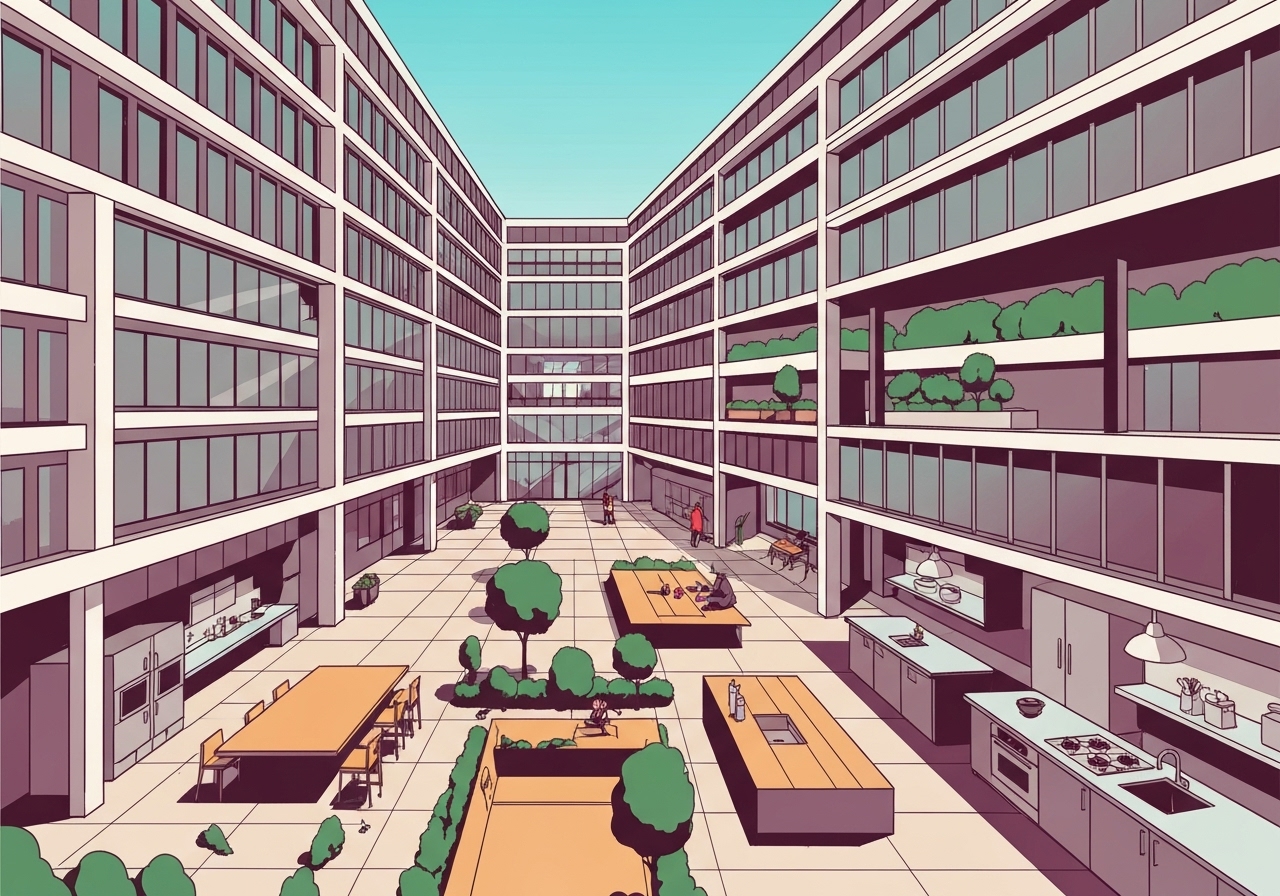
Ford unveiled its new 2.1-million-square-foot world headquarters in Dearborn, Michigan, in a ceremonial opening on Nov. 16, 2025, while construction is expected to continue through 2027. The single campus — nicknamed “The Hub” — consolidates multiple sites and will ultimately house up to 4,000 executives and staff, replacing a 12-story Glass House facility roughly three miles away. The building is split roughly evenly between design operations and corporate workspaces, and features extensive communal amenities including a 160,000-square-foot dining hall, six interior courtyards and advanced design studios. Executives say the facility is intended to encourage collaboration, support the Ford+ turnaround plan and entice salaried employees back to the office after pandemic-era hybrid schedules.
Key Takeaways
- The new Dearborn headquarters totals 2.1 million square feet and is expected to continue finishing work into 2027.
- The campus is designed for up to 4,000 executives and staff involved in daily business, design and product development.
- A 160,000-square-foot dining area houses eight rotating “kitchen concepts,” including $6 whole rotisserie chickens and a herb-garden juice bar.
- The facility combines large design studios, a modern showroom and a 64-foot screen for virtual reviews and testing.
- Exterior features include enhanced walkability, a test track and an 18-acre “Horsepower Park” adjacent to the building.
- The project continues a campus transformation linked to an earlier $1 billion effort begun under former CEO Jim Hackett.
- Interior branding is subtle: a giant blue oval will appear externally, while interior glass patterns encode Ford patent numbers rather than overt logos.
Background
Ford has occupied multiple headquarters since its founding in 1903; the new Dearborn campus replaces the company’s 12-story rectangular Glass House and marks the automaker’s sixth headquarters. The move reflects a broader corporate strategy to consolidate dispersed operations into a single, multifunctional campus that blends design, engineering and corporate functions under one roof. The shift also aligns with Ford’s public commitments to efficiency and transformation articulated in the Ford+ plan introduced by CEO Jim Farley in 2021.
The office redesign comes after a prolonged period of hybrid work arrangements following the COVID-19 pandemic. As of year-end 2024, Ford reported roughly 30,500 U.S.-based salaried white-collar employees; company guidance shared earlier in 2025 expected many of those employees to be in the office at least four days per week. Company real-estate leadership framed the new building as a productivity tool—designed to reduce “domain staking” where workers try to claim permanent desks—and to enable flexible, team-focused “neighborhoods” that match tasks and collaboration needs.
Main Event
The ceremonial opening on Nov. 16, 2025, showcased both the public-facing and operational elements of the campus. Visitors were shown a large central lobby, broad staircases intended to encourage walking, a coffee bar overlooking automotive artwork and display areas that blur corporate and design identities. Outside the building the company staged a large blue oval installation; inside, branding is intentionally subdued with patent-number motifs embedded in glass walls.
Design operations occupy about half of the interior footprint and include multiple private studios arranged around six courtyards. A dual-level courtyard at the heart of design studios allows modelers and designers to move prototypes outdoors for evaluation in natural light. The studios are equipped with clay milling machines and a showroom that functions as a modern design dome, centered on a 64-foot screen for virtual review and testing.
The other half of the headquarters houses corporate functions, open work areas and meeting neighborhoods rather than traditional private offices, except for top executives. Stairs are treated as architectural features with generous widths, seating zones and visual journeys so employees will opt for them over elevators. The surrounding campus improvements include new pedestrian connections, a test track and an 18-acre landscaped Horsepower Park intended for employees and visitors.
Analysis & Implications
Ford’s new headquarters is as much a cultural signal as it is a physical asset. By investing in shared amenities — notably the large dining complex with eight kitchen concepts and a herb garden juice bar — Ford aims to make on-site work more attractive and to embed informal cross-team interactions into daily routines. For a company pursuing the Ford+ efficiency agenda, the facility also serves as a centralized hub for product development and faster decision-making between design and business teams.
The capital outlay underscores a bet that in-person collaboration will deliver returns in speed and innovation, particularly for complex hardware and vehicle design where physical prototyping and collective review remain important. For recruitment and retention, a modern campus can be a differentiator in a competitive labor market for designers, engineers and product managers. However, the full payback depends on sustained occupancy levels and operational discipline to avoid underused space or higher-than-expected facilities costs.
Locally, consolidating offices into a single Dearborn site will affect commuting patterns, nearby real-estate demand and the fate of the outgoing Glass House building planned for demolition. The project also raises questions about long-term real-estate strategy for multinationals: whether firms will replicate campus consolidation or continue to distribute remote-first teams across geographies. Environmental and community impacts from construction and increased foot traffic will be watched by local planners and stakeholders.
Comparison & Data
| Feature | Old Glass House | New Hub (Dearborn) |
|---|---|---|
| Footprint | 12 stories, rectangular (city site) | 2.1 million sq ft, four stories |
| Planned occupants | Previous corporate workforce (varied) | Up to 4,000 executives & staff |
| Dining | Standard cafeteria | 160,000 sq ft, 8 kitchen concepts |
| Design facilities | Limited studio space | Large studios, 6 courtyards, 64-foot screen |
The table highlights a move from a vertical, older urban headquarters toward a sprawling, horizontally arranged campus that prioritizes integrated design and workplace amenities. The new layout reduces reliance on elevators, increases natural light via glass walls and skylights, and centralizes product development tools previously scattered across multiple properties.
Reactions & Quotes
Company leaders framed the new campus as a tool to support collaboration and the Ford+ turnaround.
“This is a space that is a tool for our employees to be more productive, to be more collaborative, and really help deliver the Ford+ plan,”
Jim Dobleske, Ford Land chair and CEO (company official)
Design and operations staff emphasized practical choices that support creative work.
“We wanted to do something different, push the boundary of business dining,”
Grant Vella, executive chef for the new headquarters (operations lead)
Workplace managers noted behavioral design choices to discourage permanent desk claims.
“Domain staking will be discouraged — the building is organized into neighborhoods so people can choose spaces based on what they’re doing each day,”
Jennifer Kolstad, global design and brand director, Ford Land (company official)
Unconfirmed
- Exact total capital expenditure for the Dearborn headquarters was not disclosed by Ford; public references link the project to an earlier $1 billion campus transformation but company-specific totals remain unreported.
- The timetable and precise schedule for demolition of the prior 12-story Glass House building have been announced in broad terms, but specific demolition dates and permits were not confirmed in company statements.
- Long-term occupancy and routine on-site attendance levels beyond the company’s guidance (many salaried staff expected on-site four days weekly) will depend on future policy updates and were not fixed at opening.
Bottom Line
Ford’s new Dearborn headquarters is a strategic bet that physical proximity, purpose-built design spaces and amenities will accelerate product development and support cultural change under the Ford+ plan. The campus consolidates thousands of roles and blends corporate and creative functions to reduce friction between design and business decision-making.
What to watch next: whether the Hub sustains consistent occupancy, how quickly the company achieves operational efficiencies tied to consolidation, and the practical outcomes in product development cadence and hiring. Local impacts—traffic, land use and the eventual fate of the Glass House—will also determine how the project is judged by community and market observers.
Sources
- CNBC — news reporting and photographs (media)
- Ford Motor Company — corporate site and company statements (official)