
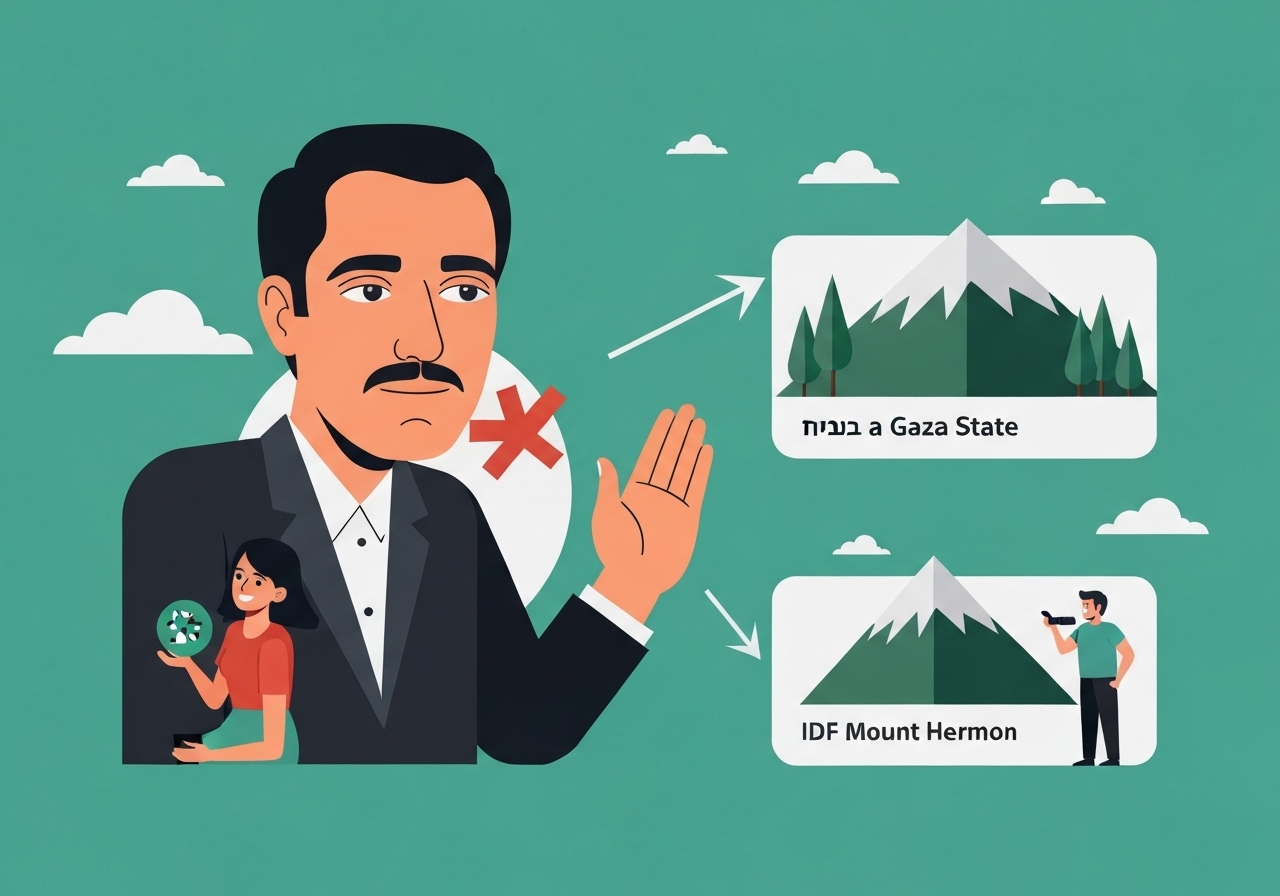
Lead: On November 16, 2025, Israeli Defence Minister Israel Katz publicly rejected near‑term proposals to establish a Palestinian state amid talks tied to former U.S. President Donald Trump, and he confirmed an ongoing Israel Defense Forces (IDF) presence on Mount Hermon. Katz framed the position as coordinated with Prime Minister Benjamin Netanyahu, saying both leaders will oppose concrete statehood measures for the foreseeable future. The statements came as Katz traveled domestically and addressed security concerns tied to Israel’s northern border. The comments have immediate diplomatic and political implications for Israeli‑Palestinian negotiations and regional stability.
Key Takeaways
- On November 16, 2025, Defence Minister Israel Katz said Israel will reject concrete attempts to establish a Palestinian state in the foreseeable future; he linked the stance to ongoing negotiations involving Donald Trump.
- Katz confirmed an active IDF presence on Mount Hermon, underscoring the mountain’s strategic role on Israel’s northern border with Lebanon and Syria.
- Prime Minister Benjamin Netanyahu is reported to share Katz’s position, signaling unified government opposition to near‑term statehood moves.
- Katz’s remarks followed public appearances and domestic travel, including a reported visit to Mahaneh Yehudah Market on September 2, 2025, noted in coverage of his activities.
- The comments are likely to affect U.S. mediation efforts and regional diplomacy, with implications for Palestinian leadership response and international stakeholders.
- Public and international reactions are emerging; official U.S. positions on any specific proposals tied to the talks have not been published in full by U.S. or Israeli authorities as of Nov. 16, 2025.
Background
Israel’s debate over Palestinian statehood has long been central to its domestic politics and foreign relations. Successive Israeli governments have differed over conditional frameworks, security arrangements, and timelines; since 2024, the current government led by Prime Minister Benjamin Netanyahu has tended toward greater skepticism of immediate statehood. Defence Minister Katz, a senior cabinet member, has been a consistent voice opposing concessions that, in his view, would compromise Israel’s security posture.
Mount Hermon sits at a geopolitically sensitive point on Israel’s northern frontier, overlooking parts of Lebanon and Syria. Military control or observation points there have strategic value for surveillance and deterrence; the IDF’s presence has been periodically adjusted in response to regional tensions. Negotiations or proposals that touch on territorial arrangements or security guarantees therefore draw direct attention to deployments such as those on Hermon.
Former U.S. President Donald Trump has remained active in Middle East diplomacy since leaving office, promoting proposals and shuttle diplomacy in some quarters. Reports that link recent discussions to Trump’s initiatives have raised questions about how far external mediation might influence Israeli cabinet decisions. Israeli leaders face domestic political pressures as well as international expectations, and announcements on statehood or security deployments are read through those intertwined lenses.
Main Event
On November 16, 2025, Katz addressed reporters and supporters, stating that he and Prime Minister Netanyahu would oppose concrete proposals to create a Palestinian state for the foreseeable future. He characterized the position as driven by security concerns and by a belief that current conditions do not support a viable, secure Palestinian polity. Katz singled out the need for clear guarantees on demilitarization and border control before any such step could be contemplated.
Separately, Katz confirmed that IDF forces maintain a presence on Mount Hermon, a point of longstanding military significance. He said the deployment supports surveillance and rapid response along the northern approaches and was necessary given regional volatility. The confirmation followed inquiries from domestic media about troop posture in the area and came amid heightened attention to northern border security after clashes elsewhere in the region.
The defence minister’s remarks were made in a domestic context: Katz had been visible in public settings in Jerusalem and elsewhere in recent weeks, including a reported visit to Mahaneh Yehudah Market on September 2, 2025. Officials framed his statements as a reiteration of government policy rather than a new diplomatic offer. Government spokespeople emphasized coordination between the Defence Ministry and the Prime Minister’s office.
Analysis & Implications
Katz’s categorical rejection of near‑term statehood proposals reinforces a hardline posture within the Israeli cabinet and narrows the political space for immediate Israeli concessions. Domestically, that stance is likely to consolidate support among voters and parties prioritizing security and territorial control, while deepening opposition from constituencies and international actors that favor renewed steps toward Palestinian sovereignty. The political calculus in Jerusalem now weighs short‑term stability and electoral dynamics against long‑term diplomatic costs.
Internationally, the move complicates mediation efforts tied to Donald Trump and other external actors, who may be seeking to relaunch or reframe talks. If the Israeli government publicly rejects concrete statehood measures, mediators will need to decide whether to press proposals, adjust parameters to address Israeli security demands, or pursue incremental confidence‑building steps instead. Responses from the Palestinian leadership and key regional actors—including Egypt, Jordan, and the Gulf states—will shape the practical prospects for any renewed negotiations.
On the ground, confirming an IDF presence on Mount Hermon signals that Israel is prioritizing northern deterrence and intelligence collection amid cross‑border threats. That posture could reduce immediate security risks from the north but also raise tensions with non‑state actors and neighboring states that perceive increased militarization. Sustained deployments may become a bargaining chip in any future security arrangements tied to political negotiations.
Comparison & Data
| Actor | Position (2024) | Position (Nov 16, 2025) |
|---|---|---|
| Netanyahu government | Conditional skepticism toward immediate statehood | Firm rejection of concrete statehood measures for foreseeable future |
| Israel Katz | Advocated strict security prerequisites | Publicly reiterated rejection; confirmed IDF Hermon presence |
| U.S. mediation (reported) | Periodic engagement; varied approaches | Reports of proposals tied to Donald Trump; details not fully public |
The table summarizes shifts in public posture rather than numerical indicators. While public statements show a hardening stance within Israel’s leadership, specific proposals, timelines and technical security arrangements remain either unpublished or in private discussions. Analysts will watch for shifts in language or for brokered compromises that address Israel’s stated security conditions.
Reactions & Quotes
“For the foreseeable future we will not accept concrete measures that establish a Palestinian state without ironclad security guarantees,” Katz said, framing the stance around defence needs.
Israel Katz, Israeli Defence Minister (public statement)
“The government must first be assured that any arrangement preserves Israel’s security along both northern and southern fronts,” a senior government official said, stressing coordination with the prime minister’s office.
Government official (on condition of anonymity)
“External proposals must meet the realities on the ground — including clear mechanisms for demilitarization and control of border crossings,” said a regional security analyst, describing likely negotiation sticking points.
Regional security analyst
Unconfirmed
- Specific contents of any proposals reportedly put forward by or discussed with Donald Trump have not been publicly released and remain unverified.
- Detailed troop numbers or the exact operational posture of IDF units on Mount Hermon were not disclosed alongside Katz’s confirmation of a presence.
- Any private agreements between Israeli cabinet members and foreign mediators relating to statehood concessions have not been made public and cannot be confirmed.
Bottom Line
Katz’s public rejection of near‑term Palestinian statehood proposals, coupled with confirmation of IDF activity on Mount Hermon, signals a clear Israeli preference for prioritizing security and maintaining the status quo in the short term. The unified posture with Prime Minister Netanyahu reduces the likelihood of immediate Israeli concessions in multilateral or U.S.‑led talks.
For mediators and regional partners, the question now is whether any future proposals can be reframed to meet the security prerequisites Israel insists upon or whether diplomacy will shift toward incremental confidence‑building measures. Observers should watch for further official statements, any publication of negotiating texts, and responses from Palestinian leadership and key regional governments.
Sources
- The Jerusalem Post — news media report summarizing Katz’s statements and related coverage (Nov. 16, 2025)