
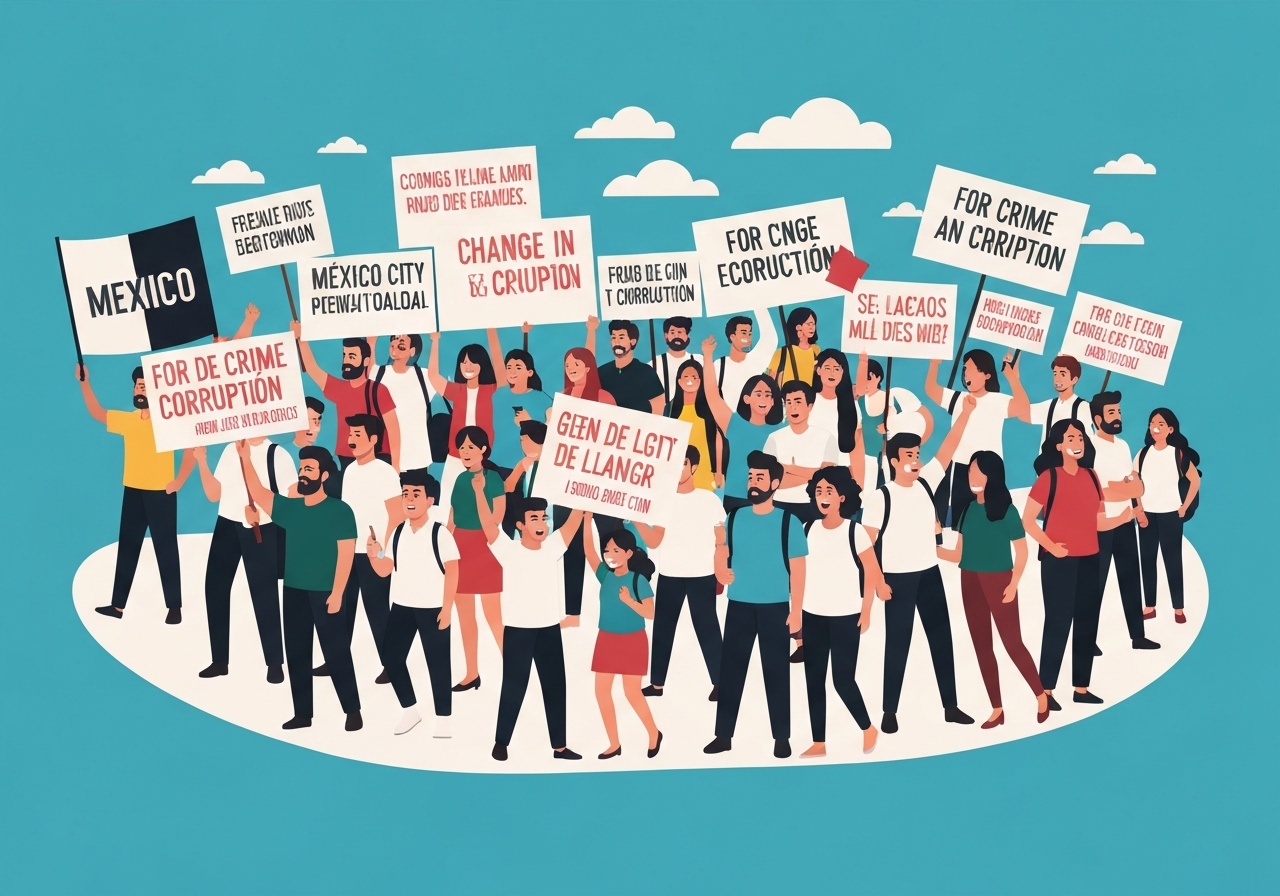
On Nov. 15 in Mexico City’s Zócalo, several thousand people marched to demand action on crime, corruption and impunity in a demonstration initiated by members of Generation Z and later joined by older opposition supporters. The protest remained largely peaceful for hours but ended with clashes between some youths and police, leaving 120 people injured, including about 100 officers, and 20 people detained. Organizers and participants said the rally reflected deep frustration with systemic failures to curb violent crime and hold perpetrators to account. Officials and political figures offered sharply different readings of who organized and supported the mobilization.
Key Takeaways
- Attendance: Several thousand people gathered in Mexico City’s main square on Nov. 15 to protest crime and corruption.
- Casualties and arrests: Local authorities reported 120 injured (about 100 police officers) and 20 arrests after clashes with some demonstrators.
- Violence reported: Police said protesters threw stones, fireworks and used sticks and chains; some officers’ shields and equipment were seized.
- Leadership and demographics: The demonstration was organized by young activists identified with Gen Z but drew backing from older opposition supporters, including public figures.
- Political response: President Claudia Sheinbaum retained relatively high approval ratings even as authorities face criticism over impunity and high-profile murders.
- International context: Activists born in the late 1990s to early 2010s have staged protests elsewhere this year, notably large anti-government actions in Nepal in September.
- Local voices: Participants included 29-year-old Andres Massa and 43-year-old physician Arizbeth Garcia, who framed the march as a call for security and stronger public services.
Background
Young people across multiple countries have mobilized this year to protest inequality, democratic erosion and corruption. In several places, Gen Z activists have used social media to organize rapid, high-profile demonstrations; the largest cited example this year occurred in Nepal in September, where a ban on social platforms helped trigger mass street protests that pressured political change. In Mexico, frustration among younger generations has been driven by persistent violent crime, perceived impunity for perpetrators and slow institutional responses.
Mexico has seen a string of high-profile killings in recent months that have intensified public debate about security policy and political accountability. Opposition leaders and civil-society groups say impunity remains a central problem: victims’ families often report limited investigative progress and few convictions. At the same time, President Claudia Sheinbaum maintains notable public support, complicating calls for urgent political change from protesters and critics alike.
Main Event
The Nov. 15 march began as an urban, youth-led demonstration focused on calls for greater safety, anti-corruption measures and demand for investigations into recent murders. Organizers said they sought a broad, peaceful turnout; many participants carried symbolic items associated with the Gen Z movement, including a pirate skull flag cited by attendees. As the day progressed, older opposition supporters and local activists joined, swelling the crowd and altering the event’s composition.
Late in the demonstration some groups clashed with police. Authorities said officers were attacked with stones, fireworks, sticks and chains, and that police shields and equipment were seized during confrontations. The city’s security secretary, Pablo Vázquez, provided the official injury and arrest figures: 120 people hurt and 20 detained, with about 100 injured being members of the police force.
Voices from the crowd expressed varied grievances. A 29-year-old business consultant described the march as a demand for more security, while a 43-year-old physician emphasized the risks health workers face amid widespread violence and the need for increased funding for public health. Supporters of the recently killed Michoacán mayor Carlos Manzo attended wearing the straw hats associated with his movement, linking local grievances to the national protest.
Analysis & Implications
The demonstration illustrates how a youth-driven movement can catalyze broader political engagement when older constituencies and established figures lend support. The mix of generations can increase turnout and visibility but may also invite competing agendas, making cohesive demands harder to sustain. In Mexico’s polarized environment, the infusion of high-profile backers from the political right and business sphere risks reframing a youthful civic protest as a partisan event.
Public-safety metrics and political approval ratings will shape the fallout. Even with Sheinbaum’s relatively high approval, persistent reports of unresolved murders and widespread criminal activity can erode trust over time; protesters are seeking concrete policy changes, not only symbolic attention. Authorities face the dual challenge of restoring public order when clashes occur while addressing the underlying causes — investigations, prosecutions and institutional reforms — that drive recurring demonstrations.
Economically, recurring unrest and perceptions of insecurity can deter investment and tourism in affected areas, though the short-term economic impact of a single protest is usually limited. Internationally, Mexico’s protests feed into a broader narrative about Gen Z’s growing role in civic life, suggesting these cohorts will be an enduring force in future elections and issue-based campaigns.
Comparison & Data
| Metric | Nov. 15 Mexico City Rally |
|---|---|
| Estimated attendance | Several thousand |
| People injured | 120 (≈100 police officers) |
| Arrests | 20 |
The table above summarizes the verified operational figures released by city authorities. While attendance is reported in broad terms as “several thousand,” official injury and arrest counts come from the capital’s security secretary; independent counts of participants and a full incident timeline have not been published. Comparing this event to other Gen Z-led actions globally highlights a pattern of rapid mobilization coupled with uneven outcomes: some protests led to political concessions (as reported in Nepal), while others have prompted limited policy shifts.
Reactions & Quotes
“We need more security.”
Andres Massa, 29, demonstrator
Massa framed the protest as a straightforward demand for safer streets and stronger public institutions, echoing many young attendees’ motivations.
“Doctors are also exposed to the insecurity gripping the country, where you can be murdered and nothing happens.”
Arizbeth Garcia, 43, physician
Garcia linked the call for security to broader public-service concerns, stressing that threats extend into hospitals and clinics.
“The state is dying.”
Rosa Maria Avila, 65, Michoacán supporter
Avila connected the protest to the recent killing of Michoacán Mayor Carlos Manzo and framed the demonstration as a response to perceived failures to confront organized crime.
Unconfirmed
- The claim by President Sheinbaum that right-wing parties used bots and attempted to infiltrate the Gen Z movement has not been independently verified in public reporting.
- Reports that some social media influencers withdrew support ahead of the march are partial; the extent and impact of those withdrawals on turnout remain unclear.
Bottom Line
The Nov. 15 rally in Mexico City’s Zócalo underscores growing frustration among younger Mexicans over crime, corruption and perceived impunity, while also demonstrating how cross-generational support can amplify a protest’s visibility. Verified figures from city officials — 120 injured and 20 arrested — show the event turned violent in spots, complicating the narrative of a purely peaceful youth movement.
Looking ahead, authorities’ ability to investigate high-profile killings, prosecute perpetrators and improve public safety will shape whether such protests evolve into sustained political pressure or episodic street actions. For observers, the key questions are whether Gen Z organizers can maintain an independent agenda and whether policy responses address the structural problems protesters have highlighted.
Sources
- NBC News (media)
- Mexico City Government (official)