
Lead
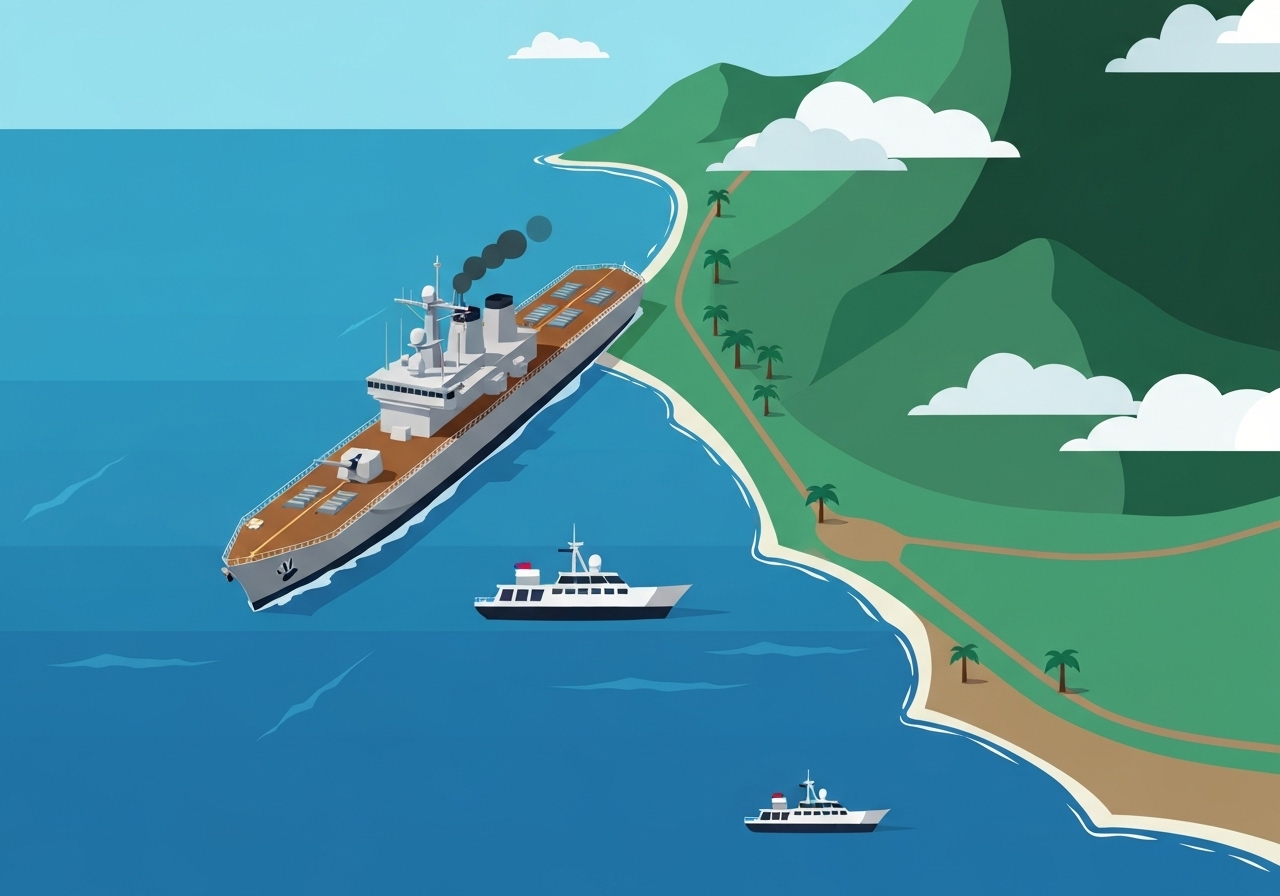
On Sunday the nuclear-powered aircraft carrier USS Gerald R. Ford entered the Caribbean Sea, joining a U.S. force that Defense officials describe as the largest regional buildup in generations. The deployment, announced in a U.S. military news release, comes amid a campaign the administration calls counterdrug operations but that critics see as pressure on Venezuelan President Nicolás Maduro. Since early September, U.S. strikes on small boats have killed at least 80 people in 20 separate attacks, and the Ford’s arrival elevates the military presence to roughly 12,000 personnel aboard nearly a dozen Navy vessels. The move has stirred alarm across the hemisphere and sharpened debate over the legal and strategic justification for expanded use of force.
Key Takeaways
- The USS Gerald R. Ford entered Caribbean waters on Sunday as part of a larger U.S. naval buildup, the Navy said.
- The deployment joins about 12,000 U.S. troops and almost a dozen ships operating under what Defense Secretary Pete Hegseth called “Operation Southern Spear.”
- Since early September, U.S. strikes on small boats have resulted in at least 80 deaths across 20 attacks in the Caribbean and eastern Pacific.
- The Ford’s carrier strike group transited the Anegada Passage near the British Virgin Islands en route to the operating area.
- U.S. officials frame the deployment as counterdrug operations; critics and regional leaders see it as coercive pressure on Venezuela’s government.
- Venezuelan authorities announced large-scale mobilization of troops and civilians in response; President Nicolás Maduro has rejected U.S. accusations and called them fabricated.
- International reactions include concern from the U.N. human rights office and requests from U.S. lawmakers for more legal and factual justification for the strikes.
Background
The Ford’s arrival is the latest episode in a months-long escalation of U.S. military activity near Venezuela. The Trump administration has characterized its operations as an effort to interrupt drug flows into the United States, while also publicly stigmatizing the Maduro government as complicit in narcotics transit. Those competing narratives reflect broader regional tensions: several Latin American capitals and international organizations have expressed unease about the prospect of sustained U.S. military pressure in the hemisphere.
Carriers are traditionally used by the United States to project power and to deter adversaries because they carry aircraft able to strike deep inland without relying on foreign bases. Officials assert the presence of a carrier strike group increases surveillance and interdiction capacity at sea, but analysts note carriers are not optimized for counter-narcotics work against fast-moving, small maritime craft. The U.S. has nonetheless pursued a stepped-up campaign since early September that officials say targets drug-trafficking operations in the Caribbean and eastern Pacific.
Main Event
The USS Gerald R. Ford, a 100,000-ton carrier, joined a flotilla transiting the Anegada Passage near the British Virgin Islands before moving into broader Caribbean operations, the Navy statement said. Rear Adm. Paul Lanzilotta, commander of the carrier strike group, said the Ford will strengthen an already sizable constellation of U.S. warships tasked with what he described as protecting national security and prosperity against “narco-terrorism” in the Western Hemisphere.
Defense Secretary Pete Hegseth has referred to the deployment as part of “Operation Southern Spear,” a designation the administration uses to describe coordinated naval deployments and interdiction efforts. The carrier group brings fighter squadrons and guided-missile destroyers to the region, increasing the military’s surveillance and strike options at sea and, potentially, influencing political calculations in Caracas.
U.S. forces have conducted strikes on small boats since early September; U.S. authorities say those vessels were involved in drug trafficking and hostile activity, while they have not publicly released detailed evidence linking each incident to transnational criminal groups. The strikes—20 attacks resulting in at least 80 deaths according to military tallies—have prompted legal and political questions in Washington and among regional partners about the scope of U.S. authority to use lethal force at sea.
Analysis & Implications
Strategically, the Ford’s deployment serves multiple purposes: it visibly demonstrates U.S. conventional military capacity in proximity to Venezuela, it expands aerial reconnaissance and strike options at sea, and it communicates resolve to both domestic and foreign audiences. For the administration, the presence of a carrier can be framed as a deterrent that raises the political cost for the Venezuelan government of further provocations. However, carriers are high-profile assets whose visibility can intensify regional alarm and complicate diplomatic options.
Operationally, experts caution that a carrier strike group excels at large-scale maritime and air operations but is not specialized for chasing small, fast boats typically used in drug trafficking. That mismatch raises questions about effectiveness: while the Ford can support surveillance and provide logistical reach, interdiction of small craft usually relies on smaller surface vessels, maritime patrol aircraft, and law-enforcement cooperation with regional partners.
Politically, the deployment could deepen polarization. In the United States, some lawmakers from both parties have demanded classified briefings or legal justifications for recent strikes and for any expansion of kinetic activity. In Latin America, the move risks rallying popular and governmental support behind Maduro even as it alarms neighboring states that fear escalation or unintended incidents at sea. International human-rights bodies have also pressed for transparency about civilian harm and legal grounds for use of force.
Comparison & Data
| Metric | Count/Description |
|---|---|
| Carrier | USS Gerald R. Ford (100,000 tons) |
| Personnel and ships | Approximately 12,000 personnel on nearly a dozen Navy vessels |
| Strikes since early September | 20 attacks on small boats |
| Reported deaths | At least 80 people |
The table summarizes the public figures the U.S. military and media have reported: 20 strikes and at least 80 fatalities tied to operations in the Caribbean and eastern Pacific since early September, plus the Ford’s addition to a roughly 12,000-strong force. These numbers frame the scale of the last months’ campaign and underline why the carrier’s arrival is viewed as a significant escalation in material terms.
Reactions & Quotes
U.S. military and administration officials emphasize the anti-drug rationale; regional and international voices have expressed concern about wider political implications and civilian safety. Below are representative public reactions and their immediate context.
“We will bolster forces to protect our nation’s security and prosperity against narco-terrorism in the Western Hemisphere.”
Rear Adm. Paul Lanzilotta, Carrier Strike Group Commander
This statement accompanied the Navy’s announcement of the Ford’s deployment and frames the mission in counterdrug and security terms. It reflects the administration’s stated aim while leaving open questions about the operational methods and legal foundations for recent strikes.
“This is the anchor of what it means to have U.S. military power once again in Latin America.”
Elizabeth Dickinson, International Crisis Group Senior Analyst
Dickinson’s remark, shared during expert commentary, underlines how the carrier is read as a symbolic restoration of large-scale U.S. military posture in the region and amplifies anxiety among neighbors about potential escalation.
“The U.S. government is fabricating a war against him,”
Venezuelan President Nicolás Maduro
Maduro’s comment came as Caracas announced mass mobilization of troops and civilians to defend against possible U.S. action; his government also rejects U.S. charges and views the deployment as a pretext for intervention.
Unconfirmed
- Whether all those killed in the 20 attacks were members of organized drug-trafficking or terror groups remains unconfirmed in public records.
- Claims that U.S. strikes are part of a coordinated plan to use airstrikes against land targets inside Venezuela have not been publicly substantiated.
- The extent to which Operation Southern Spear reflects a broader policy shift versus a temporary surge in assets is not officially clarified.
Bottom Line
The arrival of the USS Gerald R. Ford significantly amplifies U.S. military visibility in the Caribbean and adds high-end aerial and maritime capabilities to an already large force. While the administration presents the deployment as a counterdrug measure, the scale and profile of the carrier make it a powerful diplomatic signal with potential to inflame regional tensions and complicate diplomatic channels.
Going forward, transparency about legal authority, evidence for targeted strikes, and the campaign’s rules of engagement will be central to domestic and international acceptance. Observers should watch whether the deployment remains limited to maritime interdiction and surveillance or whether it presages a broader set of actions with greater political and humanitarian risk.