
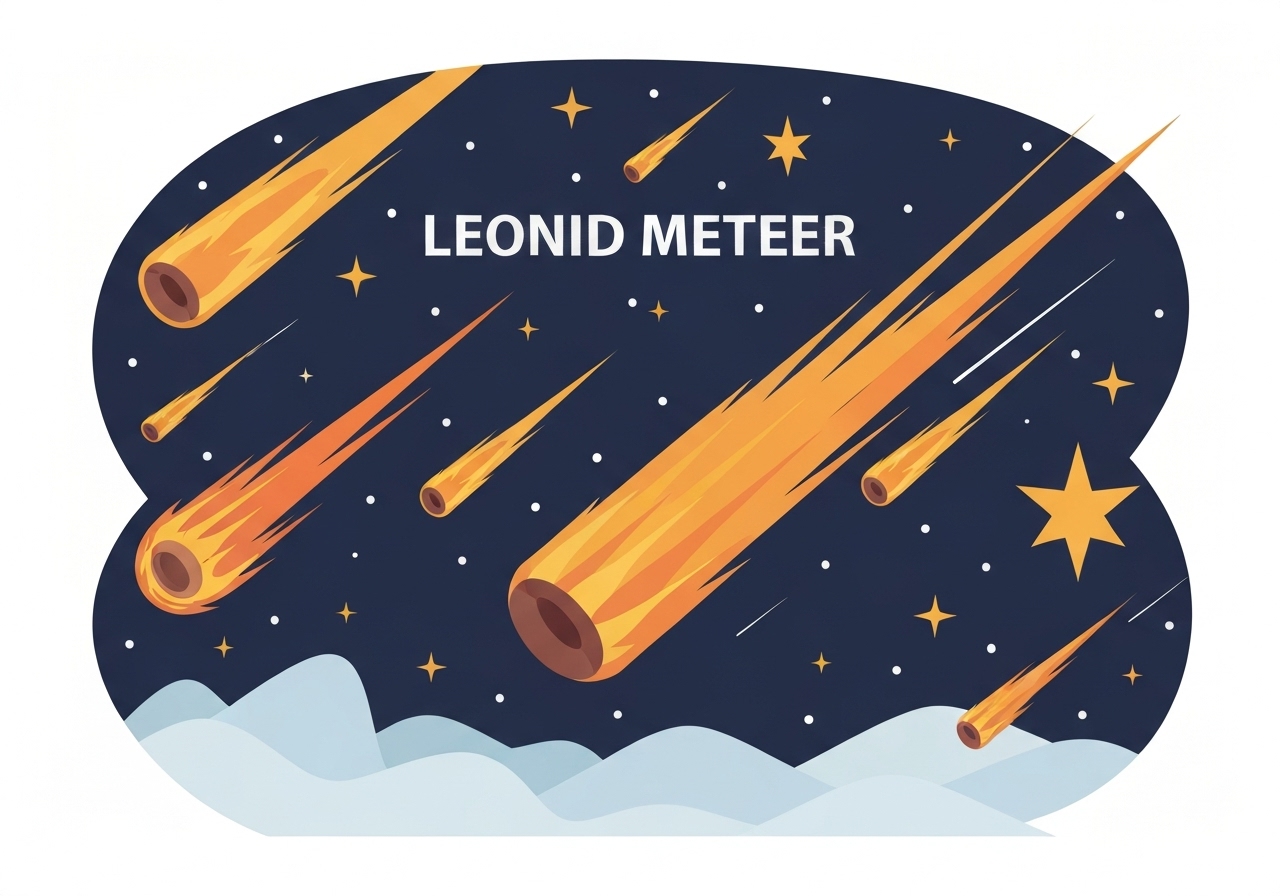
The annual Leonid meteor shower is expected to reach its sharp peak this week, offering sky‑watchers a brief but visible display. EarthSky notes the peak is timed for 1 p.m. ET on Monday, with the earliest meteors becoming visible as the constellation Leo rises around 11 p.m. local time on Sunday. Observers are advised that the most productive viewing window is between 4 a.m. Monday and local sunrise, according to Robert Lunsford, fireball report coordinator for the American Meteor Society. Under clear skies, typical rates of 10–15 meteors per hour are forecast, though activity is highly concentrated into a single night.
Key takeaways
- Peak timing: The Leonids are predicted to peak at 1 p.m. ET on Monday, with local visibility beginning about 11 p.m. Sunday as Leo clears the horizon.
- Best viewing window: Experts recommend watching between 4 a.m. Monday and local sunrise for the highest hourly counts.
- Expected rates: Under favorable skies, expect roughly 10–15 meteors per hour; rates are brief due to a narrow debris trail.
- Parent comet: The shower originates from comet 55P/Tempel‑Tuttle, which has a 33‑year orbital period that governs larger Leonid displays.
- Storm history: Leonids have produced intense storms (up to 1,000 meteors/hour); the last recognized storm occurred in 2002, with a notable historic storm in 1966 estimated at 40 meteors per second.
- Future outlook: The next alignment tied to the comet’s cycle arrives in 2033; models suggest possible elevated rates (~100/hour) but not a 1,000/hour storm.
- Related events: Upcoming meteor peaks this season include the Geminids on December 13–14 and the Ursids on December 21–22; a Cold Moon (full supermoon) falls on December 4.
Background
The Leonid shower is produced when Earth crosses the particle stream left by comet 55P/Tempel‑Tuttle. Because that comet completes an orbit about every 33 years, particularly active Leonid displays historically cluster near the comet’s perihelion passages. When Earth intersects a dense filament of debris close to perihelion, meteor rates can spike dramatically, producing storms rather than modest showers.
Leonid activity varies year to year because the comet sheds debris into narrow, discrete trails rather than a broad, uniform band. As a result, the window for elevated activity can be very short—sometimes a single night or even a few hours—making precise timing important for observers. Professional organizations and outreach outlets such as EarthSky and the American Meteor Society (AMS) monitor models to forecast when Earth will pass through the densest parts of those trails.
Main event
This year’s forecast centers on a sharp peak scheduled for 1 p.m. ET on Monday; however, local viewing opportunities begin the night before. As Leo rises after 11 p.m. Sunday local time, early meteors—often called Earth grazers—may be visible. These grazers travel along long paths and can remain visible longer than typical meteors because they skim the upper atmosphere at shallow angles.
Observers should plan to be outside and facing a dark portion of the sky well before the 4 a.m. window to allow eyes to adapt. Light pollution, low cloud cover, and moonlight will reduce visible counts; by contrast, clear, dark sites away from urban glow maximize chances of catching 10–15 meteors per hour. The shower’s brevity means that even small changes in sky conditions or timing will significantly affect what viewers see.
Historical context sharpens expectations: the Leonids can produce extremely high rates when Earth cuts through a dense stream. The last event classified as a storm was in 2002; an iconic storm in 1966 produced meteor rates estimated at around 40 meteors per second, a spectacle observers described as meteors falling like rain. Such storms require a very specific geometric intersection between Earth and a dense filament of cometary debris.
Analysis & implications
For amateur and casual observers, the Leonids this week present a reliable, if modest, opportunity to see meteors. The predicted 10–15 per hour under clear conditions is comparable to many annual showers and will be most rewarding from darker sites during the predawn window. Because the Leonids’ peak is narrow, timing is a larger factor than for broader showers like the Geminids.
From a scientific and modeling perspective, Leonid forecasts test dust‑trail predictions and orbital dynamics for 55P/Tempel‑Tuttle. Tracking which years yield elevated activity helps refine models of how cometary debris spreads and evolves under solar radiation and planetary perturbations. Improved prediction accuracy benefits both researchers studying small‑body dynamics and organizations issuing public viewing guidance.
Economically and culturally, strong Leonid activity can briefly drive public interest in astronomy, boosting attendance at outreach events and planetarium programs. However, because most years are quiet, large‑scale preparation is generally unnecessary. Agencies will prioritize rapid model updates and public advisories only if simulations indicate an elevated storm probability.
Comparison & data
| Event | Estimated rate | Year |
|---|---|---|
| Typical Leonid peak (this forecast) | 10–15 meteors/hour | 2025 |
| Leonid storm | ~1,000 meteors/hour | 2002 |
| Historic storm | ~40 meteors/second | 1966 |
| Possible elevated shower | ~100 meteors/hour (model) | 2033 |
The table summarizes observed and modeled Leonid activity. Typical annual rates for this year are modest because Earth is expected to intersect only a narrow portion of the comet’s debris. The 1966 and 2002 events are referenced as empirical extremes that shape public expectation; models indicate 2033 may produce above‑average counts but not a storm on the scale of 1966 or 2002.
Reactions & quotes
Officials and citizen observers are preparing for a short, focused viewing opportunity rather than a prolonged display. The following excerpts capture expert guidance and public interest.
The Leonids have a very sharp peak; there is often only one night with meaningful activity, so timing is critical for observers.
Robert Lunsford, American Meteor Society (fireball report coordinator)
Comet 55P/Tempel‑Tuttle’s 33‑year orbit explains why larger Leonid displays cluster approximately every three decades; only when Earth crosses a dense filament do storms occur.
EarthSky (science outreach)
Under clear, dark skies, casual viewers should expect about a dozen meteors per hour, concentrated in a short predawn window.
American Meteor Society (public guidance)
Unconfirmed
- Reports that the 2033 Leonids will produce a storm of 1,000 meteors per hour remain unsubstantiated; current forecasts suggest up to ~100 per hour but carry model uncertainty.
- Local hourly counts before 4 a.m. Sunday are variable and depend on atmospheric conditions; any higher counts reported from early evening observations should be treated cautiously until verified by organized networks.
Bottom line
The Leonid shower this week offers a concise viewing opportunity best seized in the predawn hours between 4 a.m. and local sunrise, with likely visible rates near 10–15 meteors per hour under good conditions. Because the shower’s peak is narrow, observers should plan timing and site selection carefully—dark, clear locations away from city lights will maximize sightings.
While the Leonids have produced spectacular storms in the past (notably 1966 and 2002), current models and expert commentary do not forecast a comparable storm for this event. The next perihelion‑linked alignment in 2033 could raise rates further, but substantial uncertainty remains; official updates from monitoring organizations should guide any reassessment.
Sources
- CNN (news report summarizing forecasts and expert comments)
- EarthSky (science outreach; timing and comet context)
- American Meteor Society (organization; fireball reports and public guidance)
- NASA (official; comet 55P/Tempel‑Tuttle overview)