
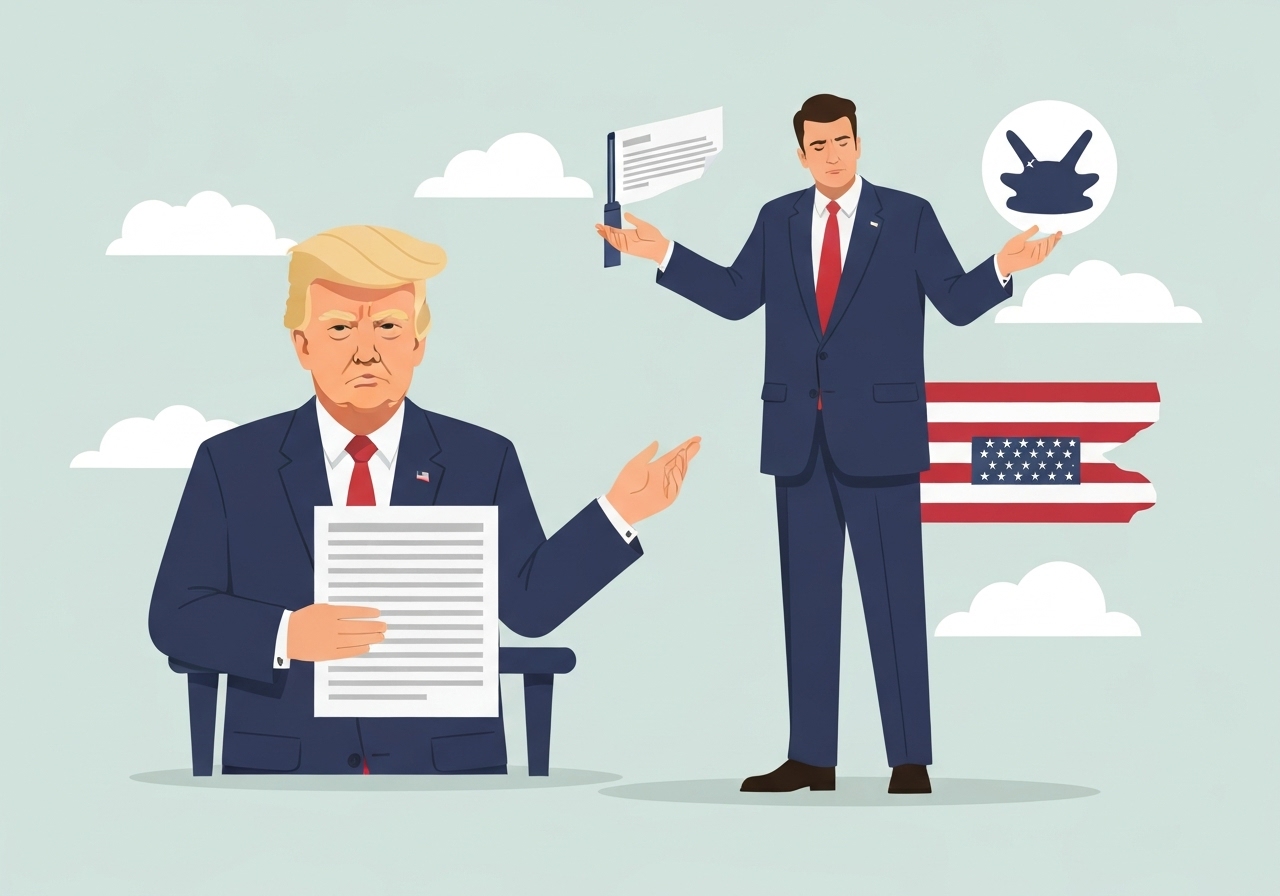
President Trump on Sunday broke from weeks of public silence and urged House Republicans to back legislation compelling the Justice Department to release records tied to Jeffrey Epstein, while also defending Tucker Carlson after his interview with Nick Fuentes. The president’s sudden endorsement of the release — framed on social media as proof that the administration “has nothing to hide” — came as House leaders prepared a floor vote expected this week and after a tranche of more than 20,000 Epstein-related emails was posted by congressional investigators. At the same time, the administration reported fresh military and immigration actions: another lethal maritime strike the Pentagon linked to narcotics trafficking, an expanded naval presence in the Caribbean, and large-scale Border Patrol operations in Charlotte that produced 81 arrests.
Key Takeaways
- Trump publicly urged House Republicans to vote to release Justice Department files about Jeffrey Epstein, calling it transparent and asserting “we have nothing to hide.”
- Congressional staff released over 20,000 Epstein-related emails this week that renewed scrutiny of Mr. Trump’s past ties to Epstein.
- The Pentagon’s campaign against suspected narcotics-smuggling boats reached its 21st known strike and at least 83 reported deaths since early September, according to U.S. Southern Command statements.
- The U.S. Navy’s Gerald R. Ford carrier strike group arrived in the Caribbean, joining roughly 10,000 U.S. military personnel already deployed to the region.
- The Federal Aviation Administration lifted flight restrictions at 40 airports, restoring normal operations beginning at 6 a.m. Monday after citing improved air‑traffic staffing.
- Border Patrol operations in Charlotte resulted in 81 arrests in one day; local businesses and community groups reported wide disruption and fear among residents.
- President Trump publicly defended Tucker Carlson for interviewing Nick Fuentes, saying “you can’t tell him who to interview,” while condemning critics who sought to police media guests.
- Two hundred California Guard members and 200 from Texas are being withdrawn from federal activation in Portland and Chicago after court challenges; about 300 Illinois and roughly 100 Oregon Guard troops will remain.
Background
The coming week in Washington reflected overlapping political pressures: an intraparty fight over access to Justice Department records tied to Jeffrey Epstein; continuing controversy around high-profile media figures and their guests; and intensifying executive actions on immigration and narcotics interdiction. Pressure to release the Epstein records has mounted from both Republican and bipartisan quarters in the House, with proponents arguing transparency is necessary after years of secrecy around Epstein’s network and contacts.
Separately, the administration’s maritime campaign against vessels it says are trafficking narcotics has expanded in recent months, with the Southern Command publicly tying strikes to a claimed armed conflict with drug cartels — a legal and policy posture disputed by many international law and use-of-force experts. At home, Interior enforcement and Border Patrol operations have been redirected into interior cities, prompting legal challenges and local resistance because federal law traditionally limits Border Patrol activity to border zones and coastlines.
Main Event
On Sunday, as he returned to the White House from Mar-a-Lago, Mr. Trump told reporters that House Republicans should “vote to release” the Epstein files and posted similar language on social media, framing the move as corrective to what he called a Democratic “hoax.” His reversal followed a recent White House push to dissuade G.O.P. lawmakers from supporting a compelled release; the new posture came after political calculations suggested dozens of Republicans might back the measure on the floor.
Republican Representative Thomas Massie of Kentucky — a leading proponent of the release — said in television interviews that he expected over 100 Republicans could support the bill and urged colleagues to consider the permanence of their votes. Speaker Mike Johnson signaled the vote would proceed this week and said there was significant G.O.P. interest in getting the matter resolved. Yet the bill’s path to law is uncertain: congressional backers acknowledged the measure faces long odds in the Senate and a near-certain presidential veto if it clears both chambers.
Meanwhile, the Pentagon announced that a joint task force strike in the eastern Pacific killed three people identified by U.S. Southern Command as linked to a “designated terrorist organization” allegedly trafficking narcotics. The command posted video of the explosion and characterized the operation as the 21st known maritime strike in the campaign that U.S. officials say has killed at least 83 people since early September. The announcement coincided with the arrival of the U.S.S. Gerald R. Ford to the Caribbean, increasing the region’s American naval presence.
In Charlotte, a weeklong enforcement operation led by Border Patrol personnel produced 81 arrests on Saturday, the largest single-day tally reported in North Carolina this year. Local businesses, churches and immigrant-advocacy groups reported widespread alarm; organizers encouraged residents to document interactions with federal agents. Federal officials said many arrested individuals had criminal histories, but local advocates and lawyers said numerous detainees appeared to be workers, parishioners or bystanders rather than people with serious records.
Analysis & Implications
Mr. Trump’s pivot to endorse the release of Epstein-related files highlights the political calculus at the center of the Republican majority: lawmakers who resist the president risk nomination challenges or loss of presidential favor, while those who defy him risk alienating an electorate that is increasingly divided about the president’s allies and methods. The move to embrace disclosure can be read as an attempt to blunt growing pressure from both the right and the center of his party, where transparency demands have gained traction.
Legally and diplomatically, the administration’s maritime campaign strains conventional frameworks governing the use of force at sea. U.S. officials have argued the strikes are lawful because the president has “determined” a formal conflict with trafficking organizations; many international-law scholars contest that assertion, saying the strikes risk harming civilians and could escalate tensions with nations in the region. The arrival of a carrier strike group raises the stakes, signaling capacity for further operations but also creating potential flashpoints with Venezuelan forces or proximate states.
Domestically, expanded interior immigration enforcement and mass arrests in cities like Charlotte risk eroding community trust in law enforcement, with economic knock-on effects for small businesses and service industries. Political backlash from local officials and state governors — who cite limits on federal authority away from border zones — could prompt fresh legal battles over the scope of federal immigration enforcement, and spur state-level political mobilization ahead of elections.
Comparison & Data
| Item | Count / Detail |
|---|---|
| Epstein emails released by lawmakers | More than 20,000 documents |
| Known maritime strikes since Sept. | 21 strikes; at least 83 reported killed |
| Airports subject to FAA restrictions | 40 airports |
| Charlotte arrests (one day) | 81 people detained |
| National Guard movements | ~200 CA and ~200 TX troops to be withdrawn; ~300 IL and ~100 OR remain |
The table highlights the scale and variety of the week’s actions: a large document release by Congress, a lethal maritime campaign, aviation staffing interventions, interior immigration sweeps, and federal Guard activations and drawdowns. Taken together they show simultaneous pressure points on transparency, national security policy, and domestic enforcement practices.
Reactions & Quotes
You can’t tell him who to interview. People have to decide. Ultimately people have to decide.
President Donald J. Trump
Mr. Trump defended Tucker Carlson’s journalistic latitude while not addressing the substance of Carlson’s sympathetic posture toward Nick Fuentes. The remark was read by allies as a signal to tolerate broad media engagement and by critics as insufficient to condemn extremist views.
There’s nothing to hide — let’s get this done and move it on.
Speaker Mike Johnson
Speaker Johnson urged colleagues to accelerate a vote, framing the release as routine transparency. House critics argued the vote’s timing reflected internal political pressures, not merely procedural clarity.
Controllers have returned to their posts and normal operations can resume.
FAA Administrator Bryan Bedford
The FAA attributed the decision to end airport restrictions to improving staffing metrics, though independent aviation-data analysis showed many carriers did not fully comply with the temporary limits when they were in force.
Unconfirmed
- Whether the Justice Department will rapidly comply with a congressional vote to release files remains unclear; timelines from the department were not provided.
- Southern Command’s public statement labeled the struck vessel a “designated terrorist organization” and linked it to narcotics trafficking; independent verification of that designation or that the boat was armed was not provided in the announcement.
- The precise breakdown of criminal histories among the 81 people arrested in Charlotte has not been disclosed by Border Patrol or local authorities.
Bottom Line
This week crystallized several tensions in U.S. policy and politics: a high-stakes transparency fight over decades-old criminal networks and powerful contacts; an expanded and contested use of military force at sea; and an assertive interior immigration enforcement posture that is provoking local backlash and legal scrutiny. Mr. Trump’s reversal to advocate disclosure of Epstein-related files is as much a political maneuver as a policy decision — designed to shift the narrative while undercutting critics within his own party.
Observers should watch three immediate trajectories: whether a House vote secures enough Republican support to override a potential veto, how the Justice Department responds to any compelled disclosure, and whether the administration’s maritime and regional military posture leads to additional strikes or diplomatic friction in the Caribbean and Latin America. At the local level, the Charlotte operation and other interior enforcement actions will likely continue to test the balance between federal authority and community protections.