
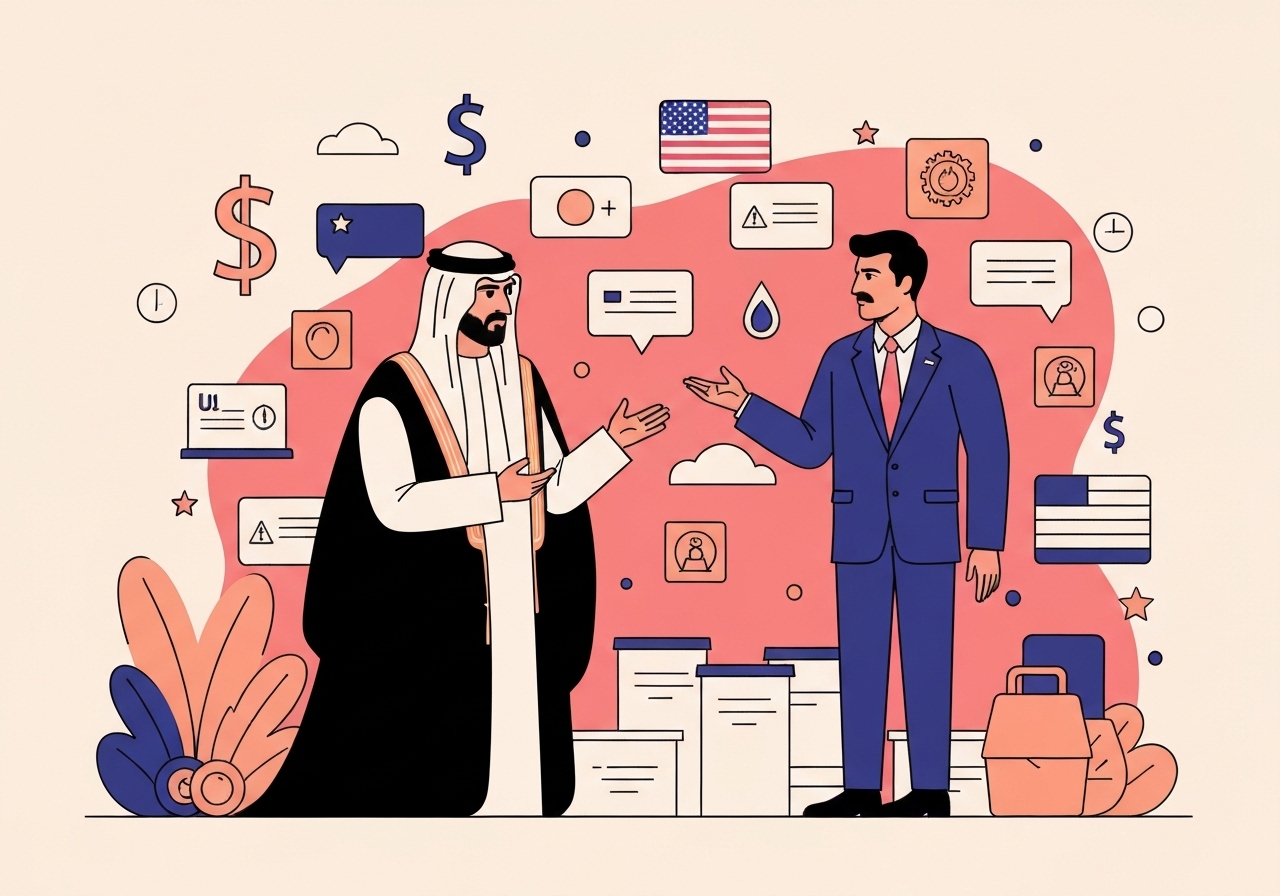
Lead: Saudi Crown Prince Mohammed bin Salman (MBS) will meet U.S. President Donald Trump at the White House on November 18 in a visit that aims to reset and deepen ties between Riyadh and Washington. Observers expect a cordial summit and a package of agreements spanning security, investment and technology. The trip represents MBS’s rehabilitation on the U.S. political stage after the 2018 Jamal Khashoggi killing strained bilateral relations. Both sides are under pressure to produce tangible commitments—financial, strategic and diplomatic—before the meeting concludes.
Key takeaways
- Visit date and purpose: Crown Prince Mohammed bin Salman meets President Trump on November 18 to pursue security, investment and technology deals.
- Historic context: Bilateral relations have improved since the 2018 murder of Jamal Khashoggi, with Trump’s early 2025 Riyadh trip tied to a $600 billion (€517 billion) Saudi investment pledge to the U.S.
- Security focus: Washington is expected to discuss a formal security arrangement similar to the September Qatar executive-order deal; such pacts can bypass Senate ratification and may be temporary.
- Nuclear and defense concerns: U.S. officials will press Saudi Arabia on civil nuclear plans and a recent defense agreement Riyadh signed with Pakistan, including worries about nuclear-related provisions.
- Technology and investment: AI, chip supply chains and Saudi funding for U.S. research are likely topics as Riyadh pushes Vision 2030 diversification.
- Palestine and normalization: Saudi conditionality—linking any normalization with Israel to a credible two-state path—remains a sticking point given Israeli rejection of that roadmap.
- Economic friction: Riyadh prefers keeping oil output restrained while Washington seeks higher production, creating a near-term policy disagreement.
Background
The November meeting follows a sequence of events that reshaped Middle East diplomacy. The 2018 killing of journalist Jamal Khashoggi in Istanbul severely damaged Saudi relations with Western governments; since then, Saudi-U.S. ties have been gradually mended. When Donald Trump returned to the presidency in January 2025, he made Riyadh his first foreign stop and announced a headline $600 billion (€517 billion) Saudi investment into the U.S., signaling commercial priorities underpinning renewed closeness.
Regional security has added urgency to the Washington visit. In June, the U.S. and Israel struck Iranian nuclear sites, triggering days of hostile exchanges. In September, Israel targeted Hamas leadership in Doha, prompting Washington to issue a bilateral security arrangement for Qatar via executive order. The October ceasefire, mediated by the U.S., temporarily halted nearly two years of fighting in Gaza, but the wider political settlement remains fragile and central to Riyadh’s conditions for deeper ties with Israel.
Main event
Expectations for the November 18 session center on two deliverables: visible cooperation projects and at least one headline agreement. For MBS, the trip is an opportunity to reassert Saudi Arabia’s strategic relevance in Washington and to secure guarantees that bolster Riyadh’s regional posture. For President Trump, the visit is a chance to solidify financial pledges, gain Saudi backing for his Gaza diplomacy and advertise renewed U.S.-Gulf alignment ahead of domestic political cycles.
Security discussions are likely to be prominent. Analysts note Trump may offer a U.S. security commitment to Riyadh that mimics the recent Qatar arrangements, designed to be administratively quick but potentially temporary if not codified by Congress. Riyadh, for its part, will push for assurances that go beyond short-term declarations, seeking a durable protective framework and cooperation on defense technology and intelligence sharing.
Nuclear cooperation and civilian power are also on the agenda. Washington will press for safeguards and oversight as Saudi Arabia develops civil nuclear capacity under Vision 2030, and raise questions about Riyadh’s defense ties with Pakistan. Technology cooperation—particularly in artificial intelligence and semiconductor supply chains—will form a second major track, with the U.S. keen to align Saudi investment toward American research and away from strategic competitors.
Analysis & implications
The trip will test whether bilateral relations rest chiefly on transactional bargains or on longer-term strategic convergence. A security pact that resembles the Qatar executive-order model would give Riyadh rapid assurances but may lack permanence without congressional buy-in. That structure serves short-term political optics, but leaves both sides exposed to policy reversal after an administration change.
If Riyadh secures strong U.S. backing while withholding normalization with Israel until a credible two-state path emerges, the meeting could reshape regional diplomacy by tying Saudi commitments to Palestinian outcomes and reconstruction pledges. Trump, however, appears focused on pushing normalization back onto the table as an endgame; whether Riyadh accepts a sequencing where security commitments precede, rather than follow, normalization remains ambiguous.
On economics and technology, Saudi commitments to invest in U.S. AI research and chip production could deepen interdependence and shift Riyadh’s tech partnerships toward Washington. Such alignment would help the U.S. in global tech competition but would require transparent safeguards and oversight to address proliferation and intellectual-property concerns. Conversely, any perceived drift of Saudi tech cooperation toward China would raise strategic alarms in Washington.
Comparison & data
| Arrangement | Timing | Key features |
|---|---|---|
| Qatar security deal | September (recent) | Executive-order assurances; faster enactment; no Senate ratification |
| Proposed U.S.–Saudi pact | In negotiation (multi-year) | Expected to include defense guarantees, intelligence sharing, nuclear cooperation safeguards |
| Abraham Accords | 2020–2021 | Normalization between Israel and several Arab states; Saudi inclusion was contingent on Palestinian progress |
The table highlights structural differences: executive actions can yield speed but limited durability, while treaty-like arrangements require legislative processes and offer longevity. That trade-off will shape what Washington and Riyadh can realistically deliver during or after the November meeting.
Reactions & quotes
“Both sides will want to come away with a major deal or arrangements that show that the meeting was a resounding success.”
Neil Quilliam, Chatham House (associate fellow)
Quilliam framed the visit as performance as much as policy, noting both capitals need demonstrable outcomes to satisfy domestic and regional audiences.
“A defense pact has been in the works for at least three years, but there’s a need to speed it up as the Qataris got there first.”
Michael Stephens, RUSI (senior Middle East security advisor)
Stephens warned the U.S.-Saudi process has lagged behind other Gulf arrangements, creating pressure to accelerate negotiations and to define what a credible pact would encompass.
“I suspect there will also be a conversation about civil nuclear power… the Americans would not want Saudi Arabia to go down its own pathway, kind of uncontrolled.”
Michael Stephens, RUSI
Stephens underscored U.S. concerns about safeguards and proliferation risks tied to expanded Saudi nuclear ambitions.
Unconfirmed
- Whether the Saudi–Pakistan defense agreement contains nuclear-related clauses remains unverified and publicly unconfirmed.
- Claims that Riyadh will normalize with Israel imminently are speculative; Saudi leaders have tied normalization to Palestinian statehood conditions.
- The exact sequencing and legal form of any U.S.–Saudi security guarantee (executive order versus treaty) has not been finalized publicly.
Bottom line
The November 18 White House meeting will be a high-stakes exercise in hedging and optics. Riyadh seeks security guarantees, technological partnerships and continued investment flows; Washington wants visible commitments on reconstruction financing, alignment in tech competition and reassurance about nuclear controls. Both sides can gain short-term political victories with executive-level agreements, but durable strategic convergence will require detailed, verifiable arrangements and, likely, congressional engagement.
Observers should watch three indicators after the visit: the legal form and scope of any security commitment, concrete Saudi investment pledges in U.S. AI and chip sectors, and Riyadh’s public posture on Palestinian statehood and normalization with Israel. Those signals will determine whether the summit delivers transient headlines or a genuinely reoriented U.S.–Saudi partnership.
Sources
- DW (news report) — international media report on the visit and expert commentary
- Chatham House (think tank) — analysis and expert commentary cited regarding expectations
- Royal United Services Institute (RUSI) (defense think tank) — security analysis and expert views on defense and nuclear concerns