
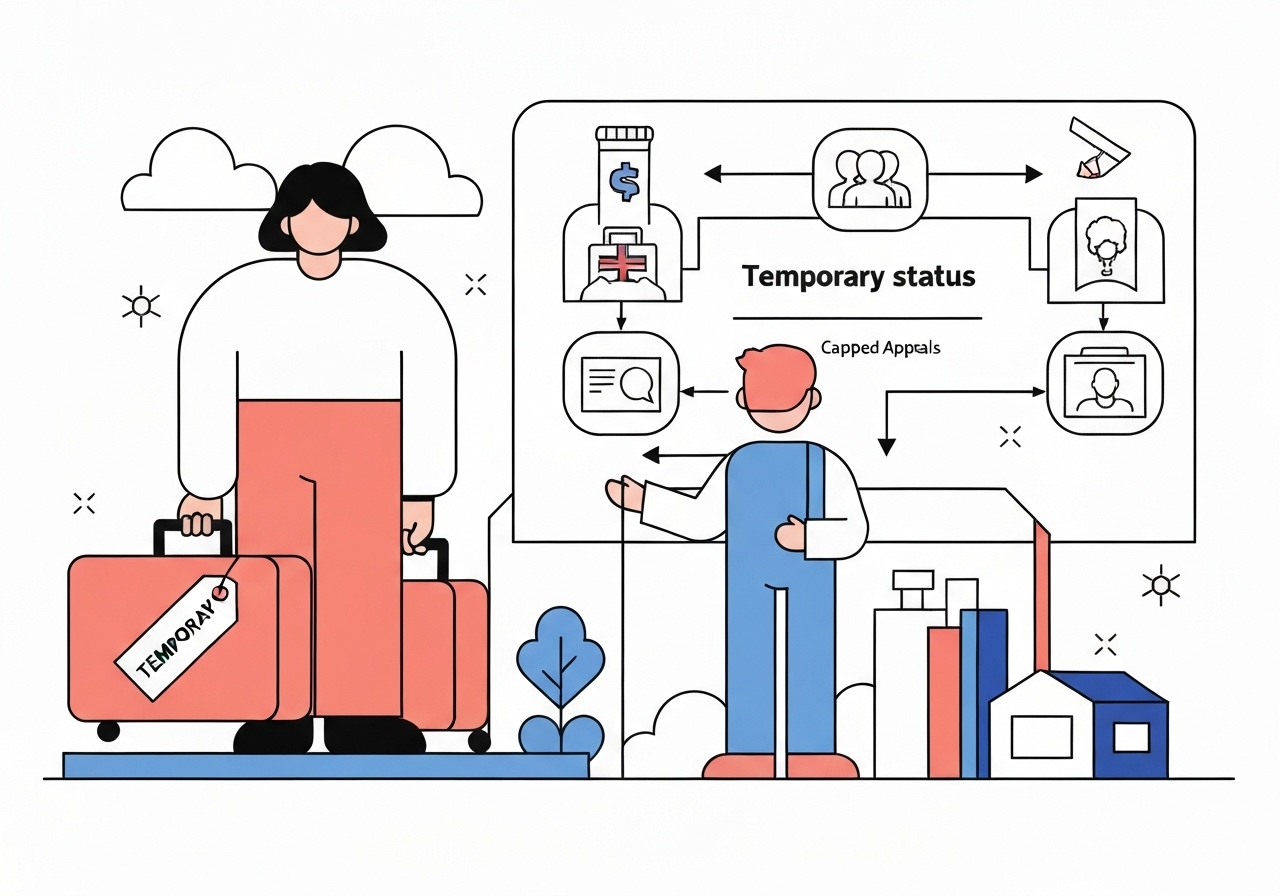
Home Secretary Shabana Mahmood on Monday announced what government briefings described as the biggest reforms to the UK asylum system in modern times, proposing temporary refugee status, stricter appeal rules and new sanctions for countries that refuse returns. The package, modeled on Denmark’s tighter approach, would review asylum permissions every 30 months and extend the residency requirement for indefinite leave to 20 years from five. Ministers say the changes aim to reduce irregular arrivals while creating new controlled legal routes; critics warn of human-rights and practical implementation challenges. The proposals also include changes to support, a new work-and-study visa stream, visa penalties and wider use of digital and AI tools for enforcement.
Key takeaways
- Temporary status: Refugee permissions would be time-limited and reviewed every 30 months; return could follow if a claimant’s country is judged safe.
- Longer path to settlement: The qualifying period for indefinite leave would rise from five years to 20 years under the proposals.
- Appeals overhaul: Multiple appeals would be replaced by a single, consolidated appeal and a new independent appeals body with early legal advice.
- Support changes: The statutory duty to provide housing and weekly subsistence would be curtailed; those able to work could be denied routine support.
- New legal routes: Community and business sponsorship schemes would expand, with an annual cap and a streamlined ten-year route to settlement for arrivals via these routes.
- Visa sanctions: Angola, Namibia and the Democratic Republic of Congo are identified for potential visa penalties if they do not co‑operate on returns.
- Enforcement tech: Trials of AI age-assessment tools and a planned digital ID aim to tighten right-to-work checks and identity verification.
- Asset contributions: Asylum seekers with assets may be required to contribute to accommodation costs; some movable goods could be targeted for seizure.
Background
For several years the UK has sought to reduce crossings of the Channel and to deter people-smuggling networks, producing repeated policy reviews and high-profile legislative efforts. Current asylum law allows indefinite refugee status after a successful claim, multiple appeals on different legal grounds, and a duty to provide housing and subsistence to those in the asylum system. The government argues those features create incentives for irregular migration and delay enforced returns, while critics contend that safeguards exist to protect people at risk and that changes risk breaching international obligations.
Denmark’s centre-left government introduced a model that issues limited-duration permits and requires reapplication; the UK package explicitly draws on that template. UK officials say the recent fall of the Assad regime in Syria and other geopolitical shifts justify a re-evaluation of where returns may be possible. At the same time, ministers are trying to expand lawful entry avenues — including community sponsorship and talent mobility — while capping numbers and tying access to local capacity.
Main event
Ministers propose that refugee status be reviewed every 30 months rather than being effectively permanent, with the possibility of return if a country is judged safe. The government says it has already supported voluntary returns to Syria and will now explore limited forced returns where removals have been rare in recent years. Concurrently, the path to indefinite leave would be extended to 20 years, though a new work-and-study visa route would allow some refugees to progress toward settlement more quickly through employment or education.
The legal framework for appeals would change: instead of a sequence of challenges brought at different times, claimants would lodge a consolidated appeal raising all grounds together. A new independent tribunal with trained adjudicators and early legal-advice support is proposed to process these appeals. Ministers frame this as reducing delays and preventing repeated, late-stage legal actions that stop removals, while emphasising speed and clarity for decision-making.
Support entitlements would be narrowed. The statutory duty to provide housing and weekly payments would be removed, with assistance retained only for those who are destitute and withheld from people who can work but refuse to do so, people breaking the law or flouting removal directions, and those judged to have deliberately become destitute. Officials also propose requiring asylum seekers with assets to contribute toward accommodation and have suggested seizing some high-value items at the border, though sentimental items are excluded.
Analysis & implications
If enacted, temporary status and lengthened settlement periods would mark a fundamental shift in the social contract for successful asylum claimants, converting what is now a route to permanence into an extended probationary model. That could reduce incentives for onward irregular migration and allow returns if conditions change in origin countries; however, it raises legal and ethical questions about the predictability of protection and the administrative burden of repeated status reviews.
The appeals consolidation aims to speed up removals and cut repeated litigation, but concentrating all grounds into a single process places pressure on decision makers and advisers to identify every relevant claim at the outset. Early legal advice may help, but reduced successive review opportunities could leave genuine protection issues inadequately explored, increasing the risk of unlawful returns and challenges under international law.
Stripping wider support and requiring asset contributions mirror measures used elsewhere to deter irregular migration, yet they risk increasing destitution and homelessness among refused families and vulnerable claimants. Local authorities, charities and businesses could face implementation pressures if hotel use ends by 2029 and community sponsorship is expanded; local capacity caps on legal routes will require careful calibration to avoid bottlenecks.
Technological measures such as AI age-assessment and a digital ID promise better fraud detection and right-to-work enforcement but come with accuracy, bias and privacy concerns. Pilots and independent validation will be necessary before full roll-out; otherwise, misclassification could lead to wrongful detention, inappropriate removals or exclusion from lawful routes.
Comparison & data
| Feature | Current UK system | Proposed UK changes | Denmark model |
|---|---|---|---|
| Refugee status | Indefinite leave after ~5 years | Temporary permits reviewed every 30 months; settlement after 20 years | Two‑year permits with renewal requirement |
| Appeals | Multiple sequential appeals possible | Single consolidated appeal; new tribunal | Faster, limited-recours processes |
| Support | Statutory housing and weekly support | Duty removed; support only for destitute | Asylum seekers contribute savings to accommodation |
| Legal routes | Existing family, work, resettlement schemes | Expanded community/business sponsorship with annual cap | Targeted resettlement and labour routes |
The table shows the shift from permanent settlement to time-limited permissions and from multiple appeals toward consolidated procedures. Officials cite cost pressures — hotels cost £5.77m per day last year — and administrative delay as drivers for reform. Any accurate assessment of impact requires modelling of return feasibility, legal challenge volumes and the capacity of new tribunals and sponsorship schemes.
Reactions & quotes
The government presented the package as a decisive reset of migration policy aimed at cutting irregular arrivals and reducing pressure on public services. Civil society and some legal experts have signalled concern about potential conflicts with international protection obligations and practical effects on vulnerable people.
“The biggest changes to tackle illegal migration in modern times,”
UK Government / Home Office briefing
“Cars and e-bikes could be targeted as part of asset contribution measures,”
Home Office Minister Alex Norris (paraphrased)
Unconfirmed
- Scope of forced returns: which additional countries beyond those already named will be considered for enforced returns remains unclear and subject to future policy documents.
- Digital ID timeline: the stated aim to introduce a digital ID “by the end of Parliament” lacks a published timetable and technical specification.
- Appeals body details: the precise remit, resourcing and independence safeguards for the proposed independent appeals tribunal have not been fully published.
Bottom line
This package represents a comprehensive attempt to deter irregular migration by shortening protection timelines, limiting successive appeals and removing some forms of welfare support while creating controlled legal routes. If implemented, it would shift the UK from a model that leads to settlement within a few years to one that makes permanence rare and contingent on long-term residence and economic integration.
The measures trade speed and deterrence against potential legal, operational and humanitarian costs: reduced safeguards risk legal challenges and increased pressure on local services, while new enforcement technologies and visa penalties could complicate international relations. Close parliamentary scrutiny, clear operational plans and independent oversight will be essential to test whether the reforms meet stated objectives without unlawfully undermining protection obligations.
Sources
- BBC News (news report summarising government announcements, 2025)
- UK Home Office (official department statements and policy materials)