
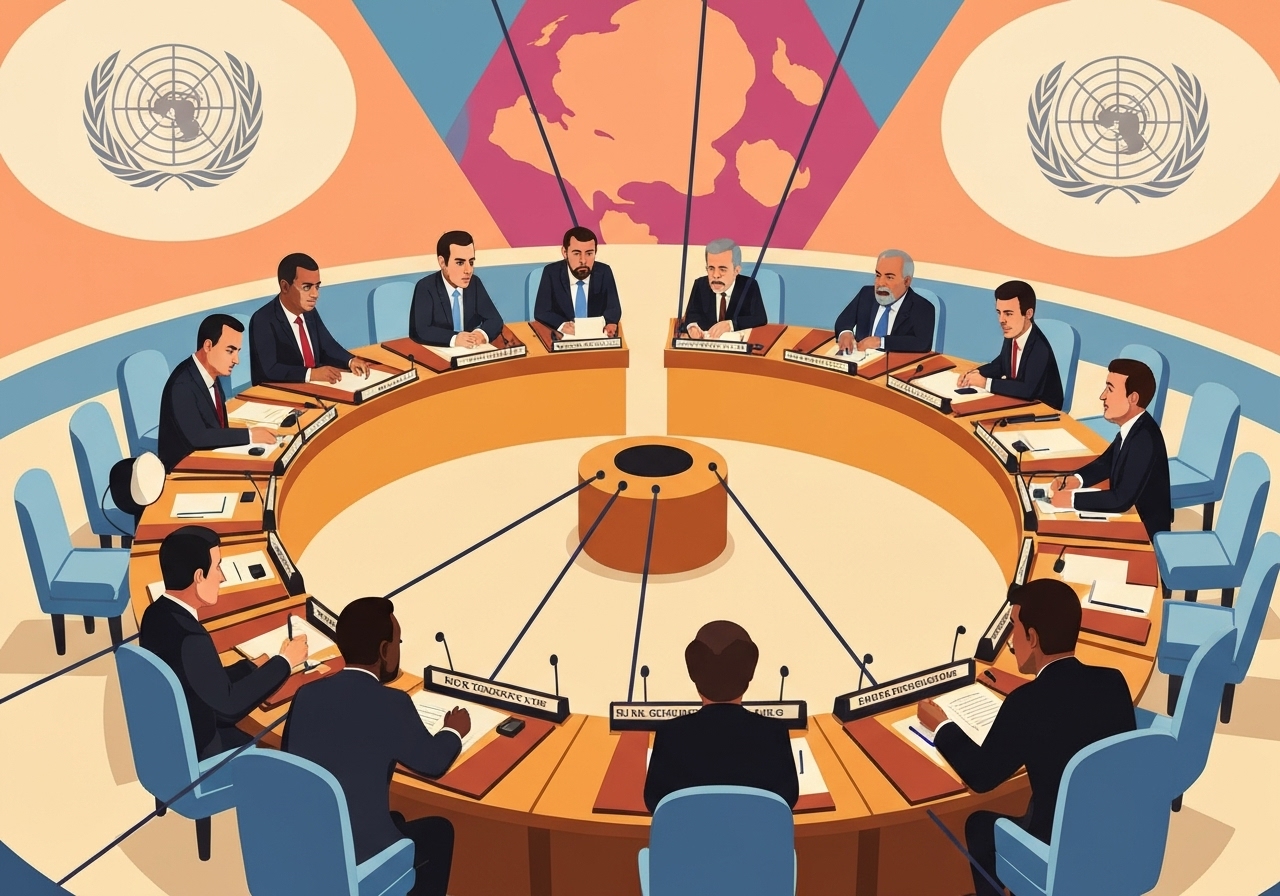
— The UN Security Council on Monday adopted a U.S.-drafted resolution aimed at moving beyond a fragile truce in Gaza toward a longer-term stabilization and reconstruction effort. The 15-member council registered a 13-0 vote in favor, with Russia and China abstaining and not using their vetoes. The text authorizes a transitional “Board of Peace,” a temporary International Stabilization Force (ISF) and a UN-backed framework for disarmament and redevelopment, while stopping short of a firm timeline for Palestinian statehood. Implementation questions remain, particularly over sequencing, the Palestinian Authority (PA) reform threshold and the ISF’s mandate.
Key Takeaways
- The Security Council vote was 13 in favor, 0 against, with Russia and China abstaining; the resolution therefore passed without a veto.
- The resolution endorses elements of a 20-point U.S. Gaza plan, authorizing a Board of Peace and a temporary ISF to operate in Gaza through the end of 2027.
- The Board is charged with overseeing disarmament of Hamas and other factions and coordinating reconstruction, but the draft lacks specific timelines for handover to the PA.
- The resolution references a potential pathway to Palestinian self-determination contingent on PA reforms and progress in Gaza redevelopment, but offers no deadline.
- U.S. officials said the UN authorization will help legitimize international participation in the ISF; diplomats warned the text is vague on sequencing and authority limits.
- Hamas rejected the draft as an imposition of international guardianship and said a force tasked with disarmament would not be neutral.
- Israeli leadership has reiterated a demand for Gaza’s demilitarization; some Palestinian and regional actors expressed concern about sovereignty and Palestinian ownership.
Background
The resolution grew out of a U.S. initiative to convert a recent ceasefire into a durable stabilization and reconstruction pathway for Gaza. That 20-point plan from Washington supplied much of the language that fed into the draft, and U.S. diplomats lobbied council members intensively before the Monday vote. The broader context includes repeated cycles of conflict between Israel and Hamas, a humanitarian crisis in Gaza, and international pressure to prevent a return to open hostilities while addressing reconstruction needs.
Key stakeholders include the Israeli government, which demands disarmament of Hamas; the Palestinian Authority, whose role would be restored only after a stated reform program; member states willing to contribute troops or resources to an ISF; and Hamas and other Gaza-based groups, many of which have publicly opposed external control. Russia and China signaled reservations through abstentions, citing concerns about Palestinian sovereignty and the need to protect the two-state framework.
Main Event
The resolution passed on Monday after marathon diplomacy in New York. The U.S. presented the draft as a way to move from a short-term cessation of hostilities to a coordinated international stabilization plan. Ambassador Michael Waltz, the U.S. representative, described the ISF as a coalition of peacekeepers — including contributors from predominantly Muslim countries, he said — operating under unified command to secure streets, oversee demilitarization and escort humanitarian corridors.
Voting details were concise: 13 votes for, none against, two abstentions. Russia and China explained their abstentions during the council exchange, each voicing distinct concerns: Russia cautioned against measures that might undermine a two-state outcome, while China said the draft did not sufficiently reflect Palestinian sovereignty or visible Palestinian ownership of the process.
Hamas responded before and after the vote, calling the proposal an attempt to impose international guardianship and warning that a stabilization force tasked with disarming the resistance would be transformed from a neutral actor into a party to the conflict. Israel’s leadership reiterated that Gaza must be demilitarized and that Hamas should be disarmed, language the resolution explicitly authorizes the Board to supervise.
Practical details in the draft remain sparse. The resolution authorizes Board and other international presences until the end of 2027 and states that the Board will transfer authority to the PA after the PA satisfactorily completes a reform program — but it does not define the reform benchmarks or dates for handover. U.S. officials have said more specifics will be announced in coming weeks about Board membership and operational plans.
Analysis & Implications
Politically, the council’s adoption grants Washington-backed elements international legitimacy that could lower legal and diplomatic barriers for troop contributors, funding partners and reconstruction contractors. A UN-backed mandate often facilitates logistics, insurance and political cover for states that otherwise hesitate to deploy forces into volatile areas. That could speed aid deliveries and infrastructure work if contributors volunteer and clear command arrangements are set.
However, the resolution’s operational vagueness elevates risks. Without clear sequencing and enforcement mechanisms, the Board and ISF could face contested authority on disarmament, policing and civil administration. Ambiguity over the PA reform criteria creates a potential open-ended transition period during which Gaza governance may be driven more by international technocrats than by locally elected institutions — heightening disputes over sovereignty.
Security risks are also acute. Demobilizing armed factions in an enclave with multiple armed groups requires credible guarantees for fighters’ safety and confidence-building measures. If armed actors perceive disarmament as a threat to their security or status, they may resist, fragment, or transfer weapons elsewhere. That would complicate reconstruction and could precipitate renewed clashes that undermine the UN-backed effort.
Regionally, major powers’ abstentions underscore a fragile consensus: Western states and some regional contributors may support stabilization under UN authority, while key global players emphasize Palestinian agency and a clearer path to statehood. This split could limit the plan’s political durability unless negotiators bridge the concerns by outlining PA-led milestones and stronger Palestinian roles in governance over time.
| Item | Detail |
|---|---|
| Security Council vote | 13 for, 0 against, 2 abstentions (Russia, China) |
| Authorized entities | Board of Peace, International Stabilization Force (ISF) |
| Mandate horizon | Authorized until end of 2027 |
| Key conditions | Handover to PA after satisfactory reform program (no timeline) |
The table summarizes core textual authorizations in the draft resolution and the vote tally. Those items will determine what states and organizations can lawfully do under a UN umbrella. Close reading of the final text and follow-on documents will be essential to understand the precise legal authorities granted.
Reactions & Quotes
U.S. officials framed the vote as a necessary step to enable an internationally backed stabilization mission and to provide a platform for reconstruction planning. They argued a UN mandate would allow states to commit forces and resources with clearer legal cover.
Waltz described the ISF as a unified multinational force intended to secure Gaza and oversee disarmament while protecting civilians and routing aid.
U.S. Ambassador Michael Waltz (statement)
Russia and China expressed reservations during council debate. Both cautioned that the resolution should not become the end of international support for a two-state political settlement or a vehicle that sidelines Palestinian sovereignty and leadership.
Russian and Chinese representatives warned the text must not undercut prospects for a two-state solution or diminish Palestinian ownership.
Russian and Chinese UN Delegations (statements)
Hamas rejected the resolution as imposing external control and argued that a force tasked with disarmament could not remain neutral, framing the authorization as damaging to Palestinian autonomy and resistance capabilities.
Hamas called the draft an attempt to impose international guardianship and said assigning disarmament tasks to an outside force would politicize it.
Hamas (public statement)
Unconfirmed
- The exact membership and leadership of the Board of Peace have not been publicly confirmed; announcements are expected in coming weeks.
- The precise troop contributors, size and rules of engagement for the ISF remain unannounced and therefore uncertain.
- The benchmarks and timeline for the PA reform program that would trigger handover are not specified in the resolution text.
Bottom Line
The Security Council’s endorsement gives a U.S.-backed stabilization blueprint an international legal and political platform, potentially easing participation by states and organizations in Gaza’s security and reconstruction. But the blueprint’s operational gaps — particularly around sequencing, PA reform criteria and the ISF’s precise mandate — leave major implementation questions unresolved.
Success will depend on rapid clarification of authority lines, credible protection guarantees for population and fighters during disarmament, and concrete measures to ensure meaningful Palestinian ownership and a credible pathway toward political settlement. Absent those elements, the authorization could at best accelerate humanitarian work and at worst entrench contestation over sovereignty and control in Gaza.
Sources
- CNN (international news report)