
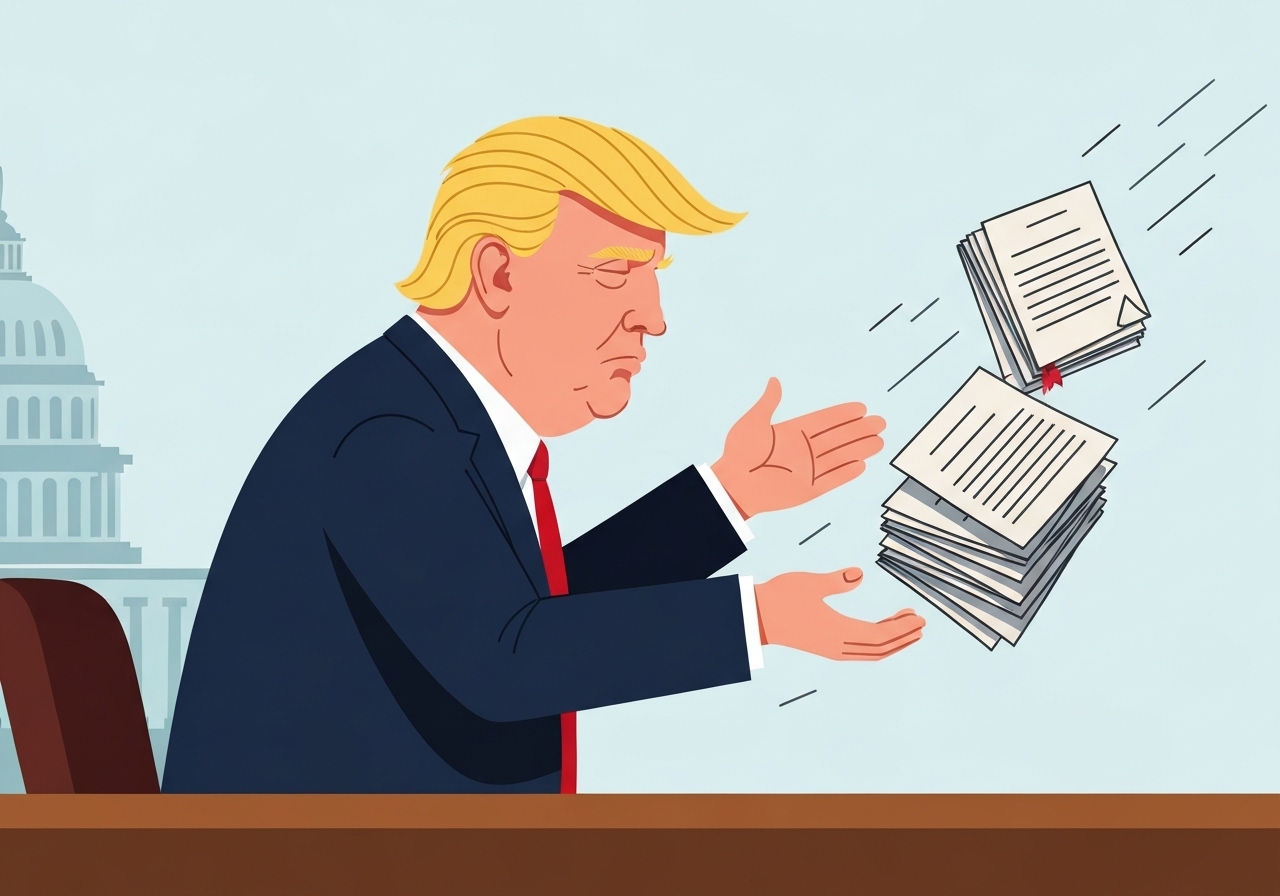
— In a sudden reversal that stunned Washington, President Donald J. Trump on Sunday night signaled he would not block a House Republican bill to compel the Justice Department to turn over its investigative files on convicted sex offender Jeffrey Epstein. The move came after partywide pressure and the threat of widespread defections on a vote expected as soon as the following day. Mr. Trump had privately and publicly resisted the release — dispatching aides, making personal calls and sending senior law-enforcement officials to intervene — but ultimately backed away to avoid a politically damaging floor defeat. The flip opened the way for broad GOP support and raised fresh questions about the limits of the president’s influence over his party.
Key takeaways
- Trump publicly reversed course on Sunday night, saying he would sign legislation ordering the Justice Department to release Epstein-related files; the statement followed intense intra-party pressure.
- The House was expected to consider the measure as soon as Tuesday, with lawmakers indicating the bill was likely to pass with wide Republican support.
- Administration officials, including the attorney general and the FBI director, reportedly engaged directly with members in the White House Situation Room to persuade them to oppose the release.
- Mr. Trump had earlier framed calls for disclosure as a Democratic hoax and warned that backing the bill would be seen as a “hostile act,” according to aides.
- Although Congress can mandate disclosure, the president could theoretically have directed the Justice Department to release records without new legislation; the department has not done so to date.
- Political dynamics — falling presidential poll numbers, rising living costs and intra-GOP strategizing ahead of midterms — were cited by Republican lawmakers as factors that weakened the president’s ability to enforce his preference.
Background
Jeffrey Epstein was a convicted sex offender whose investigations and transactions have drawn sustained congressional, media and public scrutiny since his arrest and death. Calls to review and publish Justice Department records about Epstein’s investigations have intensified over the years as lawmakers, victims’ advocates and voters have demanded transparency. Within the Republican conference, a vocal base has pressed for full disclosure, turning the files into a politically charged issue that pits accountability arguments against concerns about precedent and sensitive materials.
President Trump has, for months, projected tight control over Republican messaging and votes, frequently directing allies and party leaders on strategy. That dynamic helped him steer congressional outcomes on numerous priorities in the first ten months of his term. But the Epstein-files fight exposed tensions: some members faced a stark choice between satisfying constituent demands for disclosure and heeding the president’s explicit opposition. The standoff coincided with broader unease inside the party as several lawmakers weigh political futures beyond Mr. Trump’s leadership.
Main event
The confrontation escalated over several days. Republican holdouts threatened a mass defection on the bill unless they received assurances that their concerns were addressed. According to multiple accounts, the White House mounted an aggressive effort to head off defections: aides made direct appeals, the president placed personal calls and top law-enforcement officials visited members in the Situation Room to press for opposition. Those interventions failed to stem the momentum for disclosure.
By Sunday evening Mr. Trump moved to avert an embarrassing floor outcome. He announced he would not block the measure and indicated he would sign the legislation if it reached his desk. The announcement rapidly shifted the internal calculus in the House; members who had feared a presidential reprisal signaled they would back the bill, and Republican leaders began to clear the path for an expedited vote.
Despite the president’s about-face, practical questions remained unresolved. Legal experts note that the Justice Department retains significant discretion over investigatory files and can withhold information for law-enforcement, privacy or grand-jury reasons even when Congress demands release. Observers also flagged that the administration had the unilateral authority to authorize release earlier but chose not to do so, raising questions about whether a statutory mandate will produce fuller disclosure in practice.
The episode left a visible imprint on Capitol Hill politics. Some Republican members expressed relief that they could vote for disclosure without triggering presidential retaliation; others framed the outcome as evidence that the party must balance allegiance to the president with responsiveness to voters ahead of the midterms. The swift turnaround also energized constituents and demonstrators who have demanded transparency for years.
Analysis & implications
The president’s retreat is politically meaningful because it illustrates a constraint on his previously forceful control over Republican rank-and-file behavior. For months Mr. Trump has set agendas and steered votes with limited public resistance; this episode shows that unified opposition from caucus members and constituent pressure can force a different outcome. If such defections recur, they could complicate White House efforts to discipline the conference on future contentious measures.
Strategically, the reversal may produce short-term relief for lawmakers who feared electoral fallout from opposing disclosure. But it also risks exposing party divisions to voters at a fraught moment ahead of midterms, when messaging cohesion is often vital. House leaders must now manage legislative logistics and messaging around the vote while preparing to defend the outcome — and any deficiencies in released materials — to skeptical constituents and the press.
Institutionally, the clash raises questions about the independence and role of the Justice Department. If Congress mandates release and the department resists or redacts materials on law-enforcement grounds, a legal and political fight could follow, testing norms about investigatory secrecy, victims’ privacy and congressional oversight. International observers who watch U.S. transparency norms may interpret the episode as a gauge of institutional resilience under political strain.
Comparison & data
| Moment | Action | Significance |
|---|---|---|
| Sunday night, Nov. 16–17, 2025 | President signals he will sign bill to release files | Cleared path for broad Republican support |
| Following days (vote expected as soon as Tuesday) | House prepares expedited consideration | Possible unanimous or near-unanimous passage |
The timeline above compresses the core steps that shifted the contest from a likely White House victory over the measure to an accelerated congressional push for disclosure. The speed of the turnaround — a matter of days — is a key indicator of how acute intra-party pressure can override centralized direction.
Reactions & quotes
Republican lawmakers described intense internal pressure from voters and activists that made opposing the bill politically costly.
“Backing the release would be seen as a hostile act,”
White House aide (paraphrased)
That warning, relayed by presidential aides, reflected the administration’s early posture. Yet lawmakers said constituent calls and public demonstrations outside the Capitol altered the calculus, prompting many to prepare to vote for disclosure despite the threat.
“Sure — I would sign it,”
President Donald J. Trump (paraphrased)
The president’s succinct public concession on Monday flipped the levers of internal party discipline and relieved members fearful of retribution. Even so, legal and procedural experts cautioned that a signature does not guarantee immediate or complete publication of all records.
“This will test the bounds of congressional oversight and Department discretion,”
Legal scholar (paraphrased)
Scholars and former prosecutors emphasized the potential for lengthy disputes over redactions, grand-jury secrecy and national-security exemptions. Those debates could prolong the public’s wait for substantive, unredacted materials.
Unconfirmed
- Whether the Justice Department will release fully unredacted files if the bill becomes law is not yet confirmed; department procedures could limit what is shared.
- The specific content and scope of documents that would be produced under the bill remain uncertain pending legislative text and potential legal challenges.
- Attribution of private motivations behind individual lawmakers’ votes — beyond public statements — remains unverified and may blend political calculation with constituent pressure.
Bottom line
Mr. Trump’s decision to relent on the Epstein-files vote represents a notable, if narrow, erosion of his unilateral control over House Republicans. The episode illustrates that mobilized caucus sentiment and constituent pressure can force reversals even when the president appears determined. For lawmakers, the outcome offers short-term cover but increases exposure to subsequent scrutiny over the completeness and handling of any released records.
Looking ahead, the central questions are procedural and legal: will the Justice Department comply fully, or will redactions and legal objections dilute the public benefit of disclosure? The answer will shape not only immediate political narratives but also longer-term debates over executive influence, congressional oversight and transparency in high-profile investigations.
Sources
- The New York Times (news report)