
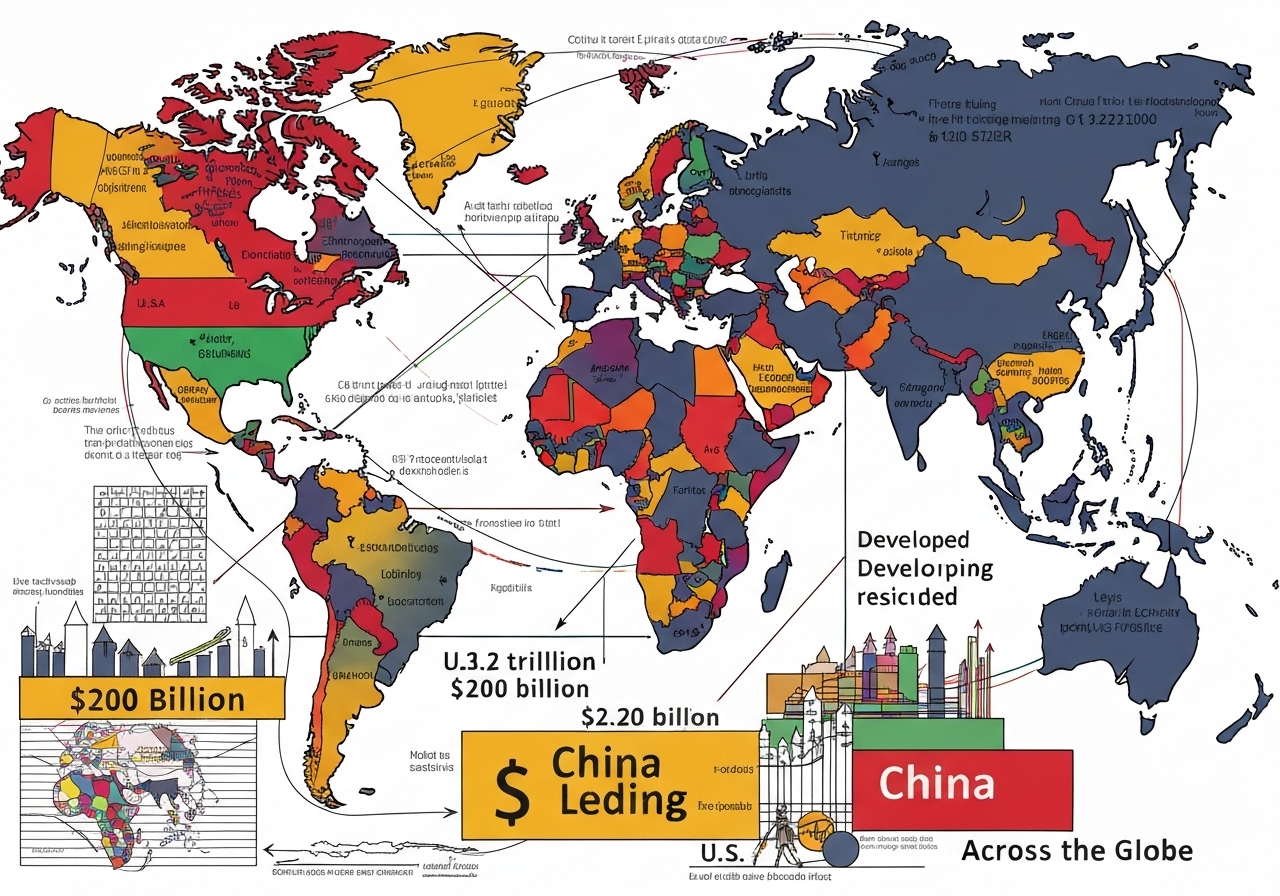
Lead: A new AidData analysis published after Nov. 18, 2025, finds that Chinese state-owned firms have deployed roughly $2.2 trillion in loans and grants worldwide from 2000 through 2023, far larger than earlier tallies. Much of more than $1 trillion in lending went to developing countries for infrastructure projects, but the single largest country recipient over the period was the United States, which received about $200 billion in Chinese financing for commercial projects. The flows covered pipelines, airport terminals and data centers and shifted over time from headline megaprojects to emergency lending and commercially oriented deals in richer markets. The study’s wider dataset and country-by-country accounting have renewed debate in capitals about commercial exposure and strategic dependencies.
Key Takeaways
- AidData’s dataset covers 2000–2023 and catalogs more than 30,000 China-backed projects in over 100 countries, totaling about $2.2 trillion in loans and grants.
- Developing countries received over $1 trillion for government-led infrastructure such as roads, ports and railways; many borrowers later required refinancing or emergency support.
- The United States received roughly $200 billion in China-originated financing for commercial projects, including data centers and corporate credit lines for firms like Amazon and Tesla.
- By around 2017, some U.S. policymakers began flagging particular deals as potential strategic vulnerabilities, especially in digital and transport infrastructure.
- China’s $730 billion holdings of U.S. Treasury securities are excluded from the AidData total and remain a separate element of bilateral financial exposure.
- The pattern differs by market: state-to-state project lending dominates in low-income countries, while commercial credit and corporate financing are more common in advanced economies.
Background
Since the early 2000s, China has expanded from exporter to financier, using state banks and state-owned enterprises to underwrite projects abroad. That expansion included large-scale, government-to-government loans often tied to infrastructure construction contracts — the familiar components of what is broadly labeled the Belt and Road Initiative. AidData’s new compilation consolidates across multiple disclosure sources to provide a more complete monetary tally than many prior public estimates.
Historically, much Western concern about Chinese finance focused on smaller- and middle-income countries where big loans could create debt distress and give Beijing leverage over strategic assets. In some cases, borrowers have sought debt relief or restructuring when revenues failed to cover repayments, prompting emergency lending and renegotiation in the late 2010s and early 2020s. Meanwhile, in wealthier markets, Chinese lending has been channeled more as commercial finance to firms and projects rather than as sovereign credit lines.
Main Event
The AidData study, authored under the leadership of Brad Parks at the College of William & Mary, aggregates project-level data and public disclosures to estimate Chinese outbound finance across sectors and countries from 2000 through 2023. The authors identify more than 30,000 individual commitments by Chinese state-owned banks and firms, yielding the headline $2.2 trillion figure. That total includes both loans and grants but excludes portfolio investments such as China’s holdings of U.S. Treasuries.
In the developing world, the research confirms the prominence of large infrastructure loans — financing for ports in South America, railways in Central Asia and road networks in Africa. These were often negotiated as government-backed packages that tied Chinese contractors and suppliers to the projects. Over time, however, the report finds a rising share of lending categorized as emergency support to renegotiate or refinance sovereign debts.
In advanced economies the pattern has been different: Chinese finance often took commercial forms such as project loans to private firms, corporate credit lines, and purchase financing. AidData’s count credits Chinese banks and state-backed financiers with roughly $200 billion of exposure to U.S. companies and projects, including funding for data centers, pipelines and airport infrastructure.
Analysis & Implications
The expanded estimate changes the scale at which policymakers and analysts must view China’s role as an international creditor. A $2.2 trillion stock of loans and grants implies deeper integration of Chinese capital into global infrastructure and corporate finance than many public inventories showed, altering risk assessments for supply chains and strategic assets. Where loans are sovereign and to low-income countries, the risk is fiscal stress and potential leverage; where lending is commercial, the risk is corporate exposure and market contagion.
For recipient countries, the economic calculus varies. Developing states gained fast-built infrastructure and short-term growth stimuli, but those benefits came with rollover and repayment risks. In richer markets, Chinese financing helped underwrite large projects and provided alternative liquidity sources to Western banks and capital markets. The commercial orientation in advanced economies has nonetheless raised questions about technology transfer, data security and foreign ownership in sensitive sectors.
Geopolitically, the findings underscore that Chinese finance is not a single strategy aimed only at influence in poorer nations; it is multifaceted and adapts to market conditions. That complicates policy responses: restrictions or screening targeted at sovereign credit may miss commercial exposures, while investor-led safeguards may not address the fiscal vulnerabilities of indebted states. Over the coming years, expect renewed scrutiny of deal terms, transparency standards and reciprocity in market access.
Comparison & Data
| Metric | Estimate | Notes |
|---|---|---|
| Total China-backed loans & grants (2000–2023) | $2.2 trillion | Project-level aggregation by AidData |
| Amount to developing countries | More than $1 trillion | Primarily government-backed infrastructure loans |
| Amount to United States | About $200 billion | Mostly commercial financing to firms and projects |
| Dataset coverage | 30,000+ projects in 100+ countries | Includes loans and grants; excludes portfolio Treasury holdings |
| China’s U.S. Treasury holdings (excluded) | $730 billion | Separate from project finance totals |
The table is a distilled snapshot; the report itself disaggregates by sector, lender type and recipient classification. That breakdown shows a higher share of sovereign infrastructure loans in low- and middle-income countries and a concentration of commercial credit in advanced economies. Analysts should treat aggregate figures alongside contract-level terms: amortization schedules, collateral arrangements and political clauses materially affect long-term risk.
Reactions & Quotes
“Our project-level compilation yields a materially larger estimate of China’s outbound finance than many prior public inventories,”
Brad Parks, AidData (lead author)
In context, AidData researchers framed the revision as the result of reconciling many fragmented disclosures into a single dataset. Officials and analysts in several capitals have since weighed the strategic implications of substantial China-originated commercial finance in critical infrastructure.
“The pattern of finance now includes emergency lending and more commercial deals, which changes how governments should assess exposure,”
AidData report summary
Washington policymakers have responded with stepped-up reviews of foreign investment and infrastructure financing, while some developing-country officials emphasized the immediate development benefits such capital provided during construction and expansion phases.
“Certain transactions merit closer examination for their strategic footprint, even when they resemble routine commercial financing,”
U.S. congressional staffer (public statement)
Unconfirmed
- Whether every identified commercial credit line includes full collateral or sovereign guarantees — many contract terms remain unpublished and vary by deal.
- The long-term strategic intent behind specific financing choices in each country — motives can be commercial, political or mixed and are not uniformly documented.
- Exact exposure by industry to supply-chain chokepoints — granular risk mappings are still in progress across sensitive sectors such as semiconductors and data infrastructure.
Bottom Line
The AidData findings recalibrate how governments, investors and analysts should view China’s role as a global creditor: the scale is larger, the instruments are diverse, and the geographic footprint spans poor and wealthy countries alike. For low-income borrowers, the research reinforces concerns about debt sustainability and the need for transparent restructuring mechanisms. For advanced economies, the prevalence of commercial finance raises questions about corporate dependence and strategic vulnerabilities in critical sectors.
Policymakers will likely respond with a mix of tightened investment screening, calls for greater contract transparency and initiatives to mobilize alternative financing for infrastructure. For readers and decision-makers, the takeaway is practical: assess exposures project by project, demand clearer terms, and factor both commercial and sovereign channels into strategic risk planning.
Sources
- The New York Times — Major media report summarizing AidData’s findings (press coverage).
- AidData — Research institute, College of William & Mary; primary dataset and report (academic/research).
- College of William & Mary — Institutional affiliation of AidData (academic).