
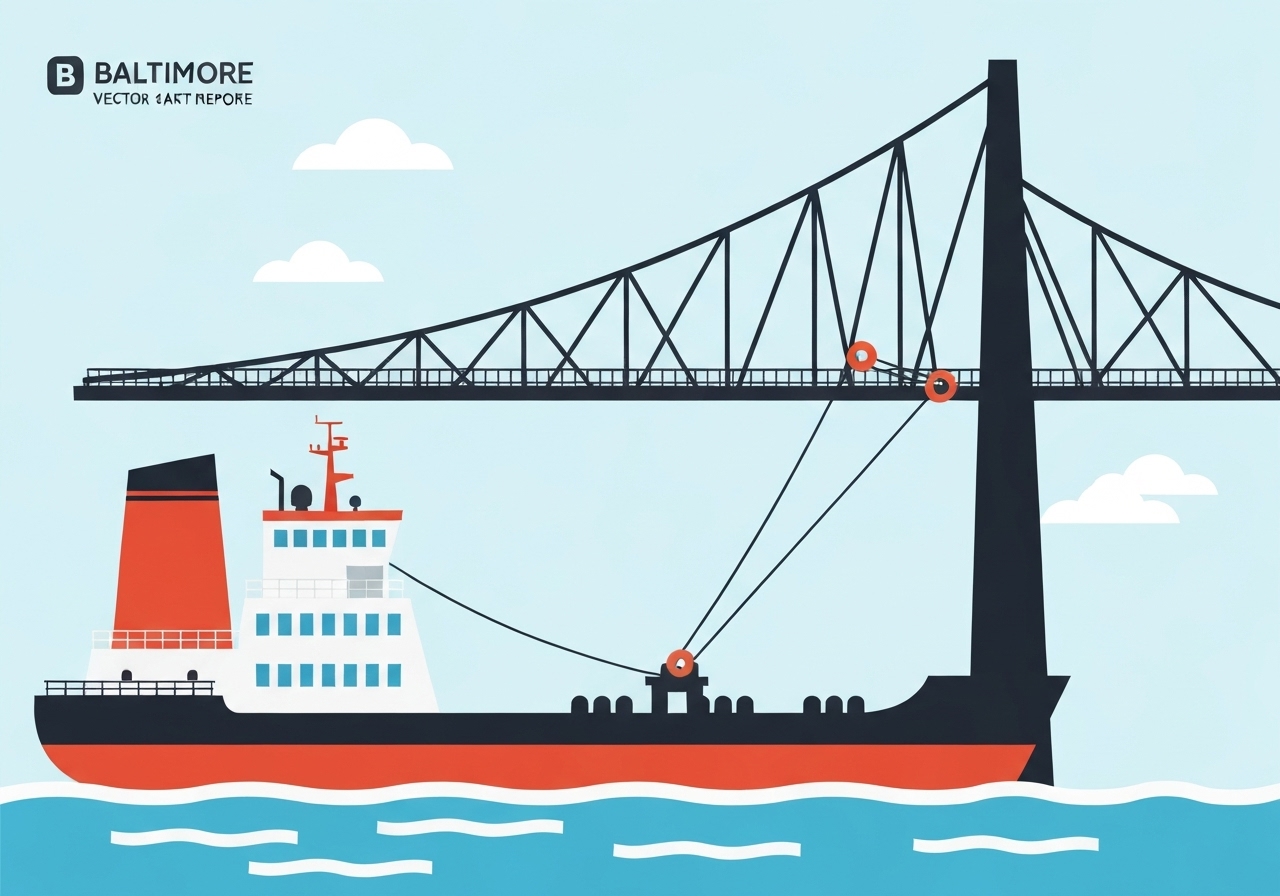
On 26 March 2024, investigators concluded that a loose electrical cable aboard the container ship Dali likely triggered a power outage that contributed to the collapse of Baltimore’s Francis Scott Key Bridge, killing six construction workers. The National Transportation Safety Board (NTSB) said the chain of events — including a ship systems failure, delayed warnings to on‑site crews and the vessel striking a bridge pier — made the disaster preventable. Police at each end of the span were alerted that the Dali had veered off course, but construction inspectors were not notified; NTSB analysis suggests an evacuation window of about one minute 29 seconds might have been available. The collapse closed the Port of Baltimore and damaged a major interstate link, triggering months‑long investigations and large repair‑cost estimates.
- The NTSB investigation attributes the immediate trigger to an electrical power loss on the Dali caused by a faulty cable; investigators also cite a malfunctioning fuel pump and other vessel system problems.
- Six construction workers died after several vehicles plunged into the Patapsco River when the bridge span collapsed on 26 March 2024.
- Police were notified that the ship had deviated from course before impact, but the construction team’s inspector was not alerted; investigators estimate about 1 minute 29 seconds would have been available for evacuation.
- Initial repair estimates released by officials projected completion by 2028 at roughly $1.9 billion; a later update raised the cost to about $5 billion and moved the timeline to 2030.
- NTSB Chair Jennifer Homendy described the accident as preventable and said the agency will review and update safety recommendations to address bridge vulnerability and vessel system failures.
- The incident temporarily halted operations at the Port of Baltimore and severed a major interstate artery, with statewide economic and supply chain impacts cited by state officials.
Background
The Francis Scott Key Bridge is a critical freight and commuter link for Baltimore and the surrounding region, carrying interstate traffic and providing access to the Port of Baltimore. The bridge has been the focus of maintenance and upgrade efforts in recent years, including ongoing construction where crew members were working the night of the collapse. Large container ships regularly transit the approach channels to reach port berths; navigational incidents, while rare, present acute risks to bridge infrastructure located over busy shipping lanes.
Following the March 2024 collapse, federal and state authorities launched parallel inquiries into vessel systems, bridge design and emergency communications. The NTSB opened a year‑long investigation that examined shipboard electronics, propulsion and fuel systems, maritime traffic control, and the notification chain to on‑site bridge workers. Emergency response records and radio transmissions were reviewed to reconstruct the final minutes before the collision.
Main Event
In the predawn hours of 26 March 2024, the Dali lost electrical power shortly before the vessel struck a support pier on the Key Bridge. NTSB investigators traced that blackout to a damaged or loose electrical cable aboard the ship, which led to failures in propulsion control and other critical systems. With limited steerage and thrust, the vessel drifted off its intended track and impacted a bridge pier, causing the collapse of a span where overnight construction workers and vehicles were present.
Police officers positioned at the bridge approaches received warning that the ship was off course and transmitted information through their channels. However, the construction inspector responsible for on‑site safety was not informed in time. The NTSB’s timeline reconstruction indicates that from first notification to impact there would have been approximately one minute and 29 seconds — a period the agency says might have permitted an orderly roadway evacuation.
The bridge failure resulted in multiple vehicles falling into the icy Patapsco River and left six workers dead. Local emergency teams conducted recovery operations in challenging night‑time and water conditions. The collision also damaged port access infrastructure, forcing a temporary closure of a major East Coast shipping facility and disrupting freight flows.
Analysis & Implications
The incident highlights vulnerabilities at the intersection of maritime operations and roadway infrastructure. A single point of failure on a large vessel — in this case an electrical cable and a fuel pump — cascaded into a catastrophic impact because of limited redundancy and insufficient countermeasures around a high‑risk bridge pier. Regulators will face pressure to require stronger vessel maintenance standards and redundant systems for critical shipboard power and steering components.
Communications and notification protocols are also under scrutiny. The NTSB emphasized that timely warnings to on‑site personnel could change outcomes when an incident unfolds in minutes. Agencies and owners may now be asked to adopt automated alerting systems that bridge maritime traffic monitoring with construction and roadway site safety teams, especially during night operations.
Financial and logistical consequences are substantial. Preliminary repair estimates of roughly $1.9 billion with a completion target of 2028 were later updated to about $5 billion and a 2030 timeline, reflecting supply chain pressures and higher material prices. Those revised figures carry implications for state budgets, federal aid requests and regional commerce, with ripple effects on freight costs and project prioritization.
Comparison & Data
| Estimate | Initial (reported) | Updated |
|---|---|---|
| Repair cost | $1.9 billion | ~$5 billion |
| Projected completion | 2028 | 2030 |
The two sets of estimates illustrate how early projections can change as assessments deepen and market conditions shift. The jump from $1.9 billion to roughly $5 billion reflects both the scale of structural repairs and increased costs for materials and labor cited by state officials. Extended timelines also increase economic disruption from reduced port throughput and diverted highway traffic, adding indirect costs not captured by repair budgets alone.
Reactions & Quotes
At the NTSB hearing, agency leaders framed the collision as preventable and stressed the need for revised safety measures. The chair highlighted systemic failures spanning vessel maintenance and communication lapses.
This tragedy should have never occurred. Lives should have never been lost. As with all accidents we investigate, this was preventable.
Jennifer Homendy, NTSB Chair (official statement)
Investigators described the narrow window that may have been available for evacuation and noted how small differences in notification timing can affect survival outcomes. An agency engineer quantified that potential escape interval when reconstructing the timeline.
There would have been about one minute and 29 seconds to evacuate.
Scott Parent, NTSB engineer (testimony reported to press)
State leadership emphasized the economic strain of rebuilding amid higher material prices and supply pressures, linking the reconstruction challenge to broader trade and inflation dynamics.
Trade policies out of Washington, D.C. have raised prices on everything — including essential materials we need in order to rebuild the Francis Scott Key Bridge. Still, despite this new economic reality, our resolve is unwavering.
Governor Wes Moore, State of Maryland (official statement)
Unconfirmed
- Precise origin of the loose cable: investigators identified a faulty cable as the proximate cause of the blackout, but the initial source of that damage—whether maintenance lapse, wear, or external impact—remains under further review.
- Whether a timely warning would have definitively saved all six workers: NTSB modeling suggests evacuation might have been possible within the estimated 1 minute 29 seconds, but exact outcomes depend on individual response and traffic conditions.
- Final repair cost and timeline: the $5 billion and 2030 figures are estimates that could change as detailed engineering assessments and procurement bids proceed.
Bottom Line
The NTSB’s findings point to a multicausal failure: a shipboard electrical blackout tied to a faulty cable, additional vessel system problems, and breakdowns in the chain of notification to workers on the bridge. Taken together, these factors produced a preventable catastrophe with immediate human costs and long‑term economic consequences for Maryland and the regional freight network.
Policymakers and industry stakeholders face clear choices: strengthen vessel maintenance and redundancy requirements, improve real‑time communication links between maritime traffic control and roadway or construction supervisors, and reassess protective measures for critical bridge piers. How regulators act on those choices will shape whether a similar lapse can be prevented in the future.
As repair plans advance and federal, state and local agencies coordinate recovery, close public oversight and transparent reporting of technical findings will be essential to restore confidence and to ensure that lessons from this tragedy translate into concrete safety improvements.
Sources
- BBC — News report summarizing NTSB findings and local reactions (news)
- National Transportation Safety Board (NTSB) — Official agency information and investigation materials (federal agency)
- Office of the Governor of Maryland — Official statements and state updates (state government)
- The Washington Post — Reporting cited for timeline details (news)