
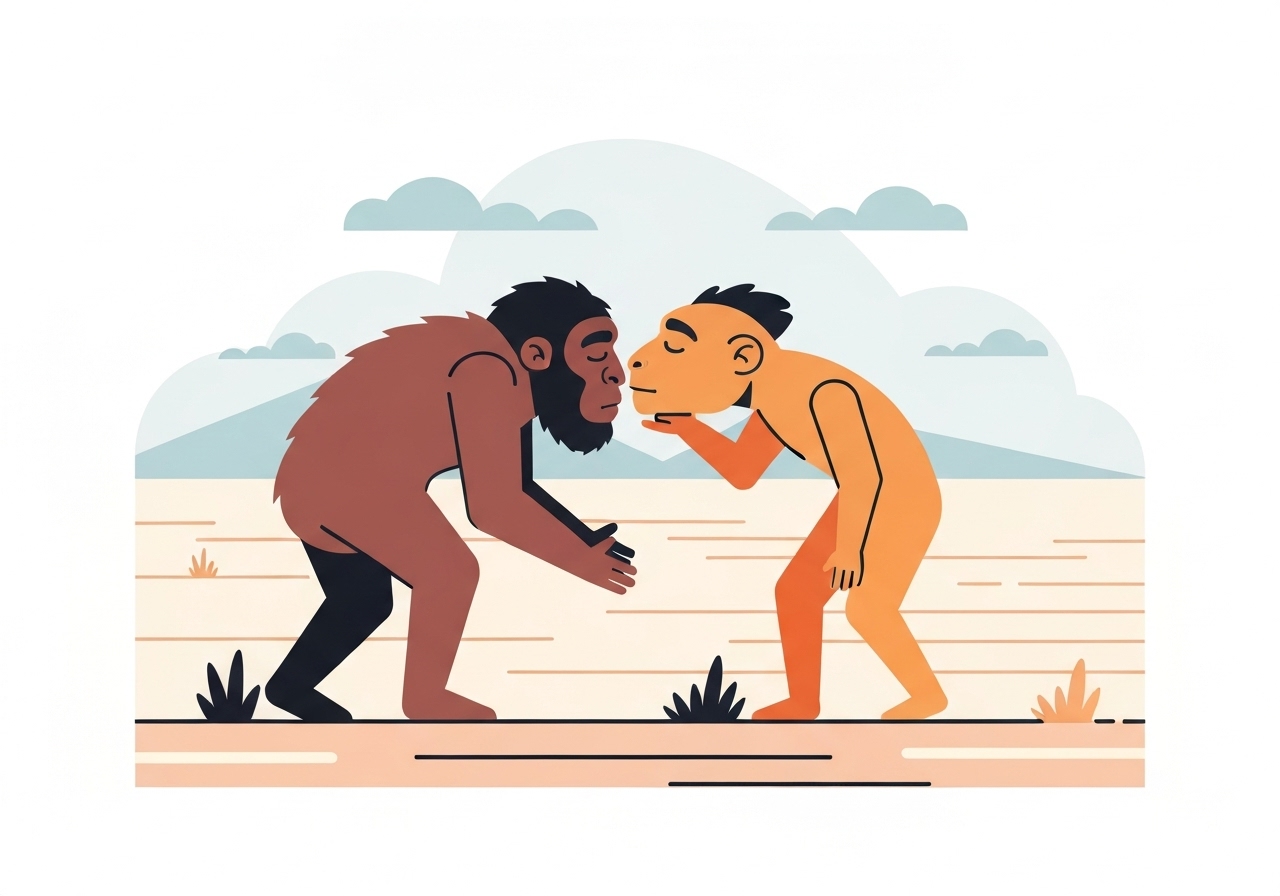
— British researchers report that behaviors matching a humanlike definition of kissing likely emerged between about 16 million and 21 million years ago. The paper, led by evolutionary biologist Matilda Brindle of Oxford University, documents examples of directed, intraspecific oral–oral contact with lip or mouth movement across a surprising range of species, from large apes to insects. The team focused analysis on great apes and related primates but found comparable behaviors reported in birds, fish and mammals. Their findings suggest kissing is far older and more widespread than previously documented, prompting new questions about its evolutionary roles.
Key takeaways
- The research estimates the earliest occurrences of kiss-like behavior at roughly 16–21 million years ago based on comparative observations and phylogenetic inference.
- Study lead Matilda Brindle and colleagues concentrated on large apes (gorillas, orangutans, baboons) while also cataloguing reports across diverse taxa including ants, fish, albatrosses and polar bears.
- Neanderthals are included in the study’s comparative set; microbial overlap with Homo sapiens leaves open the possibility of oral contact between the species.
- The authors define kissing operationally as non-agonistic, directed oral–oral contact with movement and no food transfer, separating it from feeding or aggressive mouthing.
- Researchers emphasize the behavior’s social functions—bonding, trust, parental care—rather than clear direct survival or reproductive benefits.
- Dr. Brindle said field data remain sparse; the study calls for standardized behavioral records to test adaptive hypotheses.
Background
The practice commonly labeled as kissing has long been recorded in human societies worldwide, appearing in ritual, romantic and familial contexts. Anthropologists have debated whether human kissing is a cultural invention, a byproduct of other behaviors, or an evolved social signal; empirical testing across species has been limited. Brindle’s team sought to move beyond anecdote by applying a precise behavioral definition and mapping reports onto primate phylogeny to estimate minimum ages for the trait. The approach combines field observations, published ethology reports and phylogenetic methods to infer when an ancestral lineage likely exhibited the behavior.
Past work has emphasized primate mouth-to-mouth contact in grooming, food sharing and aggressive displays, but distinguishing affectionate oral contact requires separating it from those other contexts. The study therefore excluded food transfer and agonistic mouthing and focused on directed, non-hostile mouth contact with discernible lip or mouthpart movement. Oxford’s project fits into a small but growing literature that uses comparative data to time the emergence of social behaviors. Stakeholders include primatologists, evolutionary biologists, anthropologists and behavioral ecologists seeking testable hypotheses about social bonding mechanisms.
Main event
The team collected and reviewed behavioral records from a wide set of species, then concentrated analysis on large apes where documentation was richest. In apes such as orangutans, gorillas and some baboon groups, researchers reported gentle oral–oral contact used in affiliative contexts between mates, kin and social partners. Field notes and published observations provided the raw instances that the authors mapped onto a primate tree to estimate when the trait likely appeared in ancestral nodes.
Unexpectedly, the literature search turned up analogous behaviors in taxonomic groups outside primates—ants showing oral contact during social exchange, fish engaging in mouth-to-mouth touches, and seabirds and large mammals displaying affectionate oral behaviors. Those reports were typically described differently in original sources but fit the operational definition once context and movement were considered. The multidisciplinary review expanded the behavioral dataset but the authors flagged variation in reporting standards and observation intensity across taxa.
On hominin relatives, the paper notes that Neanderthals shared oral microbiota with modern humans based on paleogenomic studies, and the authors argue such microbial overlap leaves open the plausibility of occasional oral contact between the groups. The study does not claim direct fossil evidence of kissing—no morphology preserves such behavior—but uses comparative inference to place a conservative minimum age on the behavior in ancestral primates.
Analysis & implications
If kissing-like behavior genuinely dates to at least 16 million years ago, it predates the human lineage’s split from many ape relatives and must be understood as part of broader primate social repertoires. That timing implies the behavior evolved in lineages where social bonding and close affiliative contact conveyed group-level advantages even if fitness payoffs were indirect. For example, mouth-to-mouth contact could facilitate social cohesion, parental care, or pathogen exchange that shapes immune system dynamics—none of which require immediate reproductive payoff.
The study reframes kissing not as a uniquely human cultural oddity but as a behavior with deep evolutionary roots that multiple lineages have used for affiliative purposes. This interpretation urges researchers to explore proximate mechanisms—sensory cues, neural reward pathways, oxytocin-mediated bonding—that could make the behavior rewarding across taxa. It also raises public-health and microbiome questions: oral contact transfers microbes, and long-term coevolution of host and microbiota might have influenced social tolerance for such exchanges.
However, the authors and the reporting stress limits: comparative inference cannot prove past behavior directly, and uneven observation effort biases which taxa appear to exhibit kissing. Field studies historically prioritize some species over others, and casual or culturally framed descriptions in older ethnographies and natural-history reports complicate standardization. The paper therefore frames its dates as conservative estimates based on the current evidence base, while inviting systematic, standardized behavioral recording going forward.
Comparison & data
| Item | Value/Example |
|---|---|
| Estimated earliest occurrence | ~16–21 million years ago |
| Primary taxa analysed | Gorillas, orangutans, baboons (large apes/primates) |
| Other taxa with reported oral contact | Ants, fish, albatrosses, polar bears |
| Operational definition | Directed, non-agonistic oral–oral contact with movement; no food transfer |
The table summarizes the study’s core numbers and categories: an inferred minimum age range, the primate focus, cross-taxa reports, and the behavior’s working definition. These data reflect the authors’ conservative mapping rather than direct fossil or genomic evidence of the action; the age range comes from reconstructing ancestral nodes on a primate phylogeny populated with behavioral character states derived from observations.
Reactions & quotes
Researchers on the paper say the breadth of taxa showing comparable behaviors was a surprise and a prompt for more systematic field recording. Below are concise statements from the study lead and the paper’s reporting context.
“Kissing is a really interesting behavior — it appears across cultures and species, but we’ve not really tested it from an evolutionary perspective.”
Matilda Brindle, Oxford University (study lead)
The remark summarizes the study’s motivation: to move from anecdote to comparative inference using a clear behavioral definition and phylogenetic methods.
“If we had more data on this, then we could really start to kind of unpack the potential kind of adaptive advantages of kissing.”
Matilda Brindle, Oxford University (study lead)
Here the lead author emphasizes the limits of current observation records and encourages standardized, long-term behavioral documentation to test adaptive hypotheses.
“The study compiles surprising cross-taxa reports and argues for a conservative timing of kiss-like contact in primate ancestors.”
Report summary, The New York Times
This summarizes the paper’s central claim and the cautionary framing used by the reporting outlet.
Unconfirmed
- Direct evidence that Neanderthals and modern humans exchanged kisses is not preserved; microbial overlap makes it plausible but not proven.
- Reports of kiss-like behavior in non-primate taxa vary widely in description and may not reflect identical mechanisms or functions across groups.
- The inferred 16–21 million-year range is a conservative minimum based on available observations and could change with expanded, standardized datasets.
Bottom line
The study reframes kissing as an ancient affiliative behavior with a probable presence in primate ancestors at least 16 million years ago, rather than as solely a human cultural invention. That conclusion rests on conservative phylogenetic reconstruction combined with a wide literature survey and a strict behavioral definition that excludes feeding and aggression. While provocative, the result is not a definitive fossil record of kissing; it is an inference that highlights shared social repertoires across taxa and calls for better, standardized field data.
For readers and researchers alike, the immediate takeaway is twofold: kissing-like contact is more widespread than many expected, and understanding its evolutionary role requires coordinated observation protocols, experimental work on proximate mechanisms, and attention to microbial and social costs and benefits. The paper opens clear avenues for follow-up studies that could clarify whether kissing confers measurable adaptive advantages or primarily serves as a social signal shaped by other selective pressures.