
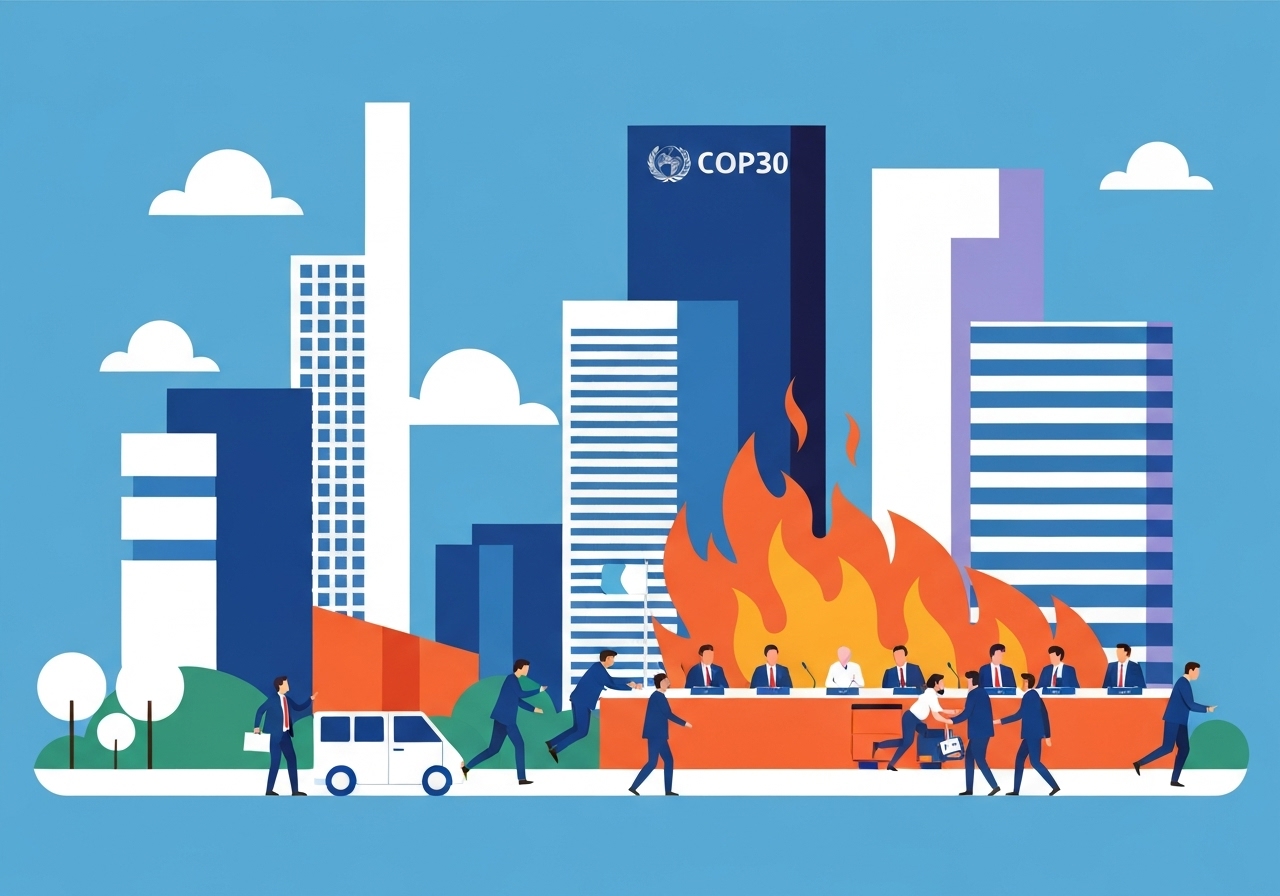
Lead: The UN climate summit COP30 in Belém, Brazil was evacuated after a fire broke out inside the conference pavilion, forcing thousands of attendees outside as emergency services responded. Brazilian authorities said the blaze is now under control and reported no injuries. The incident occurred in the closing hours of negotiations when nearly 200 countries were trying to agree next steps on climate action, and it interrupted final discussions. Organizers and local emergency crews moved to secure the site while delegates sought shelter and waited for safety checks.
Key Takeaways
- The fire erupted inside the pavilion at the COP30 venue in Belém, a site built over a former aerodrome, and produced visible flames and large columns of smoke.
- Brazilian authorities reported the blaze was brought under control and said no-one was injured; ambulances were seen arriving more than 90 minutes after the fire began.
- Evacuation left hundreds of people sitting outside in high heat and humidity; some delegations sheltered under nearby structures, including a petrol station canopy.
- Delegations from nearly 200 countries were present; organisers said the summit has been temporarily taken over by Brazilian authorities for safety assessment.
- A BBC team on site reported a hole burned through the venue’s sheeting and footage showed bystanders attempting to fight the flames before evacuating.
- Early eyewitness accounts and one attendee suggested an electrical fault might have started the blaze, but officials have not confirmed a cause.
Background
COP30 is the latest in a series of annual UN climate conferences where nearly 200 countries negotiate collective steps to limit global warming and implement the Paris Agreement. These meetings routinely attract thousands of delegates, including government officials, negotiators, scientists and observers, and the final hours often involve intense bargaining over text and commitments. The Belém venue is a temporary structure over a former aerodrome, designed to host large exhibition and negotiation spaces; such venues can present logistical and safety challenges when filled to capacity.
Security and safety at UN conferences are generally managed by a combination of UN protocol teams, host-country authorities and private contractors; responsibility for on-site emergency response often rests with local fire and police services. Previous COP meetings have faced disruptions from demonstrations, technical problems and extreme weather, but on-site fires disrupting final negotiations are rare. With so many national delegations present, any forced evacuation risks delaying consensus-building processes in the conference’s critical final hours.
Main Event
According to journalists on site, flames and smoke were seen in the pavilion area before attendees were rushed outside by UN security staff and local personnel. A hole was reported burned through the venue’s outer sheeting, and video circulated showing an individual briefly attempting to fight the blaze with a handheld extinguisher. Fire engines were observed racing past as people gathered at perimeter locations; two ambulances were seen heading toward the entrance more than 90 minutes after the initial outbreak.
Brazilian authorities announced that the fire was under control and that no injuries had been reported. UN officials said local fire services were inspecting the site and took temporary control of the summit area to carry out safety assessments. Delegations described scenes of confusion and crowding as negotiators and support staff waited outdoors in high temperatures and humidity for clearance to re-enter or for alternative arrangements.
Several national delegations were reported sheltering under nearby canopies and infrastructure, including a petrol station roof, as they awaited information. A member of the UK delegation told reporters that the incident had effectively halted negotiations, with negotiators unable to return to plenary and informal drafting sessions until the venue was declared safe. Organizers confirmed they had asked the Brazilian fire brigade to complete a full check of the premises and assess any damage to conference infrastructure or materials.
Analysis & Implications
An evacuation at a COP in the final negotiation window raises immediate procedural and diplomatic issues: compressed schedules and tight deadlines mean any delay can reduce the time available for compromises and textual revisions. With nearly 200 parties involved, reconvening key negotiating blocs and restoring momentum can be time-consuming; some smaller technical groups may be able to resume remotely, but high-level ministerial contacts often require in-person, confidential discussions that are harder to replicate outside secure meeting rooms.
Operationally, the incident underscores vulnerabilities of temporary conference infrastructure when hosting large-scale international events in challenging climatic conditions. Heat and humidity, combined with makeshift coverings and high electrical loads for booths and translation equipment, can strain power and safety systems. Host authorities and UN organizers will likely review venue certification, electrical layouts and emergency evacuation procedures as part of a post-incident assessment.
Politically, a disruption during late-stage talks could harden positions or compress the timeframe for concessions, affecting the content and ambition of any final COP outcome. If key negotiators miss crucial sessions or if draft texts are lost or inaccessible, reopening negotiations could delay adoption of agreements or produce narrower compromises. International attention to the disruption may also shift public focus from substantive negotiation outcomes to questions about event safety and host preparedness.
Comparison & Data
| Metric | Reported value |
|---|---|
| Number of countries represented | Nearly 200 |
| Evacuation/response window | Over 90 minutes reported |
| Injuries reported | None (officially) |
| Venue type | Temporary pavilion on former aerodrome |
| Attendees | Thousands |
The table places the incident in operational terms: thousands of attendees and representation from nearly 200 countries create a high-complexity environment for evacuation and accountability. The more-than-90-minute response and inspection timeframe aligns with large-scale venue checks but also reflects the time needed to clear complex temporary structures. Officials will need to report on whether critical negotiation materials or voting records were affected; that will determine whether text restoration or retransmission of documents is required.
Reactions & Quotes
“There’s a huge panic — people have been running out of here, it’s a very dramatic moment,”
Justin Rowlatt, BBC Climate Editor (on-site)
Rowlatt’s account described the immediate atmosphere and visible smoke columns; his reporting was one of several on-the-ground sources cited by media outlets covering the evacuation.
“The fire is under control and no-one has been injured,”
Brazilian government (official statement)
The Brazilian government issued a brief on-site update indicating control of the blaze and no reported injuries; authorities then coordinated with the UN on securing the venue for further checks.
“The summit has been temporarily taken over by Brazilian authorities while the fire brigade checks the venue,”
UN official statement
The UN framed the handover to host-country emergency services as a safety measure; operational control for inspections is standard practice in such incidents and aims to ensure delegations can resume work only when the site is confirmed safe.
Unconfirmed
- Cause of the fire: eyewitnesses suggested an electrical fault, but officials have not publicly confirmed a cause.
- Whether the woman taken away in a wheelchair was injured as a direct result of the fire has not been established.
- Extent of damage to negotiation documents or technical submissions has not been verified and may affect the recovery timeline.
- Potential long-term impacts on the final COP30 agreement remain unclear until negotiations resume and parties assess lost time and altered schedules.
Bottom Line
The evacuation at COP30 in Belém interrupted deliberations at a pivotal moment, introducing logistical and procedural complications for nearly 200 participating countries. While authorities reported the fire under control and no injuries, the event highlights operational risks tied to temporary conference infrastructure and the strain of hosting large international meetings in hot, humid conditions.
Immediate priorities will be a full safety inspection, an accounting of any lost or damaged materials, and a coordinated plan by the UN and Brazilian authorities to restore negotiating capacity. Whether the disruption materially alters the summit’s outcomes depends on how quickly negotiators can reconvene, access necessary documents and rebuild momentum toward any remaining decisions.