
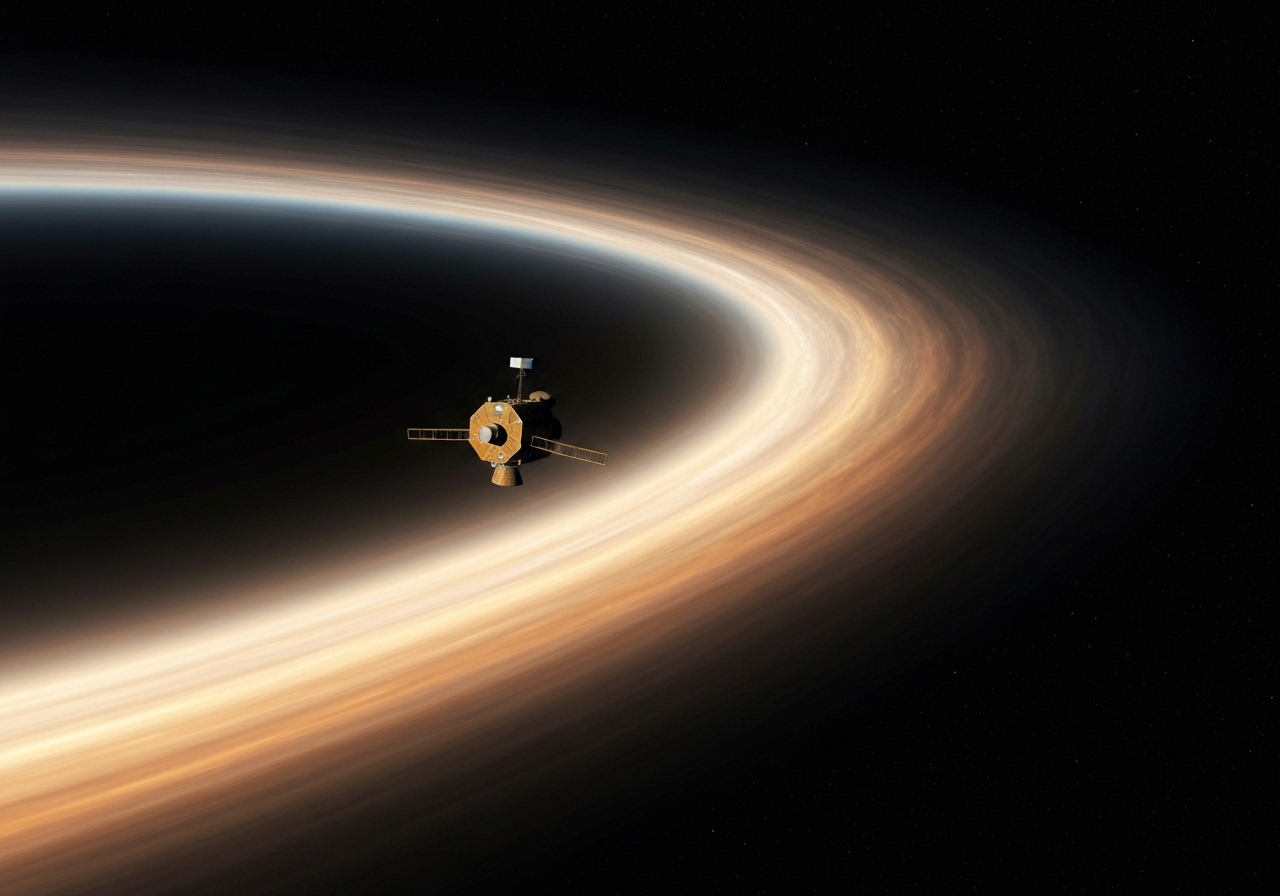
Lead: NASA’s Voyager 1 — one of two 1977-launched probes — has traversed what scientists describe as a blistering boundary at the edge of the heliosphere, recording temperatures up to 90,000°F as it slipped into interstellar space. Traveling at roughly 38,000 miles per hour and having covered more than 12 billion miles, Voyager 1 is due to reach about one light‑day from Earth by the end of this month. The observation confirms that the heliosphere ends in a sharp transition region, and it underlines the continuing scientific value of spacecraft whose instruments were built more than four decades ago. Mission teams continue to manage aging systems as the probes send back data from well beyond the Sun’s magnetic influence.
Key Takeaways
- Voyager 1 and 2 were launched in 1977 to study the outer planets and are now interstellar emissaries; both have exceeded 12 billion miles in travel distance.
- Voyager 1 crossed the heliopause in 2012; Voyager 2 followed in 2018 — a six‑year gap that highlights asymmetry in the heliosphere’s shape.
- In passing the heliopause, instruments recorded plasma temperatures ranging roughly from 54,000°F to 90,000°F, described in press coverage as a “wall of fire.”
- Current speeds are about 38,000 miles per hour for the probes; Voyager 1 is projected to be about one light‑day from Earth by month’s end.
- Data show the heliosphere is not spherical but teardrop‑shaped, producing a bow‑shock-like feature and an extended wake as the solar system moves through the local interstellar medium.
- Keeping the Voyagers operational has required shutting down some instruments and reactivating others that have not been used in decades.
Background
The twin Voyager spacecraft were launched in 1977 primarily to perform flybys of the giant outer planets. After completing planetary encounters, mission teams redirected the probes on trajectories that would carry them out of the solar system. Over the following decades they transitioned from planetary explorers to the first human-made objects to sample the region between stars.
Scientists long posited a boundary where the Sun’s outward-flowing plasma and magnetic field — the solar wind — would meet the interstellar medium. That region, the heliopause, marks the pragmatic edge of the heliosphere, the magnetic bubble surrounding our star. Alternate definitions of the solar system exist (planetary or gravitational extents), but modern consensus often uses the Sun’s magnetic and plasma influence as the defining limit.
Main Event
When Voyager 1 crossed the heliopause in 2012 it registered abrupt changes in particle fluxes and magnetic conditions, signals interpreted as entry into interstellar space. Voyager 2 crossed a similar boundary in 2018, but not at the same distance or time, revealing that the heliosphere’s outer boundary is uneven. Mission telemetry from both craft recorded unexpectedly high plasma temperatures — tens of thousands of degrees Fahrenheit — as they negotiated the transition zone.
These temperature measurements do not imply combustion; they describe highly energetic charged particles (plasma) rather than burning matter. The probes’ instruments detected increases in particle energy and magnetic field behavior that correspond to the sharp boundary between the Sun’s plasma environment and the surrounding interstellar medium. Engineers on the ground have had to manage decades‑old electronics, powering down and reactivating systems to maximize scientific return while preserving limited onboard resources.
The characterization of this boundary as a “wall of fire” is a media shorthand capturing the dramatic rise in particle energy and inferred plasma temperature. Scientists instead describe a complex, dynamic interface shaped by the Sun’s variable output and the pressure of the local interstellar medium. That interface produces a wake and a compressed region ahead of the heliosphere, giving it a teardrop or comet‑like form as the solar system moves through space.
Analysis & Implications
First, the Voyagers’ findings force a refinement of theoretical models for the heliosphere. The multi‑year discrepancy between the two spacecraft in crossing the heliopause demonstrates large-scale asymmetry; this requires models that incorporate the Sun’s time‑varying activity, interstellar magnetic field orientation, and local gas conditions. Simple spherical approximations no longer suffice when interpreting how the solar wind terminates.
Second, the high plasma temperatures measured at the boundary imply active processes — compression, magnetic reconnection, and particle acceleration — are at work. These phenomena affect how cosmic rays enter the inner solar system and have implications for long‑term radiation environments that future deep‑space missions must account for. Although the temperatures are extreme by everyday standards, they refer to particle energies and not to heat that would damage a conventional thermal sensor in the terrestrial sense.
Third, the Voyagers provide the only in-situ data points we currently have for this region. That makes each measurement invaluable but also risky to overinterpret: two trajectories through a highly variable environment cannot capture all possible configurations. Future missions, and improved heliospheric simulations validated against Voyager data, will be necessary to generalize the findings.
Finally, the operational challenges of preserving decades‑old instruments highlight the value of long‑lived missions and the need for redundancy and serviceability in designs for future probes intended to cross the heliopause or operate in interstellar space.
Comparison & Data
| Spacecraft | Heliopause Crossing | Recorded Temp (°F) | Reported Distance |
|---|---|---|---|
| Voyager 1 | 2012 | Up to ~90,000°F | Over 12 billion miles; ~1 light‑day by month’s end |
| Voyager 2 | 2018 | ~54,000–90,000°F (range reported) | Also beyond 12 billion miles |
The table condenses crossing years, the temperature range reported by mission instruments as summarized in public coverage, and the rough travel distances cited by recent summaries. Because the heliopause is dynamic, peak energies and local conditions can vary substantially along different trajectories and times.
Reactions & Quotes
Mission statements and scientific commentary emphasize both the milestone and the technical caveats around interpretation.
“Voyager 1 has entered interstellar space,”
NASA press release (official)
NASA framed the 2012 crossing as an unprecedented achievement — the first in-situ sampling of the region outside the Sun’s magnetic dominance. The agency’s brief statements focused on observable changes in particle populations and magnetic field behavior as the decisive indicators for crossing the heliopause.
“The heliosphere is shaped by the Sun’s variability and the interstellar environment, producing a non-spherical boundary,”
Voyager project scientists (paraphrase)
Voyager project scientists have repeatedly stressed that the non-spherical, teardrop-like morphology of the heliosphere and the variable timing of crossings are consistent with models that include solar cycle effects and interstellar pressure. Those interpretations shape how researchers update simulation frameworks and plan follow-up observations.
Unconfirmed
- Whether the recorded temperature spikes are uniform across the heliopause or confined to localized regions near each spacecraft’s trajectory remains unproven.
- The exact mechanisms producing the highest measured particle energies (e.g., reconnection vs. shock compression) are still under study and not definitively assigned.
- Longitudinal and temporal variability of the heliosphere over solar cycles means extrapolating these point measurements to a global heliopause description is uncertain.
Bottom Line
The Voyagers’ crossings of the heliopause — and the dramatic particle energies they encountered — mark a milestone in human exploration and in our empirical understanding of the Sun’s outermost influence. Those in-situ data confirm that the heliosphere has a sharp, complex boundary and that the Sun’s interaction with the interstellar medium produces intense particle environments that we are only beginning to characterize.
For scientists and mission planners, these findings underscore the value of long‑duration spacecraft and of designing future probes with instruments and redundancy suited to hostile, poorly understood regimes. While language like “wall of fire” captures public attention, the careful interpretation of plasma measurements will be essential to convert those dramatic words into robust models of our solar neighborhood.
Sources
- Yahoo / Jalopnik republishing (news coverage)
- NASA: Voyager Mission Page (official mission information)
- NASA Science: Voyager program (official analysis and press releases)