
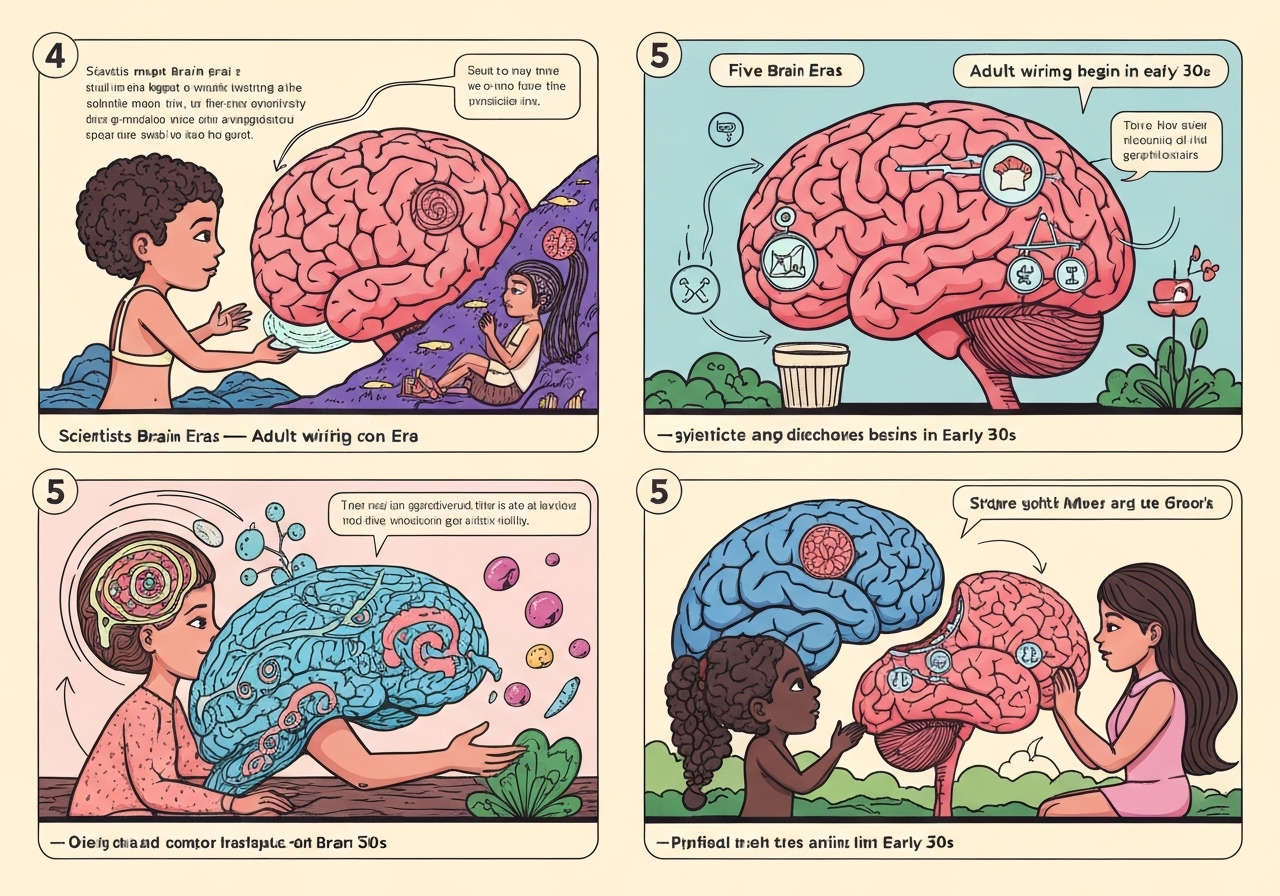
Researchers at Cambridge and collaborators say human brains progress through five broad ‘eras’ of structural organisation from infancy to very old age, based on an analysis published alongside a news report on 25 November 2025. The team examined nearly 4,000 brain scans from people aged under one to 90 and identified four major turning points at about ages 9, 32, 66 and 83. Their results show that ‘adult mode’ of neural wiring typically does not begin until the early 30s, and that the longest sustained phase follows that shift. The authors argue these punctuated shifts — rather than a smooth, constant change — help explain when the brain is most vulnerable to disruption.
Key Takeaways
- Sample and scope: The study analysed nearly 4,000 structural brain scans from participants aged under 1 to 90 years to map lifespan changes in connectivity.
- Five eras: Researchers define five major developmental epochs separated by four turning points at ~9, ~32, ~66 and ~83 years.
- Adult onset: The strongest trajectory change occurs around age 32, marking the transition to an ‘adult’ wiring pattern that lasts more than three decades on average.
- Childhood wiring: From birth to about age 9 the brain undergoes ‘network consolidation’ with synaptic pruning, reduced wiring efficiency and peaks in cortical thickness and folding.
- Adolescence and efficiency: The second epoch (roughly ages 9–32) shows rising whole-brain connection efficiency tied to continued white matter growth and cognitive refinement.
- Aging phases: Two later turning points at ~66 and ~83 correspond to decreases in connectivity attributed to white matter degeneration and broader ageing effects.
- Measurement breadth: Brain organisation was quantified using 12 structural/connectivity measures, including efficiency, modularity (compartmentalisation) and hub reliance.
Background
Understanding how brain structure changes across the lifespan has been a major aim of cognitive neuroscience, developmental psychology and clinical research. Traditional views often contrasted rapid early growth with gradual decline in later life, but recent work suggests more complex, non-linear patterns. Mapping when the brain’s wiring reorganises can help researchers locate windows of vulnerability and opportunity for learning, resilience and intervention.
Previous longitudinal and cross-sectional studies identified adolescence and early adulthood as important periods for cognitive and emotional development; however, most relied on narrower age ranges or fewer structural measures. The Cambridge-led analysis pooled many participants and used a dozen metrics to characterise network organisation, aiming to test whether the brain follows continuous trajectories or shifts between distinct phases.
Main Event
The team processed nearly 4,000 magnetic resonance scans spanning the age range from under one year to 90 years, extracting measures that capture how brain regions connect and communicate. They applied statistical models to detect prolonged trends and points where the direction or slope of those trends changed markedly. That approach yielded five sustained epochs rather than a single monotonic trajectory.
The earliest epoch, labelled childhood, runs from birth to about age nine and is characterised by network consolidation: synaptic pruning reduces the number of connections while preserving and strengthening the most active pathways. During this phase the study reports decreasing global wiring efficiency, alongside rapid increases in grey and white matter volumes, a peak in cortical thickness and stabilisation of cortical folding patterns.
The second epoch, spanning adolescence up to roughly age 32, shows continued white matter growth and rising efficiency in whole-brain connectivity, a pattern the authors link to improving cognitive performance during these years. Around age 32 the data show the strongest inflection: many measures shift to a new trajectory that the team describes as adult mode, with greater compartmentalisation of brain regions and a prolonged plateau in organisation.
Two later turning points — at about 66 and 83 years — mark early and late ageing epochs. Both are characterised by declining connectivity metrics and are interpreted as reflecting age-related white matter degradation and reduced integration across networks. The authors emphasise these are population-level patterns observed across the cross-sectional sample rather than deterministic outcomes for every individual.
Analysis & Implications
The finding that adult wiring patterns typically emerge in the early 30s reframes common assumptions about when the brain ‘matures.’ Rather than treating late adolescence or the mid-20s as the definitive end of development, this work suggests a later stabilisation of large-scale structural organisation. That has implications for policies and expectations around education, workforce transitions and mental-health screening.
Clinically, locating adolescence as a distinct epoch with rising efficiency helps explain why many psychiatric disorders first appear in that window: changes in wiring may interact with genetic and environmental risk to produce symptoms. Knowing the approximate timing of major organisational shifts could focus prevention and early-intervention efforts around specific age ranges.
For ageing research, the identification of two separate ageing epochs underscores that decline is not a single uniform process. Early ageing around the mid-60s may reflect different mechanisms from changes after the early 80s; disentangling these could aid targeted strategies to preserve connectivity, for example through vascular health, cognitive training or lifestyle interventions.
Methodological caveats matter. The study uses cross-sectional scans aggregated across ages, so cohort effects and selection biases can influence apparent turning points. The authors note that longitudinal data and diversified samples are needed to confirm timing and causal drivers of the observed transitions.
Comparison & Data
| Era | Approximate age range | Primary structural feature(s) |
|---|---|---|
| Childhood | Birth–~9 | Network consolidation, synaptic pruning, peak cortical thickness |
| Adolescence | ~9–~32 | Rising whole-brain efficiency, white matter growth |
| Adult mode | ~32–~66+ | Stabilised wiring, increased compartmentalisation, long plateau |
| Early ageing | ~66–~83 | Declining connectivity, white matter degradation begins |
| Late ageing | ~83+ | Further connectivity loss and network reorganisation |
The table summarises the five eras identified by the study and the approximate ages of turning points at 9, 32, 66 and 83 years. These numbers are population-level averages derived from the study’s models; individual trajectories can differ substantially. The researchers based their classification on 12 quantitative measures of brain organisation, combining metrics sensitive to efficiency, modularity and hub structure.
Reactions & Quotes
“Looking back, many of us feel our lives have been characterised by different phases. It turns out that brains also go through these eras.”
Prof Duncan Astle, Cambridge University (senior author)
Astle framed the results as a change in perspective: the brain’s structural journey consists of a few major turning points rather than a smooth, continuous progression. He and colleagues say that recognising those turns should help identify when wiring is most vulnerable.
“We’re definitely not saying that people in their late 20s are going to be acting like teenagers… It’s really the pattern of change.”
Alexa Mousley (lead author)
Mousley emphasised that the labels describe patterns of change in network measures, not literal behavioural stereotypes. She also noted potential links between life events such as parenthood and brain changes, while making clear the study did not explicitly test causal relationships.
Unconfirmed
- The suggestion that life events such as parenthood contribute to the age-32 shift is plausible but was not tested in this analysis and remains unproven.
- How these five eras generalise across diverse populations and ethnic groups is unclear because the sample composition and representativeness are not detailed in the news report.
- Whether the identified turning points correspond to abrupt within-individual reorganisations or to smoother, variable changes across people requires longitudinal confirmation.
Bottom Line
The study provides a parsimonious framework for thinking about brain development as a sequence of five broad eras punctuated by four population-level turning points at roughly 9, 32, 66 and 83 years. The clearest practical shift is around age 32, when structural measures indicate a move into a prolonged adult wiring pattern that can last several decades.
These findings should prompt researchers, clinicians and policymakers to treat developmental and ageing windows as discrete periods with distinct risks and opportunities, while recognising limitations of cross-sectional inference. Confirmatory longitudinal work and more diverse samples will be essential to translate this lifespan map into targeted interventions.
Sources
- The Guardian — news report (media)
- University of Cambridge — academic institution (research group/press)