
Lead
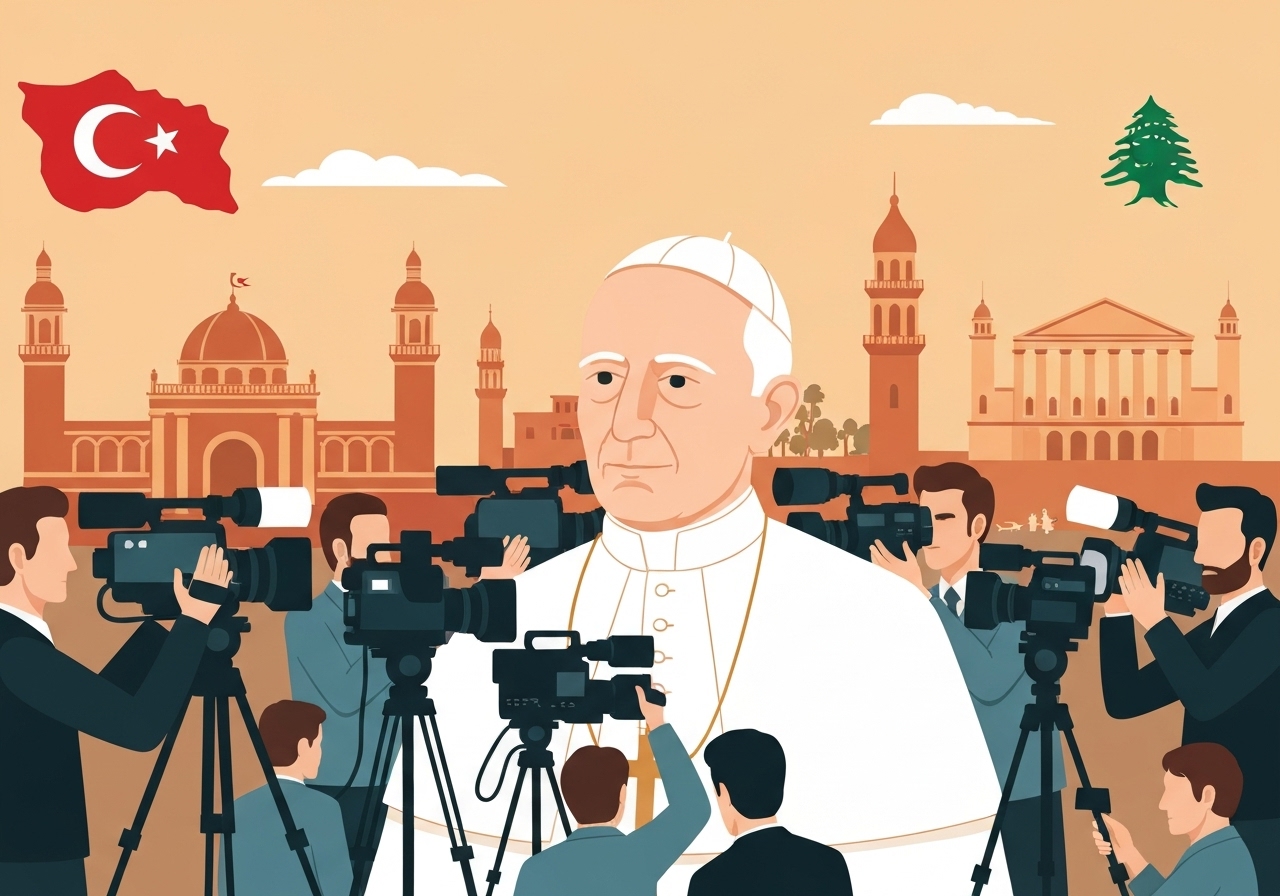
Pope Leo XIV will make his first foreign journey, traveling to Turkey and Lebanon from Nov. 27 to Dec. 2 to mark the 1,700th anniversary of the Council of Nicaea and to minister to Lebanese communities still reeling from the Aug. 4, 2020, Beirut port blast. The trip — originally planned by Pope Francis — combines ecumenical outreach in Turkey with pastoral and justice-focused visits in Beirut, including a silent prayer at the blast site. The itinerary is being followed intensely by about 80 journalists from Vatican, Lebanese and Turkish outlets and a U.S. media pool that includes major networks. Security concerns and ongoing regional tensions add to the diplomatic sensitivity of an American pope’s first overseas tour.
Key Takeaways
- Pope Leo XIV will travel Nov. 27–Dec. 2, stopping first in Turkey and concluding in Lebanon, with a returning in‑flight press conference on Dec. 2.
- The Turkey leg centers on the 1,700th anniversary of the Council of Nicaea (325 AD); Leo will pray with Ecumenical Patriarch Bartholomew in Iznik and sign a joint declaration.
- In Lebanon, Leo plans a silent prayer at the Aug. 4, 2020 Beirut port blast site, which killed at least 218 people and wounded more than 6,000.
- About 80 journalists compose the papal press corps, with U.S. networks (ABC, CBS, NBC, Fox), CNN and the BBC included in the traveling pool.
- Leo will speak in English in Turkey and in English and French in Lebanon, departing from the Vatican’s customary use of Italian for public remarks.
- The Vatican says no formal extra security measures were announced, and the pope will not visit southern Lebanon, an area affected by recent strikes.
- Regional violence remains acute: an Israeli strike on Beirut recently killed Hezbollah’s chief of staff and four others, reinforcing security worries.
Background
The trip traces its origins to a visit planned by Pope Francis and is intended to reinforce ties between the Roman Catholic Church and Eastern Orthodoxy while addressing pressing humanitarian and political concerns in Lebanon. Turkey hosts the Ecumenical Patriarchate, and marking the Council of Nicaea’s 1,700th anniversary is a deliberate gesture toward historic Christian unity after centuries of division. Leo, who served 12 years as superior of his Augustinian order and spent two decades as a missionary in Peru, brings both religious administrative experience and pastoral credentials to the journey.
Lebanon’s inclusion on the itinerary responds to a prolonged social, financial and political crisis compounded by the devastating 2020 port explosion, widely blamed on negligence and corruption and still without criminal convictions. Church leaders hope a papal presence will renew international attention to demands for accountability and offer moral support to Christians and Muslims alike who continue to suffer displacement and economic collapse. The visit arrives amid broader regional tensions — including the Gaza conflict and spillover incidents — that make any high-profile diplomatic travel inherently sensitive.
Main Event
The Turkey stop will include a public prayer in Iznik at the site associated with the 325 AD Council of Nicaea and a joint declaration with Ecumenical Patriarch Bartholomew, a visible act aimed at narrowing a millennium-old schism. Vatican officials framed the gesture as part of long-term ecumenical work; Patriarch Bartholomew has publicly called for efforts to heal the “deep wound” of division between East and West. Leo’s choice to use English during his Turkey appearances underscores an effort to reach broader global audiences.
In Beirut, the schedule mixes public liturgies, meetings with church leaders and a private moment of silence at the port blast site on Dec. 2. Lebanese clergy and aid workers say the visit is meant to be both consoling and a call for justice after a probe into the 2020 explosion repeatedly stalled. Local organizers also arranged youth meetings aimed at encouraging young Lebanese facing migration pressures and chronic economic instability.
Media coverage is unusually intense: U.S. networks and international outlets have seats in the traveling pool, and an in‑flight press conference on the return leg (Dec. 2) is expected to draw particular attention. Vatican spokespeople emphasize continuity with Francis’ diplomatic priorities — humanitarian appeals, interfaith outreach and concern for migrants — even as Leo’s public tone has been described as more cautious and diplomatic than his predecessor’s.
Security arrangements have been a focus given recent strikes in Lebanon and the region’s volatility. Vatican officials stated publicly that no extra measures had been announced; local church officials, however, stressed that situational monitoring and contingency planning are in place. Organizers confirmed that Leo will not travel to southern Lebanon, an area heavily affected by last year’s clashes and recent strikes, to limit exposure to heightened risk.
Analysis & Implications
Ecumenically, the Turkey stop is symbolically weighty: the Council of Nicaea is foundational for shared Christian creeds, and a visible gesture there could renew momentum for sustained Catholic-Orthodox dialogue. While a single visit cannot erase a millennium of theological and institutional differences, a joint statement with Patriarch Bartholomew could widen channels for cooperation on practical matters such as migration, humanitarian relief and protection of Christian minorities across the region.
For Lebanon, Leo’s presence carries both pastoral and political weight. A papal call for truth and justice regarding the 2020 port explosion could amplify internal and international pressure on Lebanon’s political elite, renewing attention to stalled investigations and the broader governance failures that precipitated the catastrophe. Yet the Vatican’s capacity to effect legal outcomes is limited; its leverage will be primarily moral and diplomatic, influencing public debate rather than judicial processes.
On global media and public diplomacy, an American pope’s first foreign trip draws particular U.S. attention, shaping how migration and humanitarian themes are framed domestically. The decision to speak in English and French — rather than Italian — signals a strategic communication choice to engage wider audiences and to emphasize universality over the Vatican’s Roman identity. This may intensify coverage in the saturated American news environment and reinforce Leo’s profile on migration issues that contrast with recent U.S. political debates.
Security-wise, the trip underscores the constrained environment for high-profile religious diplomacy in a volatile region. Recent strikes that resulted in senior militant casualties highlight the constant risk of escalation. Even if no new security protocol is publicly declared, route planning, venue selection and decisions such as avoiding southern Lebanon reflect risk mitigation that will shape how and where the pope can speak candidly on contentious political questions.
Comparison & Data
| Event | Date | Key figures |
|---|---|---|
| Beirut port explosion | Aug. 4, 2020 | At least 218 dead; >6,000 wounded; billions in damages |
| Council of Nicaea | 325 AD (1,700th anniversary) | Foundational ecumenical council in Christian history |
| Papal trip | Nov. 27–Dec. 2 | Press corps ~80 journalists; major U.S. networks in travel pool |
This table places the trip in two registers: the historical-ecumenical milestone in Turkey and the recent humanitarian catastrophe in Lebanon. The Beirut blast remains a touchstone for discussions about governance and accountability, while the Nicaea anniversary offers an opportunity for interchurch rapprochement that could influence cooperation on social issues in the Middle East.
Reactions & Quotes
Natalia Imperatori-Lee, a theology professor at Fordham University, framed the trip’s media dynamics and symbolic weight.
“Anytime the pope travels, it’s a big deal,”
Natalia Imperatori-Lee, Fordham University (theology professor)
Experts noted Leo’s profile on migration will shape U.S. media coverage and public perception.
“His engagement on migration keeps coverage focused on the peripheries and the vulnerable,”
Kim Daniels, Georgetown University (director, Initiative on Catholic Social Thought)
Local clergy emphasized the significance of the pope’s support for Palestinians and the Lebanese populace.
“In a moment when many Western powers hesitated on Gaza, Francis — and then Leo — was very strong,”
Rev. Paolo Pugliese, Capuchin superior in Turkey
Unconfirmed
- The Vatican declined to say whether the pope’s vehicles or popemobiles are bullet‑proof; that detail has not been independently confirmed.
- No official confirmation was provided that additional, undisclosed security measures were implemented beyond routine protections for papal travel.
- It remains unconfirmed whether Leo will publicly demand specific legal actions or name individual officials in relation to the Beirut investigation.
Bottom Line
Pope Leo XIV’s Nov. 27–Dec. 2 journey to Turkey and Lebanon is both a symbolic ecumenical outreach and a pastoral mission into a country still seeking accountability after a devastating explosion. The trip’s twin aims — to renew ties with Orthodox Christianity and to stand with Lebanese citizens across confessional lines — place the pope at a crossroads of history, memory and politics.
How Leo frames issues of justice, migration and interfaith relations during public appearances and in the Dec. 2 in‑flight press conference will determine how much practical influence the visit exerts beyond its symbolic power. International media attention, especially from U.S. outlets, ensures the pope’s words will reach a global audience and could shape public and diplomatic conversations about the Middle East in the weeks ahead.