
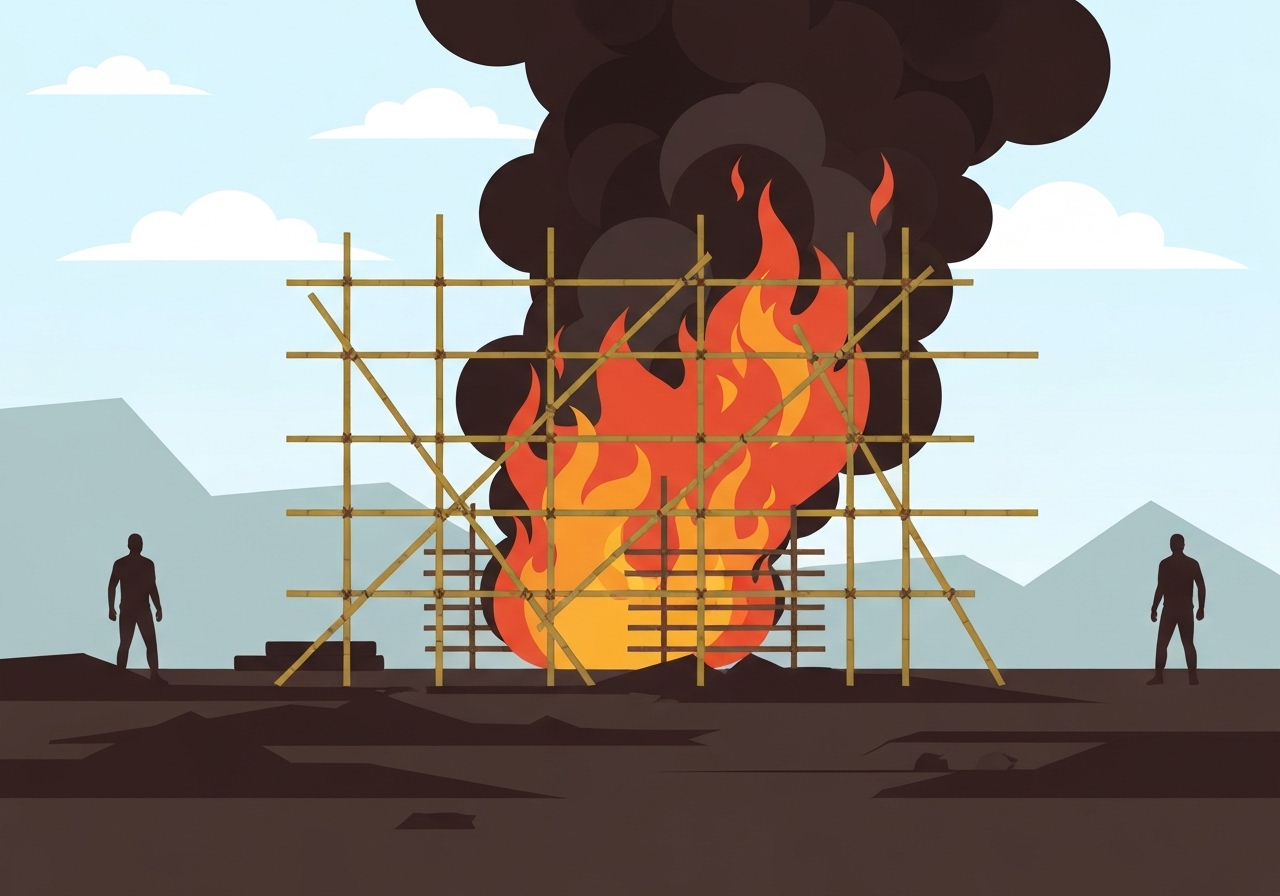
A fast-moving fire tore through bamboo scaffolding and exterior netting on Wednesday at a large residential complex in Tai Po, Hong Kong, killing four people and leaving others trapped, authorities said. Video from the scene showed flames and heavy smoke issuing from multiple adjacent high-rise blocks as firefighters attacked the blaze from ladder trucks. The government reported the complex comprises eight blocks with nearly 2,000 apartments housing about 4,800 residents; five people were hospitalized, including three in critical condition. Local officials upgraded the incident to a level 5 alarm after nightfall and opened temporary shelters for displaced residents.
Key Takeaways
- Fatalities: Four people died in the fire, including one firefighter, according to the Hong Kong government and Fire Services Department figures.
- Injuries and hospitalizations: Five people were hospitalized; three were reported in critical condition, one in serious condition and one stable.
- Scale of complex: The housing estate contains eight blocks, almost 2,000 apartments and roughly 4,800 residents according to government records.
- Fire spread mechanism: Flames spread rapidly across bamboo scaffolding and external construction netting that wrapped multiple buildings.
- Response level: The Fire Services Department raised the incident to a level 5 alarm — the highest severity — after nightfall.
- Vulnerable residents: Local officials and a district council member indicated many of those trapped were elderly residents.
- Displacement: District authorities established temporary shelters for those who lost homes to the blaze.
Background
Tai Po is a suburban district in Hong Kong’s New Territories, north of the city center and near the Shenzhen border. The estate affected is made up of eight high-rise residential blocks; official records put the housing stock at almost 2,000 units and an estimated population of about 4,800. Bamboo scaffolding is a traditional construction method widely used in Hong Kong for maintenance and renovation, prized for its flexibility and speed but long criticized for fire-safety risks when combined with flammable netting and building exteriors.
Hong Kong authorities have in recent years moved to phase out bamboo scaffolding on public projects, citing safety concerns, though private projects continue to use it under licensed contractors. The Fire Services Department maintains a system of graded alarms; a level 5 designation signals a major incident requiring maximum resources, including aerial ladder operations and multi-station coordination. High-density housing, narrow streets and closely sited blocks can complicate firefighting and evacuation in older estates.
Main Event
The blaze was first reported in mid-afternoon and escalated as flames climbed the bamboo scaffolding and engulfed construction netting on multiple adjacent towers. Video footage distributed by local media showed bright flames and thick plumes of smoke pouring from numerous apartment windows as darkness fell. Firefighters deployed ladder trucks and aimed water streams from elevated positions to contain flames reaching several storeys of facade.
Police received multiple reports of residents trapped inside the affected blocks; authorities did not immediately release detailed counts of those rescued versus still missing. Among the casualties were three civilians and one member of the Fire Services Department, official statements confirmed, and another firefighter was treated for heat exhaustion. Local district staff opened emergency shelters for displaced residents and began welfare checks for elderly occupants believed to be among those affected.
Local council member Lo Hiu-fung told television reporters earlier that many of the residents reported trapped were elderly, highlighting the particular vulnerability of older tenants in high-rise evacuations. A resident identified only by the surname Wu told reporters he had “given up thinking about [his] property” after watching the building burn, underscoring the human toll and sudden displacement families faced after the blaze.
Analysis & Implications
The rapid vertical spread of the fire points to a combination of combustible external coverings and the chimneylike behaviour created by scaffolding and netting. When bamboo and nylon netting ignite, flames can propagate externally across floors faster than interior sprinkler systems or individual residents can respond, especially in older apartment blocks with limited means of horizontal evacuation. That dynamic helps explain both the speed of spread and the difficulty crews faced in preventing multiple-block involvement.
Beyond immediate rescue and recovery, the incident intensifies longstanding policy questions in Hong Kong about the safety trade-offs of bamboo scaffolding. While authorities have announced plans to phase it out on public contracts, private-sector use and retrofitting remain widespread. The tragedy will likely renew pressure on regulators to accelerate alternatives, tighten inspection regimes, or impose stricter fire-resistant requirements for external netting and façade works.
There are also broader social implications: high-density estates in older parts of Hong Kong often house significant numbers of elderly or mobility-impaired residents who face higher evacuation risks. The event could prompt reviews of evacuation planning, mandatory safety audits for scaffolded projects near residential towers, and targeted support for vulnerable tenants during renovation work.
Comparison & Data
| Measure | Value |
|---|---|
| Blocks in complex | 8 |
| Approximate apartments | ~2,000 |
| Estimated residents | ~4,800 |
| Deaths | 4 (including 1 firefighter) |
| Hospitalized | 5 (3 critical, 1 serious, 1 stable) |
The table above summarizes the public figures released by authorities and reported by media. Those numbers show the scale of potential exposure in a single estate: nearly 5,000 residents in closely packed towers. Historically, external-fire propagation across scaffolding has been implicated in other rapid-spread façade fires in the region, underscoring why building-envelope treatments and scaffold materials matter for containment and life safety.
Reactions & Quotes
Officials and residents expressed shock and concern as rescue and relief efforts continued.
“One of our firefighters died and another received heat-exhaustion treatment,”
Andy Yeung, Fire Services Department Director (official statement)
Yeung’s comment, given to reporters at the scene, confirmed both the fatalities and the toll on emergency personnel, highlighting the dangers faced by crews operating close to intense external flames.
“Most of the people trapped were believed to be elderly,”
Lo Hiu-fung, Tai Po District Council member (local official)
Lo’s remark was relayed to local television and drew attention to the demographic vulnerabilities in the affected buildings, prompting calls for focused welfare checks and prioritised evacuations for older residents.
“I’ve given up thinking about my property. Watching it burn like that was really frustrating,”
Resident surnamed Wu (local resident)
Wu’s statement to TVB captured the immediate personal loss and displacement experienced by tenants, many of whom will require temporary housing and recovery assistance.
Unconfirmed
- The precise ignition source of the fire has not been confirmed by investigators at the time of reporting.
- The exact count of people briefly trapped inside versus those successfully evacuated was not released by police and remains unclear.
- Whether the scaffolding installation fully complied with all relevant private-sector permits and safety inspections is not yet publicly verified.
Bottom Line
The Tai Po high-rise fire is a severe reminder that external construction methods and façade coverings can transform localized work-site incidents into multi-block emergencies in dense, vertical housing estates. Immediate priorities include accounting for all residents, supporting the displaced, and conducting a transparent, technical investigation into origins and any regulatory lapses. The confirmed death of a firefighter also spotlights the human cost borne by first responders in complex urban fires.
Looking ahead, this incident will likely accelerate regulatory and policy discussions in Hong Kong about the continued use of bamboo scaffolding, the fire-resistance of temporary netting, and targeted protections for elderly or mobility-limited residents during renovations. For residents and policymakers alike, the event underscores the need for clearer safety conditions and contingency planning where high-rise living and façade works intersect.
Sources
- Associated Press (news report)
- Hong Kong Fire Services Department (official agency)
- TVB (local broadcaster)