
Lead
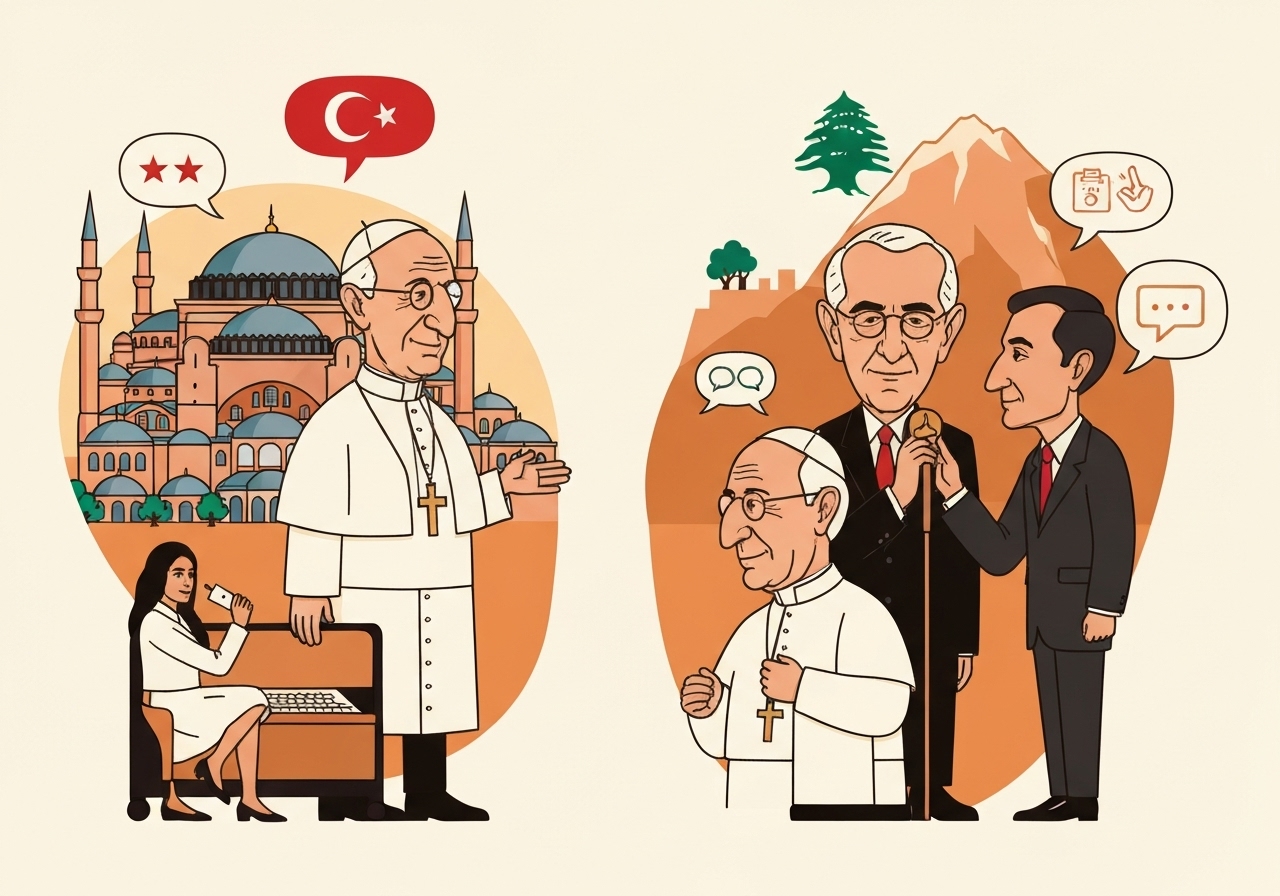
Pope Leo XIV opened a six-day trip to Turkey and Lebanon on Thursday, his first foreign journey since becoming pontiff, arriving amid renewed regional tensions and an unfolding diplomatic agenda. The visit centers on themes the pope has emphasized since his election — peace, dialogue and Christian unity — and includes stops in Iznik, Istanbul, Ankara and Beirut. He arrives in Beirut days after Israeli strikes on the city and will mark the 1,700th anniversary of the Council of Nicaea in Turkey and pray at the 2020 Beirut port blast site on December 2. The itinerary mixes interfaith encounters, meetings with political leaders and public liturgies, and is intended to amplify the Vatican’s diplomatic and pastoral influence in the Middle East.
Key takeaways
- Pope Leo XIV began a six-day trip to Turkey and Lebanon on Thursday, his first foreign visit since his election.
- He will mark the 1,700th anniversary of the Council of Nicaea in Iznik and sign a joint declaration with Ecumenical Patriarch Bartholomew.
- The pope will celebrate Mass at Istanbul’s Volkswagen Arena for an estimated 4,000 people and visit the Blue Mosque but will not go to Hagia Sophia.
- In Lebanon, he is due in Beirut days after Israeli air strikes and will pray at the Beirut port explosion site of August 4, 2020, where 218 died and more than 7,000 were injured.
- Leo speaks multiple languages and will deliver speeches in English and French rather than Italian, reflecting his U.S. background.
- The papal flight is on an ITA Airways plane accompanied by about 80 journalists; ground travel will include cars, military helicopter and open-top vehicles when security allows.
- Planned meetings include Turkish political and religious leaders, the Chief Rabbi of Turkey, and Lebanon’s Maronite, Muslim and Druze leaders, plus a visit to a major psychiatric hospital in Jal el-Dib.
Background
Papal foreign travel has long been a key instrument of Vatican “soft power,” allowing popes to meet state leaders, address local Catholic communities and focus international attention on regional crises. Pope Leo is following predecessors who used early overseas trips to pursue reconciliation and humanitarian goals — Francis, Benedict XVI and John Paul II all visited Turkey early in their pontificates as part of efforts toward Christian rapprochement with the Orthodox Church. The Vatican also has a history of active Middle East diplomacy; Pope Francis hosted Lebanese Christian leaders in Rome in 2021 amid Lebanon’s political and economic turmoil.
Leo’s trip also honors commitments made by his predecessor: Francis had planned visits to Lebanon in 2022 and to Turkey in 2025 that were postponed for health reasons. Turkey is predominantly Muslim but hosts the Ecumenical Patriarch in Istanbul, making it symbolically important for East–West Christian relations. Lebanon’s complex confessional system includes 12 recognized Christian communities and a Maronite president by convention, giving the papal visit added domestic resonance. The schedule combines ecumenical commemoration in Iznik with pastoral outreach in Beirut, reflecting both theological and humanitarian priorities.
Main event
The pope began his program in Turkey with an official commemoration in Iznik (ancient Nicaea) to mark the 1,700th anniversary of the Council of Nicaea (325 AD), where the Nicene Creed was formulated. He is expected to sign a joint declaration with Ecumenical Patriarch Bartholomew and to call for renewed dialogue that moves beyond theological disputes that no longer serve Christian witness. Local organizers described the occasion as an opportunity to deepen ties between Rome and Constantinople and to raise shared concerns such as environmental stewardship, an issue associated with Patriarch Bartholomew.
In Istanbul, Leo will visit the Blue Mosque, celebrate Mass at the Volkswagen Arena for roughly 4,000 attendees, and meet the Ecumenical Patriarch and other Christian leaders. He will not visit the Hagia Sophia, which was reconverted into a mosque in 2020; that decision remains a sensitive point in Vatican–Turkey relations. A late schedule addition includes a visit to the Diyanet in Ankara and a meeting with Turkey’s Chief Rabbi, underscoring the trip’s interfaith dimensions.
The pope arrives in Beirut on Sunday, where his timetable includes meetings with political leaders, private conversations with leaders of Lebanon’s Christian communities and an inter-religious gathering. On December 2 he will observe a silent prayer at the Beirut port explosion site — the 2020 blast killed 218 people and wounded more than 7,000 — and he will visit the Saint Maron monastery and the tomb of Charbel Makhlouf. The program also features a visit to the Dde la Croix psychiatric hospital in Jal el-Dib and ceremonial acts such as planting a cedar at the Presidential Palace.
Analysis & implications
Symbolically, the trip reinforces the Vatican’s aim to position the papacy as a mediator and moral voice in conflict-affected regions. By choosing Turkey and Lebanon — two countries with Muslim majorities but ancient Christian minorities — Leo seeks to underscore themes of coexistence and minority protection that have global diplomatic currency. His choice to use English and French in public addresses signals a cultural shift in the papal office and may be intended to reach wider international audiences, particularly in the United States and francophone communities.
Politically, the visit comes at a fraught moment: the pope lands in Beirut just days after Israeli strikes on the city, which could complicate security and the optics of inter-state relations. A papal presence in Beirut may amplify calls for accountability around the 2020 port explosion and for renewed international attention to Lebanon’s governance and humanitarian needs. The Vatican’s meetings with Lebanese leaders across confessional lines can also be read as a public endorsement of pluralistic dialogue within a fragile polity.
Religiously, marking Nicaea’s 1,700th anniversary with the Ecumenical Patriarch is intended to advance long-standing ecumenical rapprochement between Eastern Orthodoxy and Roman Catholicism. Joint statements and liturgical gestures at Iznik aim to lower historical barriers and foster cooperative responses to contemporary issues such as climate change and persecution of Christians in parts of the Middle East. If the trip achieves substantive commitments — for instance, on joint environmental initiatives or clearer channels for interchurch dialogue — it could have durable effects on Christian relations in the region.
Comparison & data
| Event | Year / Date | Key figure |
|---|---|---|
| Council of Nicaea anniversary (Iznik) | 325 AD / 2025 (1,700th) | Commemoration with Ecumenical Patriarch |
| Beirut port explosion | August 4, 2020 | 218 dead; >7,000 injured |
| Volkswagen Arena Mass (Istanbul) | During papal visit | ~4,000 attendees |
The small table above frames three focal data points of the trip: a historical commemoration, a recent national tragedy and a major public liturgy. Together they illustrate the dual thrust of Leo’s itinerary: bridging history and contemporary pastoral care. The contrast between a fourth-century ecumenical council and a modern urban catastrophe highlights the range of moral and diplomatic challenges the pope is addressing in a single tour.
Reactions & quotes
Vatican and regional figures framed the visit as both pastoral outreach and diplomatic engagement. Cardinal Michael Fitzgerald, a former Vatican official on inter-religious dialogue, positioned the trip within a papal tradition of visiting Turkey early in a pontificate to strengthen Christian ties.
“I think Pope Leo is following his predecessors by going to Turkey on his first trip abroad.”
Cardinal Michael Fitzgerald / former Vatican official (as reported to CNN)
The Ecumenical Patriarchate emphasized the commemorative and ecological dimensions of the Iznik events, while Lebanese aid and church leaders highlighted pastoral solidarity amid suffering and economic crisis.
“This can serve as a decisive moment for the present and the future of Christianity and its witness in the contemporary world.”
Grand Ecclesiarch Aetios / Patriarchate office (as reported to CNN)
Caritas Lebanon’s president framed the pope’s visit as a message of presence to people who have endured hardship.
“The people will know that, despite all the difficult situations they have been through, they must not feel abandoned.”
Rev. Michel Abboud / Caritas Lebanon (as reported to Vatican News)
Unconfirmed
- Whether Pope Leo will hold an inflight press conference on the return leg is not confirmed; Vatican officials have not announced a schedule for a formal flight Q&A.
- Details of any joint declaration language with Patriarch Bartholomew have not been publicly released and remain subject to negotiation.
- The precise security measures and whether open-top transport will be used at every public stop depend on real-time assessments and were not finalized at the time of reporting.
Bottom line
Pope Leo’s maiden foreign trip fuses symbolic ecumenical outreach with urgent pastoral attention to communities under strain. The itinerary — from Iznik’s Nicaean commemoration to a silent prayer at the Beirut blast site — is designed to send concurrent messages about Christian unity, interfaith engagement and humanitarian concern. Politically, the pope’s presence will put additional international focus on Lebanon’s stability and may nudge diplomatic momentum around accountability and relief. For the Vatican, success will be measured not only by warm receptions but by concrete follow-up: joint initiatives with Orthodox partners, renewed aid commitments for Lebanon and sustained diplomatic engagement with regional actors.
For observers, the trip is a test of how a U.S.-born pope with an outward-facing style translates pastoral rhetoric into diplomatic influence in a volatile region. The coming days will reveal whether Leo’s calls for dialogue and reconciliation produce lasting initiatives or primarily symbolic solidarity. Either way, the visit will shape perceptions of the Vatican’s role in Middle Eastern affairs and set a tone for the new pontificate’s international priorities.
Sources
- CNN — international news reporting (primary report on itinerary and quotes)
- Vatican News — official Vatican-related reporting and statements (religious/official)
- Ecumenical Patriarchate — institutional source for patriarchal office activities (religious institution)