
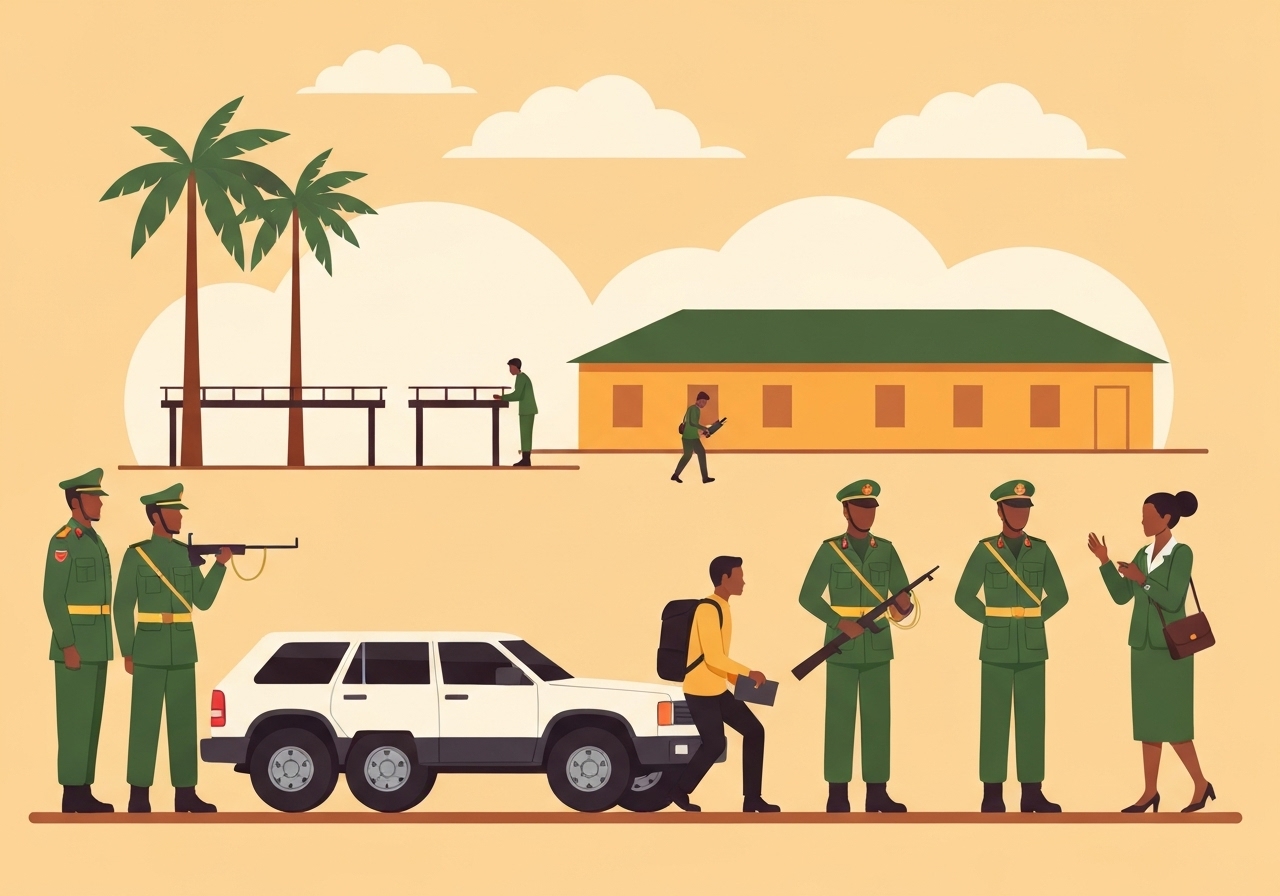
Lead: Soldiers in Guinea-Bissau appeared on state television on Wednesday saying they had seized control of the government after reports of gunfire near the presidential palace in Bissau. The announcement came three days after a presidential and legislative vote that produced competing victory claims and before provisional results were due. The military said it was suspending state institutions, closing borders and halting the electoral process; President Umaro Sissoco Embaló told French media he had been deposed and detained. Roads to the palace were blocked and checkpoints were manned by heavily armed, masked soldiers.
- Key Takeaways:
- Soldiers announced on state television on Wednesday that they had deposed the president and suspended all institutions of the republic, citing a need to “reestablish national and public order.” (Statement by spokesperson Dinis N’Tchama).
- Gunfire was reported midday Wednesday near the presidential palace and the National Electoral Commission; an AP reporter observed roadblocks and armed, masked soldiers at checkpoints around the palace.
- The move occurred three days after presidential and legislative elections held Sunday, in which both incumbent Umaro Sissoco Embaló and opposition Fernando Dias da Costa claimed victory ahead of provisional results scheduled for Thursday.
- Guinea-Bissau has experienced four coups and multiple attempted coups since independence, and the country is a known transatlantic drug-trafficking corridor between Latin America and Europe.
- The military said it detained the head of the electoral commission and sealed the commission’s offices, and also announced suspension of media activities and the closure of borders.
- Embalo told France 24 that he had been arrested and “deposed,” but he said he had not been subjected to violence; independent confirmation of his physical whereabouts remained limited at the time of reporting.
Background
Guinea-Bissau has a long history of political instability. Since gaining independence, the country has endured four successful coups and numerous attempted overthrows, including reported unrest as recently as last month. That record has been compounded by the state’s role as a transit point for cocaine and other illicit trade between Latin America and Europe, which has complicated governance and security.
Incumbent Umaro Sissoco Embaló first assumed the presidency in February 2020. A dispute over the length of his mandate has festered: opposition figures argued his five-year term should have ended on Feb. 27 this year, while the Supreme Court ruled it extended until Sept. 4; the latest presidential vote had been delayed into this month. Those legal and political disagreements intensified an already fraught environment around the recent ballot.
International election observers had been present for the vote. The presidential and legislative elections on Sunday produced competing victory claims from Embaló and opposition candidate Fernando Dias da Costa on Tuesday, even though provisional official results were not expected until Thursday. The compressed timeline and rival claims elevated tensions across the capital ahead of Wednesday’s developments.
Main Event
Midday Wednesday, gunfire was reported near the presidential palace and close to the National Electoral Commission, according to multiple on-the-ground reports. An Associated Press journalist described checkpoints blocking access to the palace, staffed by heavily armed and masked soldiers. Officials from the presidential palace and the Interior Ministry, speaking anonymously, said a group of armed men tried to attack the presidential residence, prompting an exchange of fire with palace guards.
Shortly after those incidents, soldiers appeared on state television announcing they had seized power and were suspending the country’s institutions pending further orders. The military spokesman, Dinis N’Tchama, said the move responded to the “discovery of an ongoing plan” to manipulate election results and destabilize the country; he alleged involvement by national politicians and a “well-known drug lord,” without providing substantiating details.
The soldiers also declared an immediate suspension of the electoral process, ordered media activity halted and announced border closures. Observers with an international election-monitoring mission reported the electoral commission chief had been detained and the commission’s office sealed by the military; those observers spoke on condition of anonymity because of restrictions on public comment.
President Embaló, according to French media reports, said he had been arrested in what he described as a coup led by the army chief of staff but said he had not been subjected to physical violence. The situation remained fluid with limited independent verification of some claims and continued checkpoints and troop movements in parts of the capital.
Analysis & Implications
The military’s justification—citing an alleged scheme to manipulate electoral results and naming political figures and criminal actors—reflects a recurring pattern in Guinea-Bissau where security forces position themselves as arbiters of stability. Whether the claim of electoral manipulation is accurate, and whether it was the true motive, will shape domestic and international responses in the coming days.
Regionally, this event risks further destabilizing the already fragile Sahel and West African political landscape, which has seen several coups in recent years. Neighboring states and regional bodies may face pressure to respond with sanctions, mediation offers, or calls for restraint; the Economic Community of West African States (ECOWAS) and the African Union have in past crises demanded returns to constitutional order.
Economically and socially, any extended interruption to governance—for example if borders remain closed and public institutions suspended—could worsen supply chains, deter investment, and strain humanitarian and development programs. Given Guinea-Bissau’s dependence on external assistance and fragile institutions, a protracted crisis could amplify poverty and insecurity.
Internationally, allegations involving a “well-known drug lord” and foreign nationals, if substantiated, would underline the transnational criminal pressures facing the country and could prompt cooperative law-enforcement responses. Conversely, if those allegations are unproven, they may be used to justify military intervention and complicate efforts to restore a civilian-led government.
Comparison & Data
| Metric | Value |
|---|---|
| Coups since independence | 4 (plus multiple attempts) |
| Most recent contested election | Presidential and legislative vote held Sunday; provisional results due Thursday |
| Embalo’s first inauguration | February 2020 |
These figures place the current events in historical context: repeated disruptions to constitutional order have been a persistent feature, and disputed presidential timelines have increased political friction. The table highlights the immediate triggers and structural vulnerabilities that repeatedly precipitate crises in the country.
Reactions & Quotes
Official and observer reactions were swift but constrained by limited independent access to key sites and actors.
“The High Military Command for the reestablishment of national and public order decides to immediately depose the president of the republic and suspend all institutions of the republic of Guinea-Bissau, until new orders.”
Dinis N’Tchama, military spokesperson (state television statement)
The military framed its action as corrective—aimed at preventing alleged manipulation of the vote—while providing few verifiable details. That lack of specificity is likely to be central to how external actors judge the legitimacy of the intervention.
“I have been deposed,”
Umaro Sissoco Embaló (quoted to France 24 via Jeune Afrique)
Embalo’s brief statement to French media affirmed he had been detained but denied being physically harmed. International agencies will seek independent confirmation of his status and location before taking further steps.
“The president has been speaking to people saying he’s being held by the military,”
Staffer, international election observer group (anonymous)
Observers reported the detention of electoral officials and the sealing of commission offices, which raises immediate questions about the integrity of the vote count and the ability to certify results.
Unconfirmed
- The specific identity and role of the alleged “well-known drug lord” and the named domestic and foreign nationals in an alleged scheme have not been publicly verified.
- The exact number and status of individuals detained by the military, beyond reports that the electoral commission chief was arrested, remain unconfirmed.
- The full scope and veracity of the military’s claim that an active plan to manipulate results existed have not been independently corroborated.
- Casualty figures or reports of serious injuries related to the exchange of gunfire near the presidential palace have not been confirmed.
Bottom Line
This intervention by Guinea-Bissau’s military came at a highly sensitive moment: days after a contested election and before provisional results were published. The military framed the action as restoring order and preventing electoral manipulation, but its claims lack publicly available, independent evidence at the time of reporting. That evidentiary gap will shape international reaction and the likelihood of a negotiated return to civilian rule.
Regional bodies, international partners and local stakeholders face a narrow window to press for restraint, clarity about custody and the safety of political leaders, and a transparent process for validating the vote. If the suspension of institutions and closures persist, the country risks deeper instability with social, economic and security consequences for Guinea-Bissau and the wider region.
Sources
- AP News (international news report) — primary reporting on the events, eyewitness accounts and official statements.
- France 24 (international broadcaster) — cited for President Embaló’s comments reported to French media.
- Jeune Afrique (regional news outlet) — quoted reports of Embaló’s statement and other local reporting.