
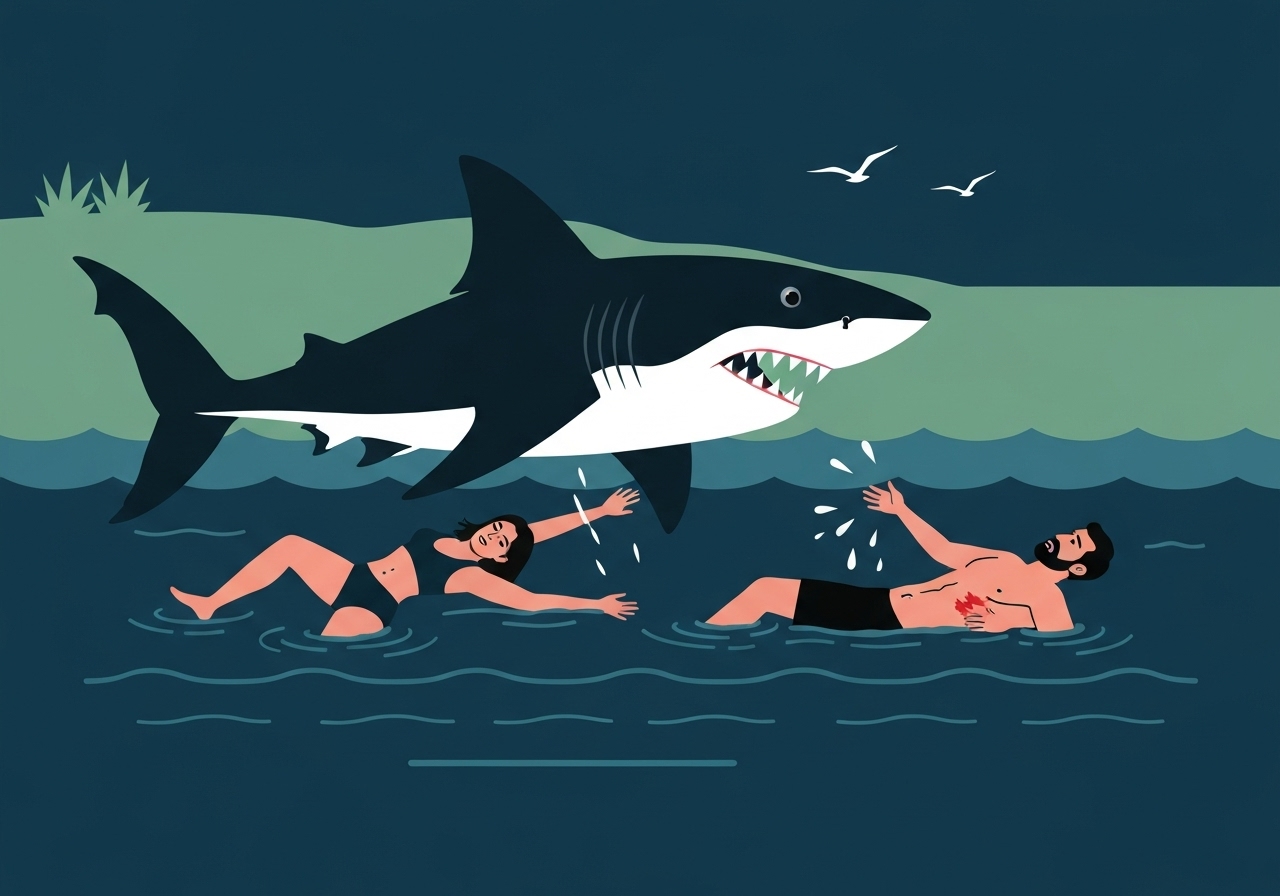
Two people in their mid-20s were attacked by a shark while swimming at Kylies Beach in Crowdy Bay National Park on Thursday; a woman died at the scene and a man was airlifted to hospital with serious injuries. Authorities closed nearby beaches and deployed baited drumlines as part of an immediate response, and state scientists later identified a large bull shark as the likely attacker. Emergency crews and a bystander provided first aid on the sand; paramedics said a makeshift tourniquet applied by the bystander likely prevented a second fatality. Police and state officials are continuing an on-site investigation while advising the public to avoid coastal waters in the area.
- The attack occurred at Kylies Beach in Crowdy Bay National Park, roughly 360 kilometres (224 miles) north of Sydney, at about 6:30 a.m. on Thursday.
- A woman in her mid-20s died at the scene; a man, also in his mid-20s, was flown to hospital in serious but stable condition.
- Authorities confirmed beaches in the immediate area and to the north were closed indefinitely following the incident.
- State scientists indicated a large bull shark was responsible, and five baited drumlines were set off Kylies Beach to try to capture it.
- Drumlines were already in place to the north at Port Macquarie and to the south at Forster prior to the attack as part of ongoing mitigation efforts.
- A bystander’s improvised tourniquet and first aid were credited by paramedics with likely preventing another death.
- Officials have not released the victims’ identities; media reports describe them as European tourists, but this has not been confirmed by police.
Background
Crowdy Bay National Park is a popular coastal reserve known for camping, fishing and walking tracks; Kylies Beach is one of several accessible beaches within the park. The region is about 360 kilometres (224 miles) north of Sydney and attracts domestic and international visitors, increasing the likelihood of human-shark encounters in summer and early morning hours. New South Wales authorities have previously used drumlines and aerial patrols in this stretch of coast to reduce the short-term risk of shark interactions near popular beaches. Bull sharks, identified by state scientists after this incident, are among the species most frequently implicated in nearshore attacks because of their tolerance for shallow, warm water and their tendency to approach areas where people swim.
Shark incidents in New South Wales draw public attention to the trade-offs between public safety, wildlife management and tourism. Local councils, state agencies and researchers balance immediate measures—like beach closures and drumline deployments—with longer-term monitoring, public education and research to better understand shark movements. Past high-profile attacks have shaped public policy and emergency response protocols, including how quickly beaches are closed and how first responders and volunteers are coordinated at remote beaches.
Main Event
Police said emergency services were alerted to reports of two people bitten by a shark at about 6:30 a.m. A bystander helped bring both victims ashore and applied emergency first aid before paramedics arrived. The woman was declared dead at the scene; the man was flown by helicopter to a hospital where paramedic Josh Smyth described his condition as serious but stable. Police Chief Inspector Timothy Bayly confirmed the two were known to each other and had been swimming together when the attack occurred, but he declined to describe specifics of the injuries while the investigation continues.
State officials moved rapidly to limit further risk: beaches around the park and to the north were shut indefinitely, and five baited drumlines were placed off Kylies Beach to target the shark involved. Drumlines had already been deployed at Port Macquarie to the north and Forster to the south as part of an existing mitigation strategy. Scientists subsequently examined evidence and stated a large bull shark was the likely species responsible for the bite pattern and wound characteristics reported.
Emergency responders credited an on-site bystander with critical first aid actions. Paramedic Smyth said the improvised tourniquet applied to the male victim’s leg likely controlled life-threatening bleeding and allowed ambulance crews to stabilise him for transport. Police and state fisheries staff continued searches and monitoring in the hours after the attack, while investigators worked to document the scene and interview witnesses.
Analysis & Implications
The attack highlights the persistent challenge of managing rare but severe wildlife incidents in locations that are also important for recreation and tourism. Bull sharks are capable of moving into shallow coastal waters and estuaries, which raises exposure risk during dawn and dusk when swimmers and surfers may be in the water. Officials must weigh immediate public-safety responses—such as beach closures and targeted catch-and-release or capture attempts—against ecological concerns and the limited effectiveness of short-term interventions.
Deploying drumlines is a common, but sometimes controversial, tactic: they can remove a local dangerous animal but do not eliminate broader risk across a coastline, and they may influence public perception and tourism. The presence of drumlines at Port Macquarie and Forster before this event indicates authorities were already monitoring a wider regional pattern, but scientists caution that individual shark behavior is variable and not fully predictable. Experts say understanding the precise sequence of the animal’s actions is necessary to determine whether it was attracted to people, mistook swimmers for prey, or acted defensively.
From a policy perspective, the incident may prompt renewed calls for increased surveillance (aerial patrols, tagging programs) and investment in non-lethal deterrents and public education about safe swimming practices. It also underscores the importance of rapid first aid and coordinated emergency response at remote beaches: the quick application of haemorrhage control in this case may have reduced the fatality count. International tourists frequenting remote beaches may face different risks than local visitors, creating an additional need for clear signage and communication at popular coastal destinations.
| Date/Year | Location | Outcome |
|---|---|---|
| Thursday (current) | Kylies Beach, Crowdy Bay NP | One fatality; one serious injury; drumlines deployed |
| 2019 | Great Barrier Reef (snorkelling) | Two British tourists attacked; one lost a foot, one sustained leg injuries |
| September (recent) | Sydney coastline | Surfer fatally mauled; surfboard recovered in sections |
The table places the Crowdy Bay event in the context of other notable recent attacks in Australian waters. While individual incident patterns vary, coastal regions that support both tourism and marine wildlife recurrently face similar management dilemmas. Statistical trends show shark bites remain rare relative to ocean use, but the severity of bite injuries drives strong media, public and policy responses after each event.
Reactions & Quotes
Officials and experts responded in the hours after the attack, emphasizing the immediate response and the need for further investigation. Police and emergency services described their actions on site, while shark researchers urged caution before drawing conclusions about motive or behavior.
“At this stage, all I’m prepared to say is they were known to each other and they were going for a swim and the shark attacked.”
Police Chief Inspector Timothy Bayly
Bayly’s brief remarks outlined the immediate facts while officials continued investigative work and preserved the scene. He declined to provide graphic injury details pending family notification and forensic review.
“I just really need to have a shoutout to the bystander on the beach who put a makeshift tourniquet on the male’s leg which obviously potentially saved his life and allowed New South Wales Ambulance paramedics to get to him and render first aid.”
Paramedic Josh Smyth, New South Wales Ambulance
Smyth highlighted how rapid layperson first aid and professional paramedic care combined to stabilise the surviving victim. The comment underscores the practical importance of haemorrhage control training for people who frequent remote beaches.
“It is very unusual. Individual shark attacks are rare. And shark attacks on two people by the same individual is not unheard of, but it’s very rare.”
Gavin Naylor, University of Florida shark research program
Naylor noted that while multiple-victim incidents do occur, they are exceptional and require behavioural detail to interpret. He said investigators need a sequence of observations to determine whether a single shark was responsible and what may have driven the interaction.
Unconfirmed
- Media reports describe the victims as European tourists; police have not officially released nationalities or identities.
- Details about the exact sequence of the shark’s behaviour—whether both bites were from the same animal or in what order they occurred—have not been publicly confirmed.
- It is unclear whether the drumlines deployed immediately after the attack successfully captured the shark; authorities reported deployment but no capture confirmation was issued at the time of reporting.
Bottom Line
The fatal attack at Kylies Beach is a stark reminder that while shark incidents are statistically rare, they carry high human and community costs when they occur. Immediate actions—beach closures, drumline deployment and rapid first aid—are intended to reduce further harm, but they are stopgap measures rather than comprehensive solutions.
Longer-term responses will likely include enhanced surveillance, scientific study of shark movements in the area and renewed public education for swimmers and visitors to coastal national parks. For now, authorities advise avoiding the water in and around Crowdy Bay National Park while investigations and mitigation activities continue.
Sources
- AP News (news) — original incident report and on-scene statements.
- International Shark Attack File, Florida Museum (academic/database) — context on shark behaviour and attack records.
- New South Wales Ambulance (official) — information on paramedic response and first-aid protocols.