
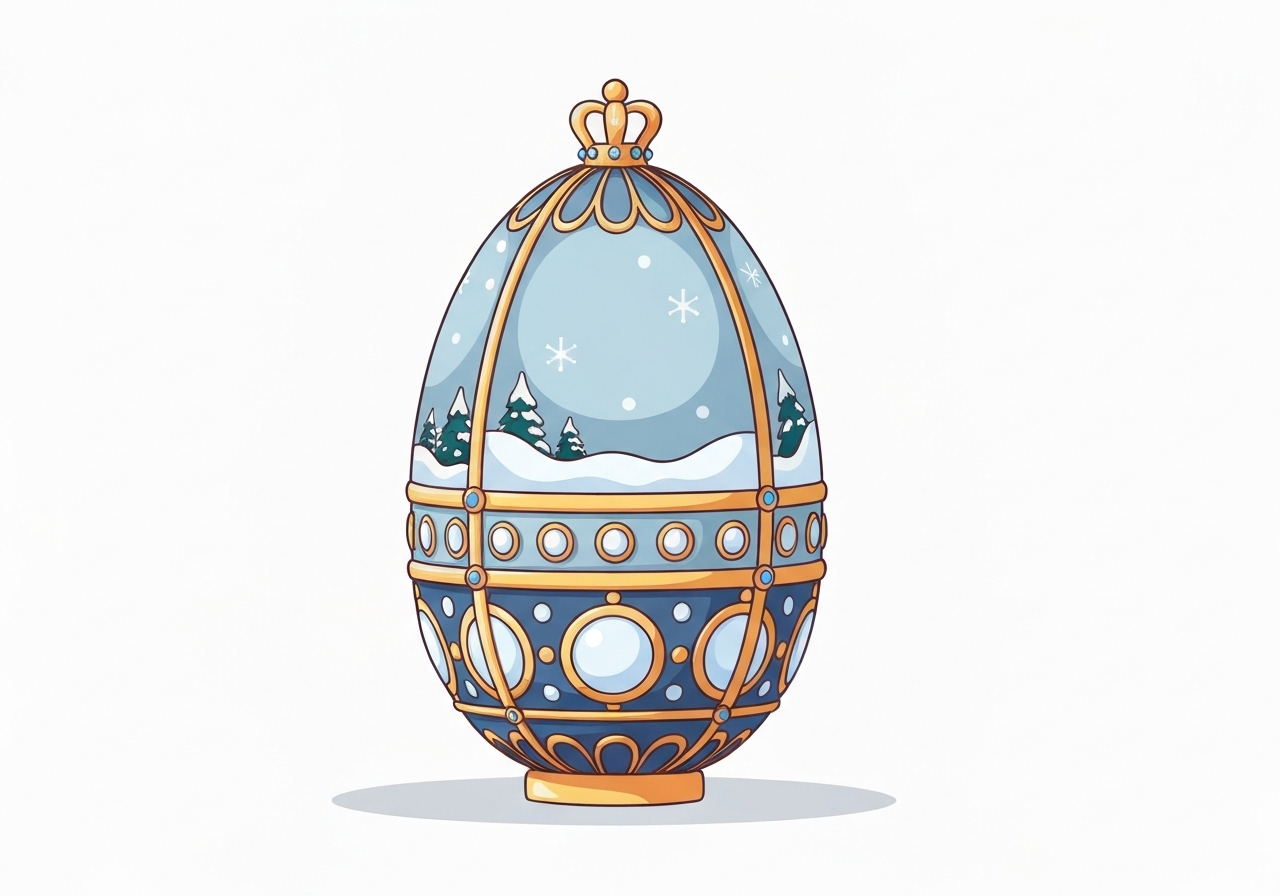
On November 27, 2025, Christie’s announced that the rare 1913 Winter Fabergé egg—crafted for Russia’s last imperial family—will be offered at auction in London, with an estimate above £20 million (about $26.4 million). The 10-centimeter rock-crystal egg, set with roughly 4,500 diamonds and a platinum snowflake motif, opens to reveal a removable basket of jewelled quartz flowers. Christie’s says the Winter Egg is one of seven such opulent Fabergé eggs still held in private hands and carries a long provenance that includes sales in the 1920s, 1994 and 2002.
Key Takeaways
- The Winter Fabergé egg dates from 1913 and was commissioned by Czar Nicholas II for his mother, Dowager Empress Maria Feodorovna.
- The object is 10 cm (4 inches) tall, carved from rock crystal, decorated in platinum with about 4,500 diamonds, and contains a removable basket of quartz flowers.
- Christie’s values the egg at more than £20 million (approximately $26.4 million) ahead of the sale at its London headquarters.
- The egg was created by Peter Carl Fabergé’s firm and is one of two designed by Alma Pihl; her other imperial egg is in Britain’s royal collection.
- Provenance notes: bought by a London dealer for £450 after Soviet sales in the 1920s, auctioned in 1994 for over 7 million Swiss francs, sold again in 2002 for $9.6 million.
- There are 43 surviving imperial Fabergé eggs, most of which reside in museums worldwide; only seven remain privately owned.
- If the Winter Egg reaches its estimate, it would exceed the $18.5 million record paid at Christie’s in 2007 for a Rothschild Fabergé egg.
Background
Fabergé eggs were produced by Peter Carl Fabergé’s workshop between 1885 and 1917 as luxury Easter gifts for the Romanov imperial family. The practice began with Czar Alexander III, who presented an intricately crafted egg to his wife each Easter; Nicholas II continued and expanded the custom to include gifts for his wife and mother. Each imperial egg was unique, renowned for meticulous materials and hidden mechanical or decorative surprises inside.
The Romanov dynasty ruled Russia for roughly 300 years until it was overthrown in 1917; Nicholas II and his immediate family were executed in 1918. After the revolution, Soviet authorities sold many imperial treasures in the 1920s to raise foreign currency, dispersing objects that later entered Western collections. Over the past century the surviving imperial eggs have followed varied paths—some to museums, others to private collectors—shaping both market demand and scholarly interest in Fabergé craftsmanship.
Main Event
Christie’s catalog describes the 1913 Winter Egg as a finely carved rock-crystal ovoid, encrusted with a platinum snowflake motif set with about 4,500 diamonds. When opened, it reveals a removable miniature basket of bejewelled quartz flowers intended to symbolize spring—the kind of concealed surprise that made Fabergé eggs celebrated examples of applied arts. The house says the egg will be offered at its London saleroom on Tuesday as part of an important sale of Russian art.
The Winter Egg was one of only two imperial eggs designed by Alma Pihl, a female designer at Fabergé, and was commissioned by Nicholas II for his mother, the Dowager Empress Maria Feodorovna. Pihl’s authorship increases scholarly interest because relatively few Fabergé objects are attributed to women designers of the period. Christie’s highlights the egg’s technical qualities—rock crystal carving, complex setting work and surviving original fittings—as factors behind the estimate.
Historical records trace the egg’s route after the revolution: it was reportedly bought from Soviet sales by a London dealer for £450 in the 1920s, believed lost for about two decades, then resurfaced and sold at Christie’s in 1994 for more than 7 million Swiss francs (about $5.6 million at the time). It later sold in 2002 for $9.6 million. Christie’s anticipates strong bidding from museums, institutions and private collectors given its rarity and condition.
Analysis & Implications
Market: If the Winter Egg sells above its £20 million estimate, it would underscore continued appetite for elite decorative arts and Russian imperial material culture among high-net-worth collectors. The 2007 record of $18.5 million for a Rothschild Fabergé egg set a benchmark; surpassing that would indicate price appreciation across top-tier Fabergé examples in real terms over nearly two decades.
Cultural: The egg’s imperial provenance and ties to the Romanov narrative heighten its public and institutional value. Objects with direct imperial associations often attract museums seeking to fill historical gaps, but export rules, conservation costs and acquisition policies make museum purchases uncertain—leaving private bidders a decisive role. The presence of a female designer’s attribution adds a curatorial angle that can broaden institutional interest.
Geopolitics & ethics: Many high-profile Russian-era objects on the market have contested histories due to post-revolutionary dispersals. While documented provenance here traces the egg’s sales, debates persist in the field over restitution, cultural patrimony and the ethics of auctioning objects tied to imperial or colonial histories. Auction houses are under growing public scrutiny to disclose provenance and due diligence.
Comparison & Data
| Year | Event | Price (reported) |
|---|---|---|
| 1920s | Purchased from Soviet sales by London dealer | £450 (reported) |
| 1994 | Sold at Christie’s | >7 million CHF (~$5.6M then) |
| 2002 | Secondary sale | $9.6M |
| 2007 | Record sale (Rothschild egg at Christie’s) | $18.5M |
| 2025 | Estimate ahead of Christie’s sale | >£20M (~$26.4M) |
The table shows the Winter Egg’s documented price trajectory and a standing market benchmark from 2007. Adjusted for inflation and changing collector demand, top-tier Fabergé pieces have shown substantial nominal appreciation. However, individual results vary by condition, documented provenance, and the presence of notable makers or designers.
Reactions & Quotes
Christie’s Russian art head emphasized the Winter Egg’s rarity and technical finesse, noting its status among a handful of surviving private imperial eggs. Curators and collectors responding to the listing highlighted both the object’s craftsmanship and its complex modern market context.
“A superb example of craft and design — the ‘Mona Lisa’ for decorative arts,”
Margo Oganesian, Head of Christie’s Russian Art Department
The auction house also framed the egg as an unusually intact specimen of Fabergé work, likely to draw institutions and private buyers. Public commentary on social media mixed admiration for the workmanship with questions about cultural ownership.
“Like a luxurious Kinder Surprise,”
Margo Oganesian, Christie’s
Unconfirmed
- Whether the Winter Egg will surpass the $18.5 million auction record from 2007 is unknown until the final hammer price is published.
- Any specific buyer identity or the buyer’s intent (museum acquisition versus private collection) has not been disclosed and remains unconfirmed.
Bottom Line
The Winter Fabergé egg is a headline lot that combines exceptional workmanship, imperial provenance and a documented sales history that tracks changing attitudes to Russian decorative arts across a century. Christie’s £20 million-plus estimate positions the object among the most valuable Fabergé pieces ever offered, and the sale will be a key data point for collectors and museums watching the high end of the decorative arts market.
Beyond price, the auction will test institutional appetite for imperial-era artifacts and spotlight provenance transparency in high-value sales. Observers should watch the hammer result, any export or acquisition conditions, and whether a public institution steps forward—factors that will shape future collecting and curatorial decisions around Fabergé works.