
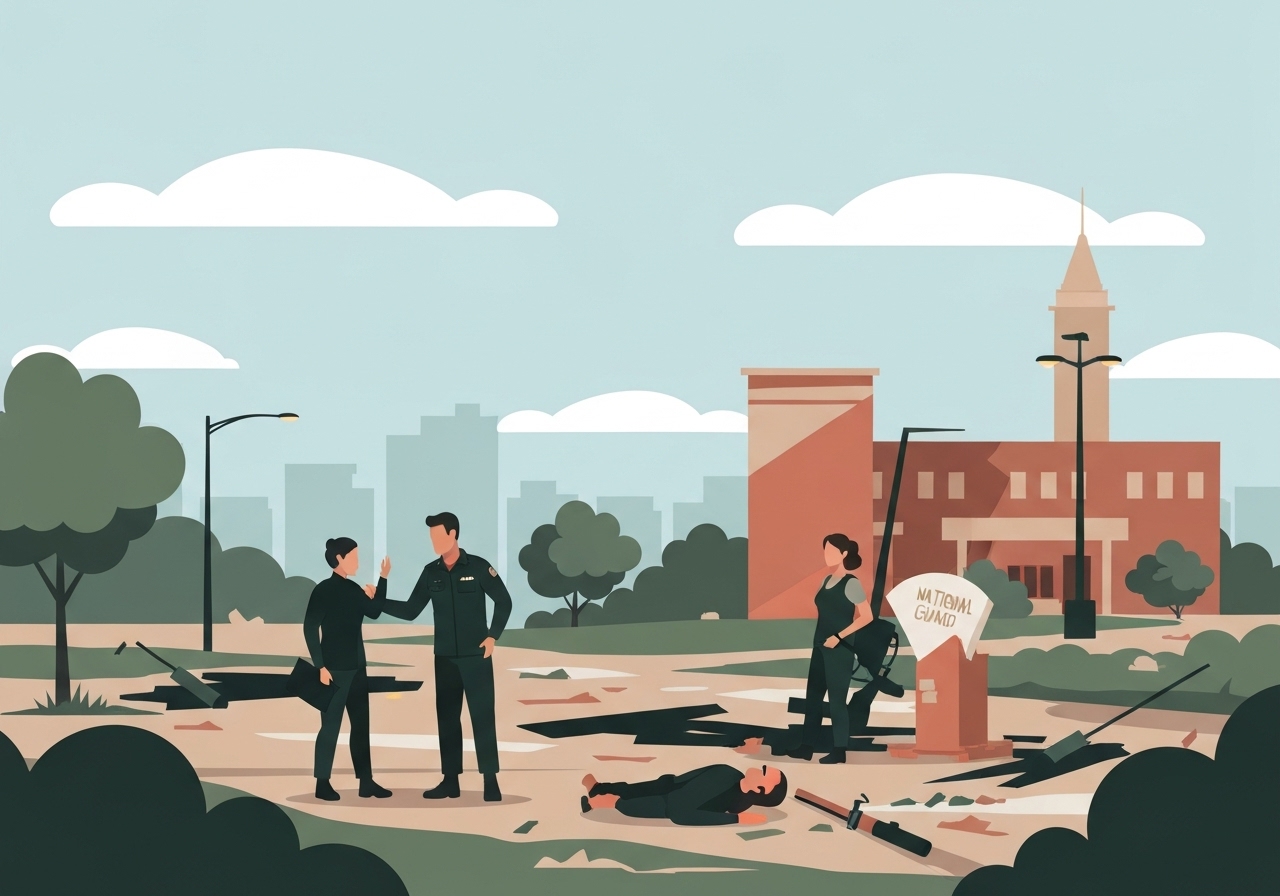
Sarah Beckstrom, a 20-year-old member of the West Virginia National Guard deployed to Washington, D.C., has died after being shot near the White House on Wednesday, former president Donald Trump announced on Thursday. Beckstrom was one of two guardsmen shot in what officials described as a targeted attack; the other, 24-year-old Andrew Wolfe, remains critically injured. Authorities have identified the suspect as 29-year-old Rahmanullah Lakanwal, who arrived in the United States in September 2021 and was granted asylum in April. Federal investigators are treating the incident as an act of terrorism while criminal charges have been announced by local prosecutors.
Key Takeaways
- Victim: Sarah Beckstrom, 20, of Webster Springs, West Virginia, has died following Wednesday’s shooting near the White House.
- Other wounded: Andrew Wolfe, 24, also a West Virginia Guardsman, remains hospitalized and critically injured.
- Suspect identified: Rahmanullah Lakanwal, 29, a former Afghan special-unit member who arrived in the U.S. in September 2021 and received asylum in April.
- Weapon and method: Authorities say the attacker used a .357 Smith & Wesson revolver in an “ambush-style” attack, shooting one guard twice before targeting the second.
- Charges and investigation: The U.S. attorney’s office announced assault and firearm charges that could be upgraded to first-degree murder; the FBI is investigating the shooting as terrorism and executed search warrants in Washington and San Diego.
- Policy fallout: The episode prompted immediate political calls for re-examining asylum and green-card approvals for Afghan entrants and temporarily halted some Afghan-related immigration processing.
- National Guard posture: The D.C. National Guard had 949 members in early November; multiple states, including West Virginia, had troops deployed to the capital.
Background
The West Virginia National Guard deployed hundreds of troops to Washington this year as part of a broader security effort tied to public-safety directives and the president’s crime agenda. Many of the Guardsmen were mobilized for duties around federal buildings and high-profile sites, including the White House perimeter. Beckstrom had entered service in June 2023 and was stationed in the capital with other state contingents.
The suspect, identified as Rahmanullah Lakanwal, arrived from Afghanistan in September 2021 under a U.S. resettlement pathway for Afghans who had worked with U.S. forces and diplomats. Public records and official statements say he was granted asylum in April. The resettlement program admitted roughly 76,000 Afghans, many of whom served as interpreters and support personnel during the U.S. presence in Afghanistan; the program has been politically contested over vetting and speed of admissions.
Law enforcement officials across federal and local agencies are coordinating the response. The U.S. attorney for the District of Columbia and FBI leadership have both spoken publicly about the investigation, and search warrants were executed at residences connected to the suspect in Washington and San Diego. Local and federal authorities say they have no confirmed motive yet.
Main Event
On Wednesday, near the White House, an individual opened fire on a group of National Guard members standing on duty. According to the U.S. attorney’s office, the assailant first shot one guard twice and then fired at a second service member. Guardsmen on scene engaged the suspect and neutralized him; both wounded guards were transported to hospital.
Sarah Beckstrom was reported critically wounded at the scene and did not recover; her death was announced by former president Trump and confirmed by West Virginia’s governor, Patrick Morrisey, in a social media statement. Beckstrom’s father told a news outlet earlier that morning he believed his daughter would not survive, describing her wounds as mortal.
Investigators identified the shooter as Rahmanullah Lakanwal, 29. Officials say Lakanwal came to the United States in September 2021 and received asylum in April. U.S. intelligence confirmed he had worked with Afghanistan-based units that were supported by the CIA during the war. Sources who knew Lakanwal in Afghanistan described him as a former team leader in a special unit.
At a press conference, U.S. Attorney Jeanine Pirro characterized the attack as “ambush-style,” noting the weapon used and the sequence of shots. Prosecutors announced initial charges including three counts of assault with intent to kill while armed plus a weapons charge; they indicated charges could be raised to first-degree murder if victims die. The FBI director stated the agency is treating the case as terrorism while inquiries continue.
Analysis & Implications
The killing of a deployed National Guardswoman on federal duty near the White House is likely to intensify debates over both domestic security posture and immigration screening. Politically, the incident has already prompted executive-branch officials to order reviews of asylum and green-card approvals tied to Afghan arrivals, and it is likely to feature prominently in partisan exchange ahead of policy decisions.
Operationally, the shooting raises questions about force protection for state guardsmen assigned to stationary posts in public spaces. Commanders must balance visible security—deterrence and public reassurance—with measures that reduce vulnerability to lone attackers. The administration’s response, including talk of sending additional troops to the capital, underscores uncertainty about deployment capacity and inter-state resource shifts.
From an intelligence and screening perspective, the case tests how historical foreign affiliations are assessed in resettlement vetting. Officials have noted that many Afghans resettled in the U.S. assisted American forces; vetting seeks to separate collaborators from potential threats, but critics point to gaps in records and the rapid pace of admissions. Any systemic deficiencies discovered in this case would likely prompt narrow policy changes and renewed scrutiny of resettlement protocols.
Internationally, treating the shooting as terrorism could influence diplomatic conversations about refugee processing and counterterrorism cooperation with partners. If investigators establish links beyond the lone suspect, regional and transnational implications would follow; if not, the case will still shape domestic policy on admission procedures and monitoring of resettled populations.
Comparison & Data
| Metric | Value |
|---|---|
| D.C. National Guard personnel (early Nov) | 949 |
| Estimated Afghans resettled | ~76,000 |
| Suspect age | 29 |
| Victim ages | 20 (Beckstrom), 24 (Wolfe) |
The table above places the shooting in operational context: nearly a thousand Guardsmen were present in the capital in early November, and the national resettlement program has admitted tens of thousands of Afghans since 2021. Those figures inform debates about manpower distribution, community screening, and the scope of policy reviews underway.
Reactions & Quotes
Former president Donald Trump spoke publicly after the shooting, linking the assault to broader immigration policy concerns and confirming Beckstrom’s death in his first live remarks since the attack.
“She’s just passed away. She’s no longer with us.”
Donald Trump (public remarks)
West Virginia’s governor praised Beckstrom’s service and confirmed her death on social media, emphasizing her courage and sense of duty.
“Sarah served with courage, extraordinary resolve, and an unwavering sense of duty.”
Gov. Patrick Morrisey (social media)
At a news briefing, U.S. Attorney Jeanine Pirro described the attack as deliberate and said the suspect drove across states to carry out an ambush-style assault.
“He launched an ambush-style attack with a .357 Smith & Wesson revolver.”
U.S. Attorney Jeanine Pirro (press conference)
FBI leadership has characterized the investigation as terrorism-related while stressing that motive remains under inquiry and that search warrants were being executed as part of a broader probe.
“The FBI is investigating this as an act of terrorism.”
FBI Director Kash Patel (press conference)
Unconfirmed
- Definitive motive: Investigators have not publicly identified a conclusive motive for the attack; links to organized groups have not been established.
- Extent of external support: There is no verified evidence that the suspect acted on behalf of or at the direction of a broader network.
- Vetting failure causation: While political leaders have tied the shooting to vetting gaps, a direct causal link between asylum processes and the attack has not been proven.
Bottom Line
The death of National Guard member Sarah Beckstrom in a targeted shooting near the White House is a rare and serious breach of security that will reverberate through federal law-enforcement and immigration policy discussions. Investigators have identified the suspect and opened a terrorism probe, but key questions about motive and any broader connections remain unresolved. Policymakers have already begun ordering reviews of asylum and green-card decisions tied to Afghan entrants, a response that will further politicize a complex resettlement program.
For service members and security planners, the attack underscores vulnerabilities in static force-protection postures and the challenges of providing visible security without creating predictable exposure. In the weeks ahead, prosecutors’ charging decisions, forensic findings, and any confirmed motives will determine whether this incident prompts targeted procedural fixes or broader policy shifts affecting resettlement and vetting.
Sources
- The Guardian (press)
- Reuters (news agency)
- Associated Press (news agency)
- The New York Times (press)
- U.S. Department of Justice / U.S. Attorney’s Office (official)
- Department of Homeland Security (DHS) (official)
- U.S. Citizenship and Immigration Services (USCIS) (official)