
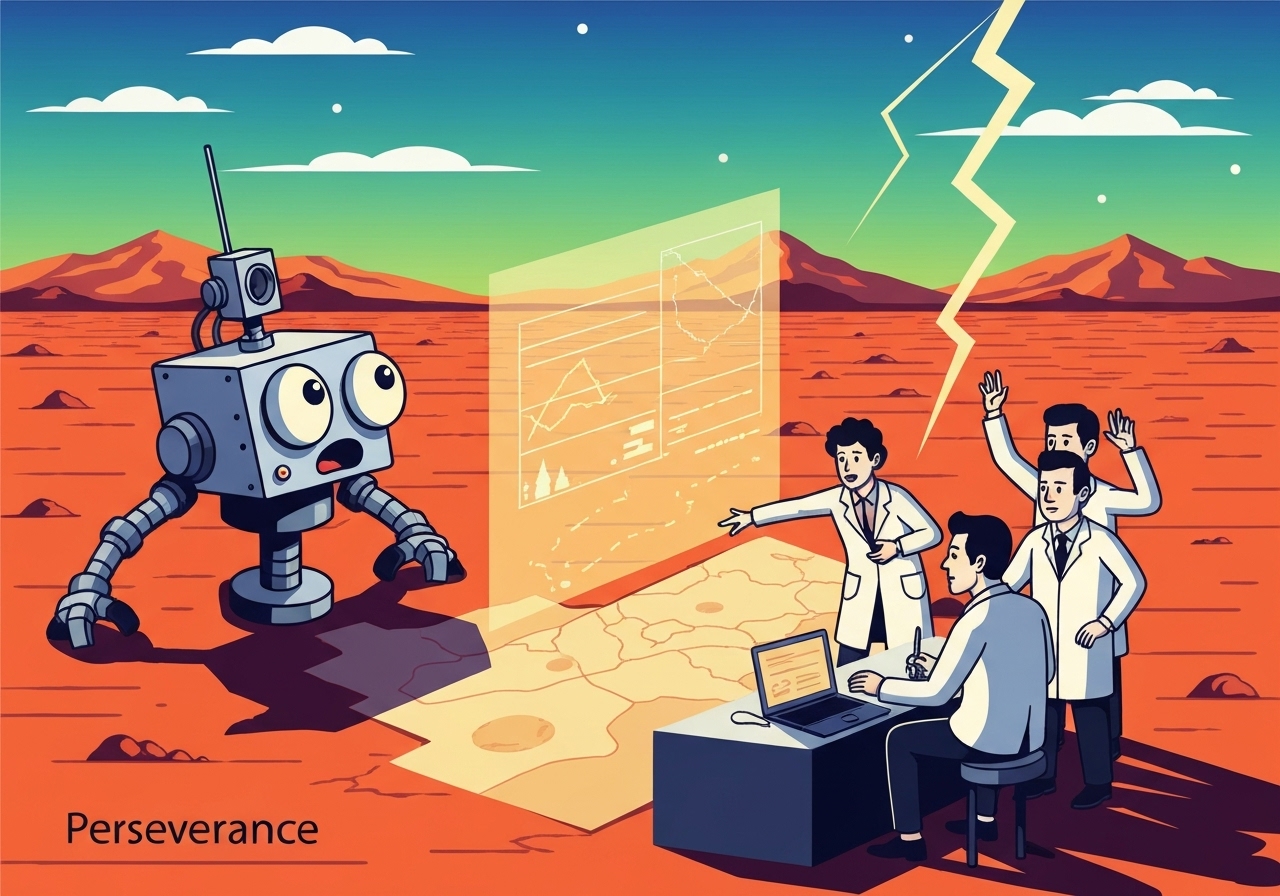
Who: A French research team working with NASA’s Perseverance rover. When & Where: Analysis covers recordings from Perseverance across two Martian years (1,374 Earth days) while exploring Jezero Crater since the rover’s 2021 landing. What: Researchers say audio and electromagnetic signatures consistent with electrical discharges — dubbed “mini lightning” — were detected. Result: If confirmed, the findings would add Mars to the short list of planets with atmospheric electrical activity and carry implications for Martian chemistry, habitability and future missions.
Key Takeaways
- The team analysed 28 hours of microphone recordings gathered by Perseverance’s SuperCam instrument over two Martian years (1,374 Earth days).
- Electrical discharges recorded in audio and electromagnetic channels were typically coincident with dust devils and dust-storm frontal activity.
- Researchers describe the signals as small-scale electrical discharges or “mini lightning,” not visually observed optical flashes.
- Lead author Dr Baptiste Chide and colleagues say the discovery affects understanding of Martian atmospheric chemistry and exploration risk.
- Independent commentary in Nature urged caution: auditory evidence is persuasive but absence of visual confirmation leaves room for debate.
- Scientists recommend sending dedicated discharge detectors and more-sensitive cameras to obtain definitive optical and electrical confirmation.
Background
Mars today is a cold, arid desert, but geological evidence shows it once hosted a thicker atmosphere and liquid water on its surface. Jezero Crater was selected for Perseverance in part because it preserves deltaic deposits that indicate standing or flowing water billions of years ago, making it a prime site to search for signs of past life. The Perseverance rover touched down in 2021 with instruments aimed at characterising geology, seeking biosignatures and caching samples for future return.
Atmospheric electrical activity is well established on Earth and has been detected on the gas giants such as Jupiter and Saturn. On Mars, the thin atmosphere and pervasive dust activity have long made scientists speculate about electrostatic phenomena, particularly because dust lifting processes can generate charge separation. Prior to these recordings, direct evidence of lightning-like discharges on Mars had been lacking.
Main Event
The French-led team examined 28 hours of SuperCam microphone recordings taken across two Martian years. SuperCam provides both acoustic and electromagnetic data; analysts searched the dataset for short, transient signals characteristic of electrostatic discharges. The signals identified are brief and recur in contexts where dust devils or advancing dust fronts were active, suggesting a link between airborne dust motion and electrical activity.
Investigators labelled the events “mini lightning” to indicate their small spatial and energetic scales compared with terrestrial lightning. The recordings included both audible clicks and correlated electromagnetic signatures, strengthening the interpretation that they are electrical discharges rather than unrelated noise. However, no accompanying optical flashes were seen in the rover imagery during the same intervals.
Lead author Dr Baptiste Chide said the discharges have direct implications for atmospheric chemistry and exploration planning. The team argues that charged dust interactions can produce reactive chemical species and influence how dust is transported and deposited — processes relevant to both astrobiology and engineering design for missions. At the same time, the lack of visual confirmation was noted as a key limitation by other experts.
Analysis & Implications
If Martian discharges are confirmed, they would expand our understanding of atmospheric processes on Mars and indicate that electrostatic chemistry plays a role in the planet’s near-surface environment. Electrical discharges can generate reactive molecules such as oxidants, which alter surface and atmospheric chemistry; that has direct consequences for interpretations of organic compounds and potential biosignatures.
For robotic and future human missions, electrical activity from charged dust could pose risks to electronics and suit systems via static discharge or particulate adhesion. Engineering for electrostatic mitigation in landers, rovers and habitats may need to be revisited if frequent discharges are present in typical dusty conditions at landing sites.
Scientifically, confirming lightning-like events would place Mars alongside Earth, Jupiter and Saturn as worlds with documented atmospheric electrical phenomena. That would motivate targeted instruments — high-frame-rate cameras, broadband electric-field sensors and more sensitive magnetometers — to measure discharge frequency, peak energy and spatial scale. Such data are essential to move from plausible detection to robust confirmation and to quantify chemical impacts.
Comparison & Data
| Planet | Confirmed Electrical Activity | Primary Source | Notes |
|---|---|---|---|
| Earth | Yes | Cloud convection | Frequent high-energy lightning; well characterised |
| Jupiter | Yes | Deep atmospheric convection | Powerful radio/optical storms |
| Saturn | Yes | Storm convective systems | Intermittent strong discharges |
| Mars | Possible (audio/electric) | Dust devils & dust fronts | 28 hours of audio/e-m data; no optical confirmation yet |
The table highlights that Mars differs from the gas giants and Earth in mechanism and scale: Martian events, as currently reported, appear linked to charged dust rather than deep convective storms. The dataset analysed totals 28 hours of microphone coverage across two Martian years (1,374 Earth days), a modest observational span that nevertheless captured repeated, similar transients associated with dust activity.
Reactions & Quotes
Researchers and commentators provided both enthusiasm and caution. Below are selected, concise quotes with context.
“These discharges represent a major discovery, with direct implications for Martian atmospheric chemistry, climate, habitability and the future of robotic and human exploration.”
Dr Baptiste Chide, lead author (Institute for Research in Astrophysics and Planetology)
Chide framed the finding as broadly consequential across scientific and mission-planning domains, emphasising chemical and operational impacts. His team interprets coincident acoustic and electromagnetic signatures as consistent with small electrical discharges tied to dust activity.
“The recordings provide persuasive evidence of dust-induced discharges, but because the discharges were heard and not seen, some doubt will inevitably remain.”
Dr Daniel Pritchard (commentary in Nature)
Pritchard’s commentary, published in Nature, urged the community to weigh the audio/electromagnetic evidence carefully and to seek optical confirmation before declaring the phenomenon equivalent to conventional lightning.
Unconfirmed
- No optical or high-frame-rate camera confirmation of the discharges has been reported; the events were detected through audio and electromagnetic channels only.
- The precise energy, spatial scale and chemical yield of the reported discharges remain unmeasured and therefore are uncertain.
- Connections between the recent mineral findings dubbed “leopard spots” and these electrical events are speculative and not established by the present data.
Bottom Line
The Perseverance recordings constitute persuasive, but not definitive, evidence that Mars can host small-scale electrical discharges associated with dust activity. Confirmation will require purpose-built instruments on future missions: sensitive electric-field sensors, broadband radio receivers and high-speed optical cameras timed with dust events.
Whether these discharges materially altered the planet’s past habitability or simply represent an active surface process, they matter for how scientists interpret chemical signatures and how engineers design equipment for dusty Martian environments. In the near term, targeted observations and cross-instrument corroboration are the most direct path to resolve remaining uncertainty.
Sources
- BBC News — news report summarising the study and reactions (media)
- NASA Mars 2020 / Perseverance — mission overview and instrument descriptions (official agency)
- Institute for Research in Astrophysics and Planetology (IRAP) — research institute of study authors (academic)