
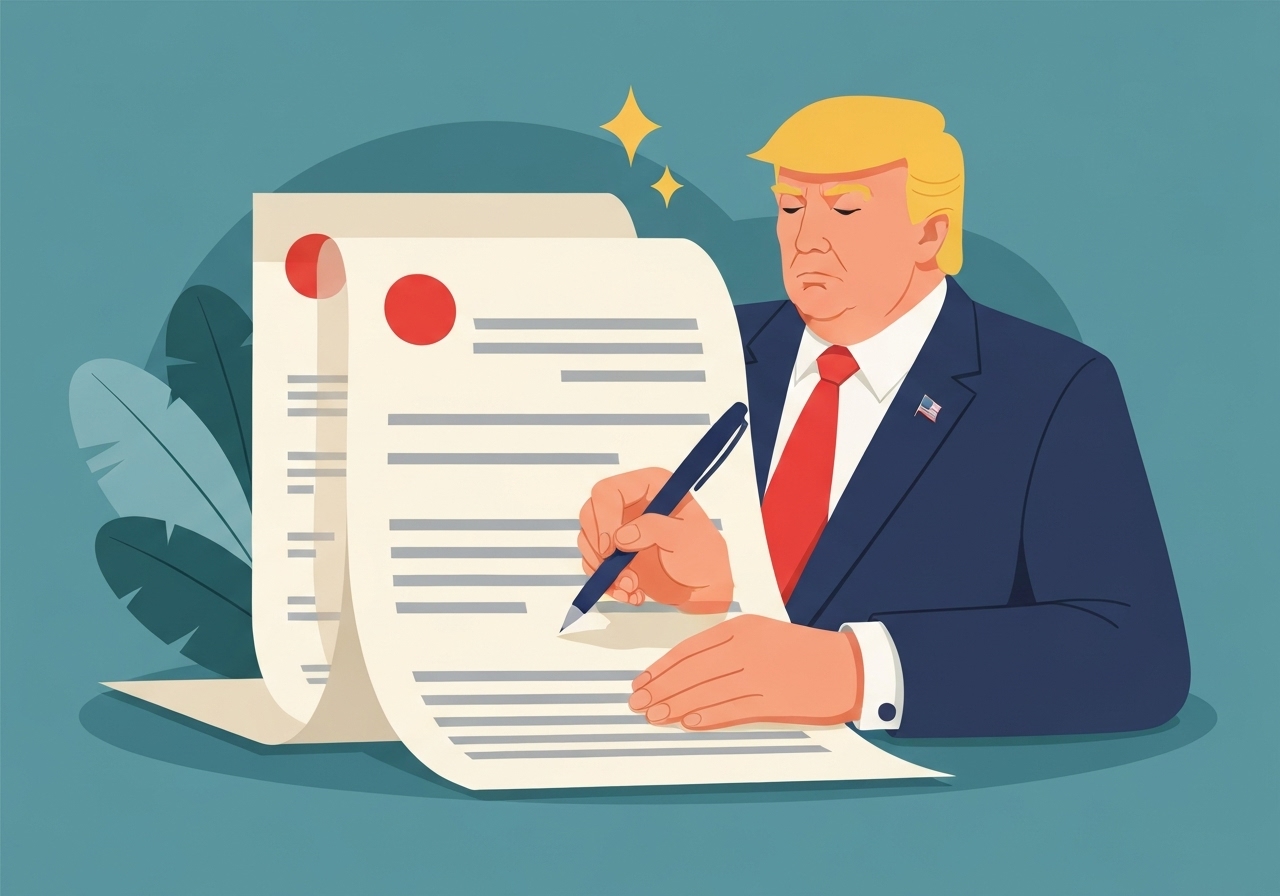
Lead: On Nov. 28, 2025, President Donald Trump announced on Truth Social that he is voiding any executive orders and other directives he says were signed by former President Joe Biden using an autopen. Trump wrote that documents “signed” via an autopen are “terminated, and of no further force or effect,” and accused operators of acting illegally. The claim follows an earlier White House review and a House Republican report that scrutinized autopen use; Biden has denied wrongdoing and said he made the decisions during his presidency.
Key Takeaways
- President Trump declared on Nov. 28, 2025, that any document he asserts was signed by Biden with an autopen is cancelled; the statement was posted on Truth Social.
- Joe Biden signed 162 executive orders during his presidency, according to the American Presidency Project; the precise number signed with an autopen is not publicly confirmed.
- The White House says Trump rescinded nearly 70 Biden executive orders shortly after his Jan. 20, 2025, second-term inauguration and removed another 19 on March 14, 2025.
- Trump has directed an investigation into autopen use and has suggested potential criminal exposure for those involved, including alleging perjury by Biden if he claims involvement.
- Presidential use of autopens has precedent: the Justice Department previously concluded a president can use a mechanical signature device for some official signings.
- House Republican investigators issued a report critical of autopen practices but did not present conclusive evidence that aides signed laws or directives without the president’s knowledge.
Background
Autopen devices reproduce a signature mechanically and have been used in the White House for decades to expedite routine paperwork and ceremonial signatures. Agencies and presidential offices have relied on mechanical signing for less consequential or time-sensitive items while reserving personal signatures for major acts. The Justice Department has previously provided legal analyses indicating a president may lawfully use such devices for certain official acts, a practice that has occasionally attracted political scrutiny.
The current dispute intensified after House Republicans released a critical report examining how the Biden White House used an autopen. That report, issued in late 2025, questioned whether staff signed some documents without direct presidential oversight but stopped short of proving a coordinated illegal scheme. Trump has made autopen use a focal point of his public critique of Biden’s fitness and the integrity of presidential processes.
Main Event
On Nov. 28, 2025, Mr. Trump posted on Truth Social that “any document signed” by Biden via an autopen is “hereby terminated.” He framed the action as an administrative nullification, asserting operators who managed the device “did so illegally” and alleging Biden was not involved in the process. Trump explicitly said he would cancel “all Executive Orders, and anything else that was not directly signed” by Biden.
The Trump statement follows earlier executive actions in which his administration rescinded a large number of Biden directives: nearly 70 orders were revoked soon after Trump was sworn in on Jan. 20, 2025, and an additional 19 were rescinded on March 14, 2025, according to White House records. Those prior revocations reflect a common practice of incoming administrations undoing predecessor policies, though Trump’s new rationale centers specifically on the method of signature.
Mr. Trump previously launched an inquiry into the Biden White House’s use of an autopen, alleging a “conspiracy” to conceal cognitive decline by relying on mechanical signatures for pardons and other documents. The Biden team has rejected those allegations; in July 2025 President Biden said he made the decisions during his presidency and called the claims “ridiculous and false.” The public record so far shows no judicial finding that autopen use by Biden’s staff amounted to criminal conduct.
Analysis & Implications
Legally, voiding orders solely on the basis that an autopen was used raises questions. Courts typically analyze standing, statutory authority, and whether an act falls within the president’s powers. Past Justice Department guidance has treated autopen use as permissible in certain contexts, and courts have not established a blanket rule that mechanical signatures automatically nullify executive acts.
Practically, the announcement could trigger administrative confusion. Agencies that relied on Biden orders to set policy, allocate funds, or guide enforcement may face sudden reversals if the new administration attempts broad invalidations without transitional review. That could disrupt programs in health, immigration, and regulation where executive directives provided operational guidance.
Politically, the move deepens partisan conflict. For Trump supporters it is framed as a corrective step; for opponents it appears as an effort to delegitimize a predecessor through procedural grounds. Internationally, allies and partners monitor executive continuity closely; inconsistent policy signals can complicate diplomatic planning and ongoing bilateral or multilateral initiatives.
Comparison & Data
| Item | Number |
|---|---|
| Biden executive orders signed (total) | 162 |
| Orders Trump rescinded shortly after Jan. 20, 2025 | ~70 |
| Additional orders rescinded on March 14, 2025 | 19 |
The table above summarizes the headline counts cited in official and archival sources. The key unknown is how many of Biden’s 162 executive orders, if any, were executed using an autopen; available public reports have not enumerated that figure. Administrative revocations by an incoming president are common, but basing rescission on signature method would be a novel legal and procedural argument.
Reactions & Quotes
White House and congressional responses illustrate the split. Trump’s post made a direct legal claim; Biden’s camp has pushed back, emphasizing presidential control over decisions.
“Any document signed by the autopen is hereby terminated, and of no further force or effect.”
Donald J. Trump, Truth Social post, Nov. 28, 2025
Trump framed the announcement as immediate and sweeping; administration officials later indicated steps would follow to identify affected documents. Legal analysts warn that immediate nullification without case-by-case review could face judicial challenge.
“I made the decisions during my presidency. Any suggestion that I didn’t is ridiculous and false.”
Joe Biden, public statement, July 2025
Biden’s statement rejects the premise that autopen use displaced his authority. Outside experts say proving that aides signed substantive orders without the president’s knowledge would require documentary evidence and witness testimony, not just device logs.
“Our review raises questions about processes, but it does not establish a criminal conspiracy to substitute signatures.”
House Republican report summary (paraphrase), 2025
The House Republican report criticized procedural controls but, according to its summary, stopped short of showing clear evidence that laws were signed without presidential intent. Legal scholars note that administrative records and sworn statements would be key to any prosecutorial inquiry.
Unconfirmed
- Number of executive orders actually signed by autopen: public reports have not confirmed a definitive count for which orders, if any, were executed mechanically.
- Allegations of a coordinated criminal conspiracy by White House aides to substitute signatures lack corroborating evidence in the public record.
- Whether courts would uphold unilateral nullification of autopen-signed documents without formal review remains untested and uncertain.
Bottom Line
Trump’s Nov. 28, 2025, proclamation frames autopen use as the basis for voiding parts of his predecessor’s record, but the legal and administrative path to sweeping, immediate cancellations is unclear. Historical practice and Justice Department guidance indicate autopens have legitimate, limited uses; overturning orders on that basis alone could prompt litigation and operational disruption across agencies.
For readers, the decisive facts to watch are (1) how many specific orders the administration identifies as autopen-signed, (2) whether agencies are given transitional guidance, and (3) whether courts are asked to adjudicate the validity of any voided directives. Absent clear documentary proof of illicit conduct, this dispute is likely to play out in administrative reviews and the courts as much as in political messaging.
Sources
- CBS News — news report summarizing the Nov. 28, 2025 announcement and context (news)
- American Presidency Project — archival data on executive orders, including the count of 162 for Biden (academic/archival)
- The White House — official statements and records on executive actions and rescissions (official)
- U.S. Department of Justice, Office of Legal Counsel — official legal guidance historically cited regarding presidential use of mechanical signature devices (official/legal)
- House Republican offices — repository for committee reports and summaries referenced in public statements (official/congressional)