
Lead
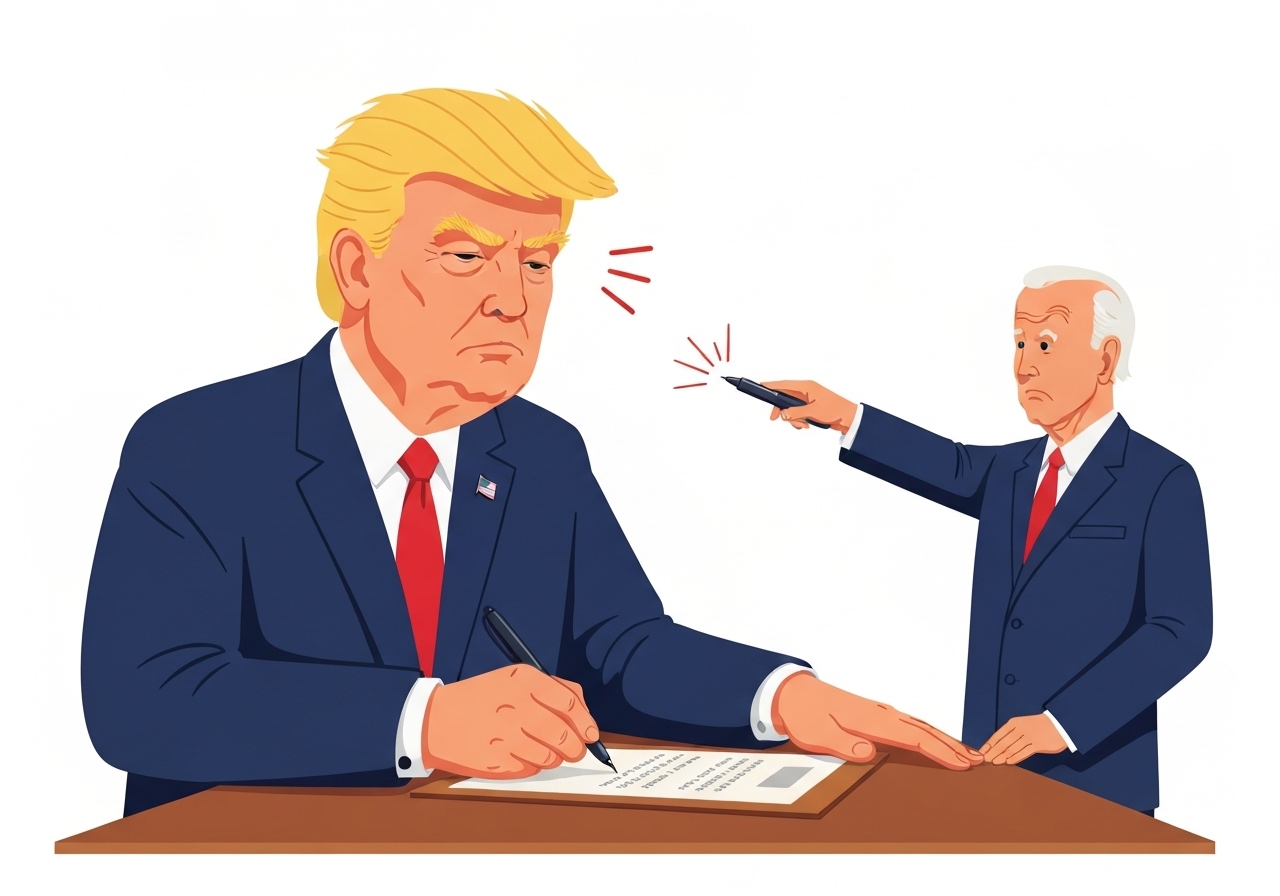
On Friday, November 28, 2025, former President Donald Trump posted on Truth Social declaring he would cancel executive actions he says were signed by President Joe Biden using an autopen. Trump asserted that roughly 92 percent of Biden’s signed documents were executed that way and said those measures should be terminated. The claim reopened legal questions about whether a successor can void prior presidential acts on the asserted basis of signature method. The announcement prompted rapid pushback from Biden allies and legal experts who say longstanding advice undercuts Trump’s theory.
Key Takeaways
- Trump posted on Truth Social on November 28, 2025, saying he would cancel executive orders and other acts he says were signed by Biden with an autopen.
- He asserted about 92 percent of Biden’s documents were autopen-signed, but did not specify which documents make up that figure.
- The Justice Department’s Office of Legal Counsel issued an opinion in 2005 stating a president need not physically affix a signature for a law to be valid.
- Legal precedent and a 1929 solicitor general memo have long treated methods for issuing pardons and signatures as governed by practice, not a strict physical-signature requirement.
- Congressional investigators questioned whether Biden was aware of some pardons signed by autopen but did not produce direct evidence that others signed on his behalf.
- Legal scholars vary in tone, with some treating Trump’s statements as political rhetoric and others weighing potential litigation over any attempt to rescind past actions.
Background
Autopen devices, which mechanically reproduce a signature, have been used in the White House for decades to execute routine documents when the president is traveling or otherwise indisposed. The device’s legality for signing legislation, orders, and other instruments has been the subject of legal memos and administrative practice rather than explicit constitutional text. In 2005 the Justice Department’s Office of Legal Counsel reviewed the issue and concluded that a president need not physically affix a signature to enact a bill, a view that has been cited in later debates about executive acts. Earlier guidance, including a 1929 solicitor general memorandum, also noted the Constitution does not prescribe a particular method for issuing pardons, leaving the mechanics to practice and legal interpretation.
The autopen became a flashpoint in partisan disputes after claims surfaced about its use for certain pardons and executive actions in the Biden presidency. Republican critics have suggested the device indicates a lack of personal involvement by the president, while Biden and allies deny any cover-up and insist the president made substantive decisions. Trump has repeatedly seized on those claims since March 2025, turning the autopen into a political theme he links to broader allegations about Biden’s capacity to lead. The current post escalates that line of argument by proposing wholesale rescission of acts the former president says were autopen-signed.
Main Event
On November 28, 2025, Trump wrote on Truth Social that he would invalidate executive orders and other measures he claims were signed with an autopen under Biden. He argued that documents executed via the device are “terminated” and therefore without force, and he warned that officials who assert otherwise could face perjury allegations if they say Biden approved the process. The post included a broad claim that about 92 percent of Biden’s signed items used the autopen, a statistic Trump did not substantiate.
The statement did not cite any immediate legal action or identify specific orders to be rescinded, and it did not outline a statutory or constitutional mechanism for carrying out such rescissions. Legal analysts noted that, while a new president generally has authority to revoke executive orders or change policy, unilaterally nullifying past measures on the basis of signature mechanics would raise novel legal and practical issues. The White House and Biden allies quickly rejected the suggestion of illegality, with Biden reiterating that he made presidential decisions and that allegations of a cover-up are false.
Trump has previously ordered probes into Biden’s autopen use and suggested a link between the device and questions about Biden’s mental acuity. Conservative executive-power scholar John Yoo told CNN in March that Trump’s framing was part political theater, suggesting the former president was ‘having fun’ at Biden’s expense rather than advancing a straightforward legal claim. Congressional investigators have looked into several instances of autopen use, especially for pardons, but produced no public evidence that decisionmaking authority was transferred away from Biden.
Analysis & Implications
If Trump or a future administration attempts to formally rescind specific executive orders on the grounds he describes, courts would likely scrutinize both the legal basis and the remedy sought. Presidents have broad discretion to amend, revoke, or replace executive orders as a matter of policy, but declaring an entire class of past actions void due to the use of a signature device would be unprecedented and would provoke litigation. Courts would examine statutory text, administrative reliance interests, and historical practice, including prior OLC opinions that treat the physical act of signing as nonessential in certain contexts.
Rescission could create regulatory and practical turmoil across agencies if it were applied broadly without clear criteria. Federal agencies rely on executive actions for rulemaking, grants, and enforcement priorities; abrupt invalidation could create gaps in authority and invite legal challenges from states, businesses, and individuals harmed by sudden policy changes. Even where a new administration has authority to reverse policy, it typically does so through rulemaking or targeted executive action rather than blanket nullification grounded solely in signature method.
The political effect is immediate: Trump’s declaration reinforces a partisan narrative about the legitimacy of Biden-era governance and could mobilize supporters who view the autopen claim as evidence of broader misconduct. Opponents see the move as an attempt to delegitimize policy outcomes rather than a serious legal effort. Internationally, allies and adversaries watch how the United States resolves disputes over executive continuity, and prolonged domestic litigation or administrative chaos could complicate diplomacy and regulatory cooperation.
Comparison & Data
| Document | Year | Finding |
|---|---|---|
| DOJ OLC opinion on autopen | 2005 | Concluded physical signature not always required for validity |
| Solicitor General memo on pardons | 1929 | Noted Constitution prescribes no specific method for issuing pardons |
The two documents shown summarize longstanding administrative views that signature mechanics alone have not been treated as fatal to the validity of presidential actions. That history undercuts a simplistic claim that autopen use automatically voids executive acts. However, those opinions do not resolve every legal question, especially where reliance interests or statutory processes are implicated. Any attempt to nullify multiple categories of actions would require courts to balance precedent against the particular equities and statutory frameworks governing each case.
Reactions & Quotes
I made every decision as president and there was no cover-up; suggestions to the contrary are false.
President Joe Biden, public statement
Context: Biden publicly disputed claims that his administration concealed autopen use, emphasizing he retained decisionmaking authority. The White House framed Trump’s post as political grandstanding rather than a sound legal argument.
He is largely poking at Biden for political effect rather than advancing a novel legal theory with clear force.
John Yoo, conservative executive-power scholar
Context: Yoo, cited in earlier coverage, described Trump’s attacks as partly rhetorical. Other legal experts say the underlying questions merit judicial and administrative clarification if pursued formally.
Unconfirmed
- The specific set of documents that make up Trump’s “92 percent” figure has not been identified or publicly documented.
- No court or official review has yet validated the claim that autopen use alone renders an executive order void.
- Allegations that White House staff made substantive decisions in place of President Biden remain unresolved in public records and lack direct evidence of decisionmaking by others.
Bottom Line
Trump’s November 28, 2025 declaration escalates a long-running partisan dispute over autopen use and the legitimacy of certain Biden-era actions. While a president can rescind many executive orders as a matter of policy, declaring past acts void solely because of a signature method would be legally untested and likely challenged. Established legal opinions from the Justice Department and historical practice provide strong counterarguments to the claim that autopen signatures automatically negate presidential authority.
For readers, the most immediate takeaway is that this is as much a political maneuver as a legal one. If enforced as policy, it would produce litigation, administrative disruption, and a renewed focus in courts on the limits of executive rescission. Observers should watch for any specific orders targeted for formal revocation and for legal filings that could clarify how courts handle signature-method challenges.
Sources
- CNN (news report, November 28, 2025)
- U.S. Department of Justice, Office of Legal Counsel (official legal opinions, including 2005 guidance)
- Truth Social (social media post by Donald Trump)
- U.S. Congress (congressional inquiries and reports on pardons and autopen use)