
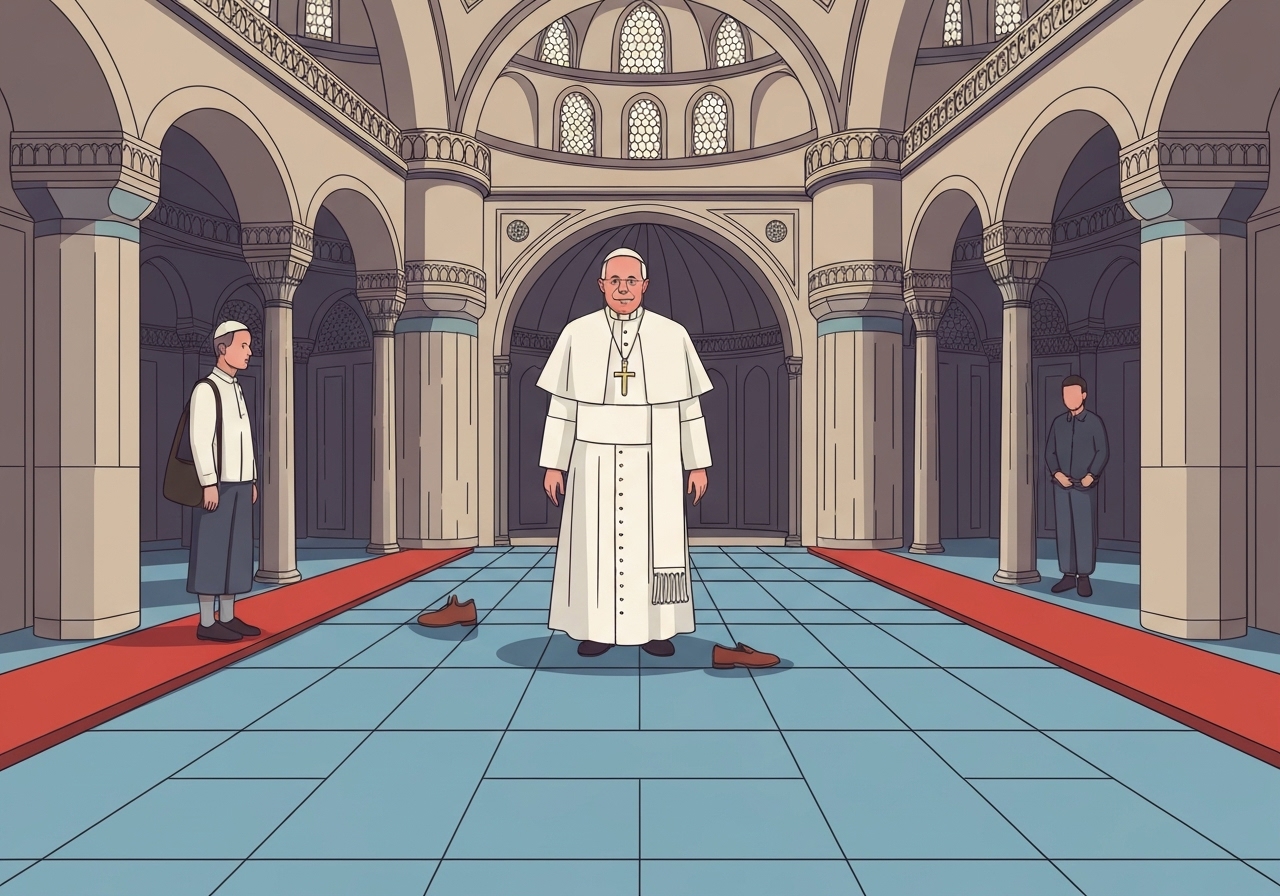
On Nov. 29, 2025, Pope Leo XIV visited Istanbul’s 17th-century Blue Mosque, removing his shoes as a sign of respect but not participating in prayer. The visit, which included a guided walk through the courtyard and the mosque interior, ended with a brief communication mix-up when the Vatican initially released an inaccurate account saying the pope had prayed. Local Muslim leaders accompanied the pope during the visit, and a Muezzin later said he had offered the pope the opportunity to worship, an offer the pope declined. The Vatican subsequently said the earlier phrasing had been sent in error and taken from pre-trip material.
Key Takeaways
- Pope Leo XIV visited Istanbul’s Blue Mosque on Nov. 29, 2025, and removed his shoes before entering, as is customary in the site (17th century Ottoman mosque).
- The pope did not pray during the visit; a Muezzin, Aşgın Tunca, said he offered the option to pray but the pope chose to observe the space instead.
- The Vatican press office initially released a statement saying the pope had observed ‘a brief moment of prayer’ and been welcomed by the head of Turkey’s state-run religious body; it later retracted that language as an error from pre-trip material.
- Leo XIV is the third pope to visit the Blue Mosque; previous papal engagements there include Pope Benedict XVI in 2006 and Pope Francis in 2014.
- The incident occurred days after celebrations marking the 60th anniversary of a major Catholic declaration on inter-religious cooperation, underscoring ongoing Vatican-Muslim dialogue.
- Details of the visit were highly choreographed: the pope walked the courtyard, toured the interior in his white socks, and received local religious hosts rather than participating in communal worship.
- The communications error drew attention to Vatican press procedures and to sensitivities around ritual gestures in interfaith settings.
Background
The Blue Mosque, completed in the early 17th century, is an emblematic Ottoman mosque in Istanbul known for its turquoise Iznik tiles and expansive courtyard. It functions both as an active house of worship and a major cultural landmark visited by domestic and international figures. Papal visits to Muslim places of worship have been rare and carefully managed, reflecting both the symbolic weight of such gestures and theological boundaries within Catholic liturgical practice. Since 1965’s Nostra Aetate, the Catholic Church has pursued structured engagement with Muslim communities, making high-profile meetings and visits important moments in bilateral relations.
Turkey’s Directorate of Religious Affairs (Diyanet) oversees religious sites and often facilitates state-hosted religious diplomacy; local imams and muezzins typically handle practical arrangements when foreign leaders visit mosques. Past papal visits to mosques have sparked debate over whether a pope may or should pray in a non-Christian house of worship, with answers shaped by theological caution and diplomatic aims. Within Turkey, mosque visits by foreign leaders can also carry domestic political resonance, intersecting with national identity and the government’s religious posture. Those layers help explain the careful choreography and the swift attention to any public misstatements.
Main Event
Pope Leo arrived at the Blue Mosque with a small delegation and was received by local Muslim leaders who guided him through the complex. He removed his shoes in the courtyard and entered the interior wearing white socks, a detail noted by local hosts and the visiting press. Aşgın Tunca, a muezzin who was among those showing the pope around, said afterwards that he had invited the pope to pray if he wished; according to Tunca, the pope declined, saying he would simply look around. The exchange was calm and brief, with no formal liturgical action by the pope inside the mosque.
After the visit, the Vatican press office released a statement that described a brief moment of prayer and suggested the pope had been welcomed by the head of Turkey’s state-run religious body. Within hours, the Vatican acknowledged that the wording had been sent in error and said it had been taken from pre-trip briefing material. The correction prompted questions from the media about internal communications at the Vatican and about why the pre-trip wording remained in a distributed release. Turkish hosts did not confirm that the state religious head had personally welcomed the pope during the visit.
The scene at the mosque was orderly; pilgrims and local worshippers continued their prayers in adjacent spaces, and the pope’s visit was framed as respectful observation rather than participation in Muslim rites. The pope’s visible choice not to pray aligns with a cautious precedent established in earlier papal mosque visits, where gestures have ranged from silent reflection to brief private moments. Security and scheduling constraints also limit the duration and nature of such visits, especially for high-profile international figures. The Vatican described Leo’s conduct as a visit ‘in silence, in a spirit of reflection and listening, with profound respect for the place and the faith of those gathered here in prayer.’
Analysis & Implications
The visit illustrates the tightrope the Vatican walks between symbolic interfaith outreach and adherence to Catholic liturgical norms. A pope praying in a mosque can be read as a powerful sign of solidarity and mutual recognition, but it also risks theological debate among Catholics who see public prayer in non-Christian rites as problematic. By choosing to observe rather than pray, Leo maintained a posture that prioritized respectful encounter while avoiding a formal religious act that could prompt doctrinal controversy. That balance may reflect internal Vatican guidance aimed at maximizing diplomatic benefit while minimizing internal dissent.
The erroneous Vatican statement amplified the diplomatic sensitivity around the event more than the visit itself. Miscommunication created a temporary factual dispute about what the pope did and who officially received him, drawing media attention away from the visit’s intended message of dialogue. The episode underscores the operational importance of accurate, timely briefings from press offices during high-stakes interfaith engagements. For the Vatican, tightening approval workflows for public statements may become a near-term priority to prevent similar misunderstandings.
For Turkey, the optics of hosting a pope in a major mosque carry potential domestic and international resonance. The Turkish government and religious authorities manage such moments carefully because they touch on national identity, secular-religious balances, and Turkey’s role as a bridge between traditions. Internationally, the visit reinforces ongoing Catholic-Muslim dialogue but also reminds observers that symbolism must be paired with sustained institutional engagement to produce measurable advances in cooperation. In short, the visit is a diplomatic gesture with limited immediate policy consequences but nontrivial symbolic weight.
Comparison & Data
| Pope | Year | Location | Action |
|---|---|---|---|
| John Paul II | 2001 | Syria (mosque) | Historic visit to a mosque, first by a pope in modern era |
| Benedict XVI | 2006 | Blue Mosque, Istanbul | Observed a moment described as ‘silent meditation’ |
| Francis | 2014 | Blue Mosque, Istanbul | Spent roughly two minutes in silent prayer |
| Leo XIV | 2025 | Blue Mosque, Istanbul | Removed shoes, observed interior, did not pray |
This table places Leo’s visit alongside three earlier papal mosque engagements. While earlier visits included brief private contemplative acts, Leo’s choice to refrain from prayer follows a pattern of cautious symbolic presence. Numerically, the Blue Mosque has hosted three papal visits in the 21st century, indicating its recurring role as a site of Catholic-Muslim encounter. The differences among visits are small in duration but meaningful in symbolic interpretation.
Reactions & Quotes
I offered him the opportunity to worship here; he said ‘no, I am just going to look around,’
Aşgın Tunca, Muezzin
This exchange, reported by local hosts, framed the visit as primarily observational rather than liturgical. Tunca’s account was a primary source for reconciling what happened on the ground with the Vatican’s later statements.
The pope ‘visited the Mosque in silence, in a spirit of reflection and listening,’
Vatican statement (revised)
The Vatican used reflective language after retracting the earlier claim of prayer, emphasizing respect and listening as the visit’s defining posture. The initial misstatement, however, had already circulated and required clarification.
Unconfirmed
- Whether the head of Turkey’s Directorate of Religious Affairs personally greeted the pope during the visit remains unconfirmed; the Vatican statement that implied such a welcome was later retracted.
- The extent to which pre-trip briefing materials shaped the initial Vatican statement is not fully verified beyond the office’s description of an error.
- Reports that the pope intended a private prayer during the visit have not been substantiated by direct Vatican confirmation.
Bottom Line
Pope Leo XIV’s visit to the Blue Mosque was a carefully managed act of interfaith outreach marked by visible respect but not by liturgical participation. The pope’s removal of shoes and quiet observation aligned with a long-standing Vatican approach that seeks symbolic engagement while respecting doctrinal boundaries. The incident also highlighted vulnerabilities in official communications when a pre-trip phraseology was accidentally released as fact, prompting a swift Vatican correction. Observers should watch for any procedural changes in Vatican briefings and for follow-up meetings between Catholic and Muslim leaders that translate symbolism into ongoing cooperation.
In the near term, the episode is likely to be remembered less for a single gesture and more for how the Vatican and Turkish hosts manage factual clarity and the optics of interfaith engagement. Continued dialogue, private exchanges between religious leaders, and formal meetings will matter more than any single visit in shaping Catholic-Muslim relations going forward. The visit reinforces the pattern of cautious, symbolic encounters that aim to build trust without provoking doctrinal disputes.