
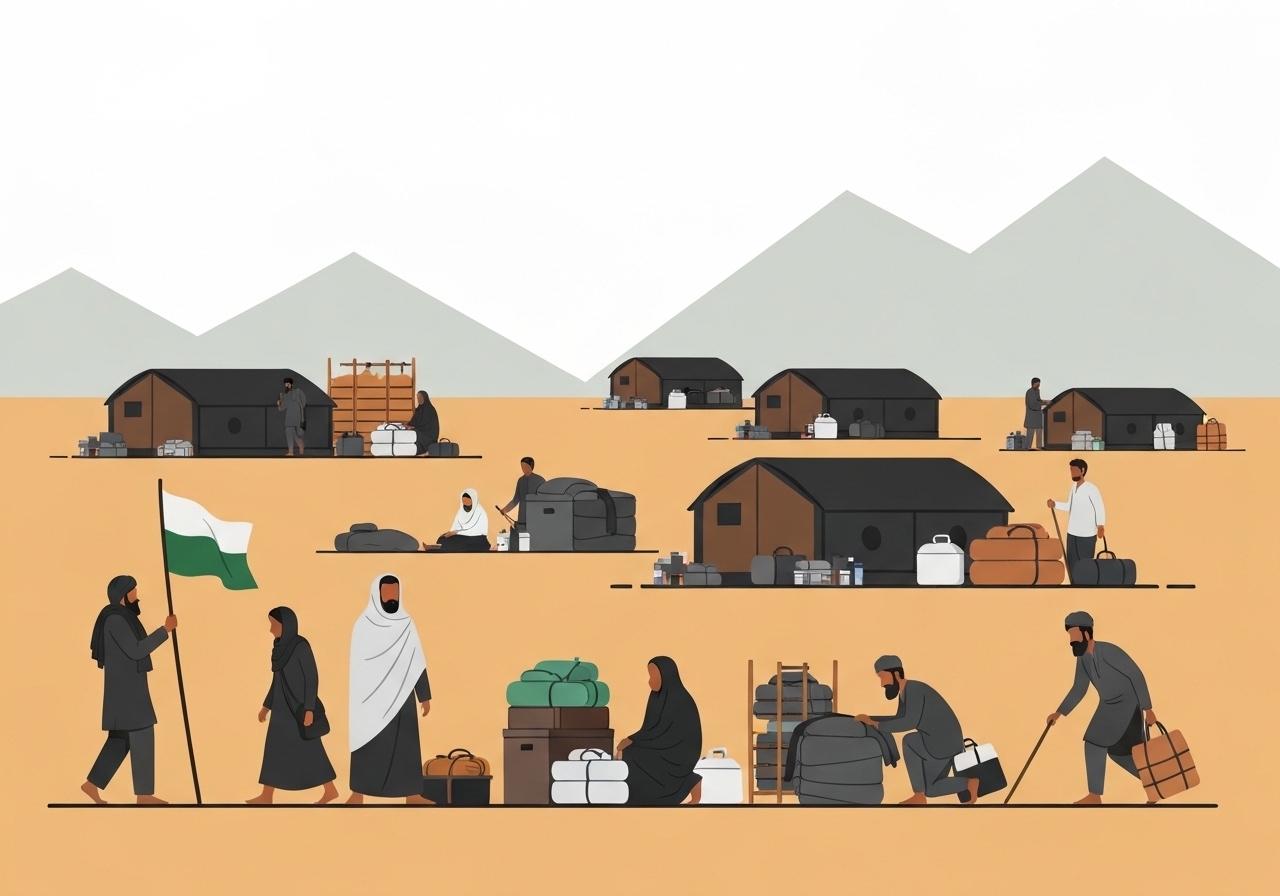
— Pakistani authorities have accelerated large-scale removals of Afghan residents this year, saying national security concerns tied to clashes with the Taliban and rising cross-border violence make longstanding refugee arrangements untenable. Roughly one million of the roughly three million Afghans who lived in Pakistan have been deported or compelled to return in 2025, many to areas where they have little or no prior residence and where humanitarian needs are acute. The moves have closed a decades-long refuge for families displaced by conflict in Afghanistan and prompted urgent warnings from aid groups about shelter, work and basic services. On the ground, people who spent entire lives in Pakistan are now traveling toward border crossings with household goods and few guarantees of reception.
Key Takeaways
- About 1,000,000 Afghans have been deported or forced to return from Pakistan in 2025, out of an estimated 3,000,000 Afghans living there before the expulsions.
- Officials frame the expulsions as a response to cross-border clashes and a perceived national-security threat tied to the Taliban conflict and militant activity.
- Many deportees were born or raised in Pakistan and lack housing, jobs, or documentation in Afghanistan; protection and shelter capacity in Afghanistan are strained.
- Large movements have concentrated at border points such as Torkham and in major cities including Karachi, producing visible scenes of families loading trucks and waiting at crossings.
- International aid agencies have warned of rising humanitarian needs, citing limited affordable housing and scarce formal employment in Afghanistan.
- Official Pakistani statements emphasize security and order; rights groups describe the returns as forced and call for safeguards for vulnerable groups.
Background
Pakistan has hosted Afghan populations for more than four decades, including waves of refugees displaced since the 1979 Soviet invasion and subsequent conflicts. Over time, many Afghans settled in urban and peri-urban areas, built businesses, and grew families that in some cases span multiple generations. The pre-2025 Afghan population in Pakistan has been estimated at around three million people, a mix of registered refugees, undocumented migrants and long-term residents.
Since the Taliban returned to power in Afghanistan in 2021, the security environment along the Pakistan-Afghanistan border has been volatile, with intermittent clashes and reciprocal accusations between the two governments and armed groups. Pakistani authorities say recent escalations and militant attacks have made it untenable to continue existing informal toleration of large Afghan communities. International organizations have repeatedly urged Pakistan to avoid mass forced returns and to coordinate any movement with humanitarian actors to prevent harm to vulnerable people.
Main Event
Throughout 2025 Pakistani law enforcement and border authorities have stepped up operations that have resulted in the removal or pressured return of roughly one million Afghans. The operations have included checkpoints, detentions, and transport to border points, according to interviews with displaced families and local observers. Large groups have been seen gathering near official crossings such as Torkham, where trucks and halted passenger vehicles became temporary holding zones for people carrying mattresses, food containers and livestock.
Many of those leaving Pakistan reported local pressure to go, including loudspeaker announcements in some neighborhoods and repeated questioning by police units. Some families said they departed ahead of more forceful measures after hearing public appeals from local officials urging Afghans to return to Afghanistan. Authorities maintain the actions are aimed at restoring security and addressing undocumented migration.
Receiving areas in Afghanistan are already coping with shortages of housing, health services and formal job opportunities. Aid organizations and local officials say that rapid inflows complicate efforts to provide shelter, winterization and livelihoods support, particularly in regions facing food insecurity and limited municipal capacity. For many deported people, the choice is between precarious returns and insecure informal status in Pakistan.
Analysis & Implications
The expulsions mark a significant shift in regional refugee policy and reshape the humanitarian landscape in both Pakistan and Afghanistan. For Pakistan, the move addresses acute political and security concerns domestically but risks international criticism and long-term labor and economic impacts, given the role many Afghans play in local economies. For Afghanistan, sudden population inflows increase pressure on already fragile public services and may deepen instability in receiving communities.
Diplomatically, the expulsions heighten tensions between Islamabad and Kabul and complicate third-party mediation. Cross-border military incidents have already strained bilateral ties; mass returns could harden positions on border management and deepen mutual distrust. Regional actors and donors may face increased demands for emergency assistance and for mechanisms to manage population movements safely.
Humanitarian organizations warn that forced or poorly coordinated returns can produce protection gaps, particularly for women, children, minority groups and people with medical needs. Without coordinated registration, legal assistance and shelter, many returnees risk slipping into informal, impoverished conditions that could prolong cycles of displacement and dependency on aid.
Comparison & Data
| Indicator | Estimate |
|---|---|
| Afghans in Pakistan (pre-2025) | ~3,000,000 |
| Afghans deported/forced to return in 2025 | ~1,000,000 |
The table above captures the broad scale reported in 2025: roughly one-third of the Afghan population in Pakistan has been removed or pressured to depart this year. Those numbers underscore why aid groups describe the situation as a large, rapid displacement that will require resources at border reception points and within Afghan provinces to avoid protection crises.
Reactions & Quotes
“We cannot continue to host people who pose risks to national security,”
Pakistani official (paraphrased public statement)
Pakistani government statements emphasize security and order, framing removals as measures to curb militants and restore control in sensitive border districts. Officials say actions are necessary in response to recent cross-border incidents and to protect citizens.
“Forced returns must not undermine protection for people in need,”
UNHCR representative (paraphrase)
International agencies have cautioned that returns must be voluntary, safe and dignified; they call for access to registration, humanitarian assistance and coordination so that vulnerable groups receive immediate support. Rights groups have described the scale of returns as alarming, urging monitoring and independent verification.
“After decades here, many of us have no homes to go back to,”
Displaced resident interviewed near Karachi (paraphrase)
Personal accounts collected in Pakistani cities depict families packing possessions and boarding trucks under pressure, emphasizing the human consequences of policy shifts and the uncertainty facing children and the elderly.
Unconfirmed
- The precise headcount of people expelled in specific provinces and dates has not been independently verified for every reported case; consolidated official lists are not publicly available.
- Attribution of individual security incidents to specific militant groups or direct links between every expelled person and militant activity remains unverified in many instances.
Bottom Line
The mass departures of Afghans from Pakistan in 2025 represent a major reconfiguration of regional displacement patterns, with roughly one million people removed or forced to return in a single year. The removals respond to security and political pressures inside Pakistan but transfer acute humanitarian and social challenges to Afghanistan and international responders.
Short-term priorities are ensuring reception capacity, registration and protection for vulnerable people; longer term, policymakers will need durable arrangements that balance security, human rights and regional stability. Donors and neighboring states face urgent decisions about funding, access and diplomatic engagement to prevent the situation from worsening into a broader humanitarian catastrophe.
Sources
- The New York Times (international news report)
- UNHCR Pakistan (international organization country page)
- Ministry of Interior, Pakistan (official government website)